Postal Congress
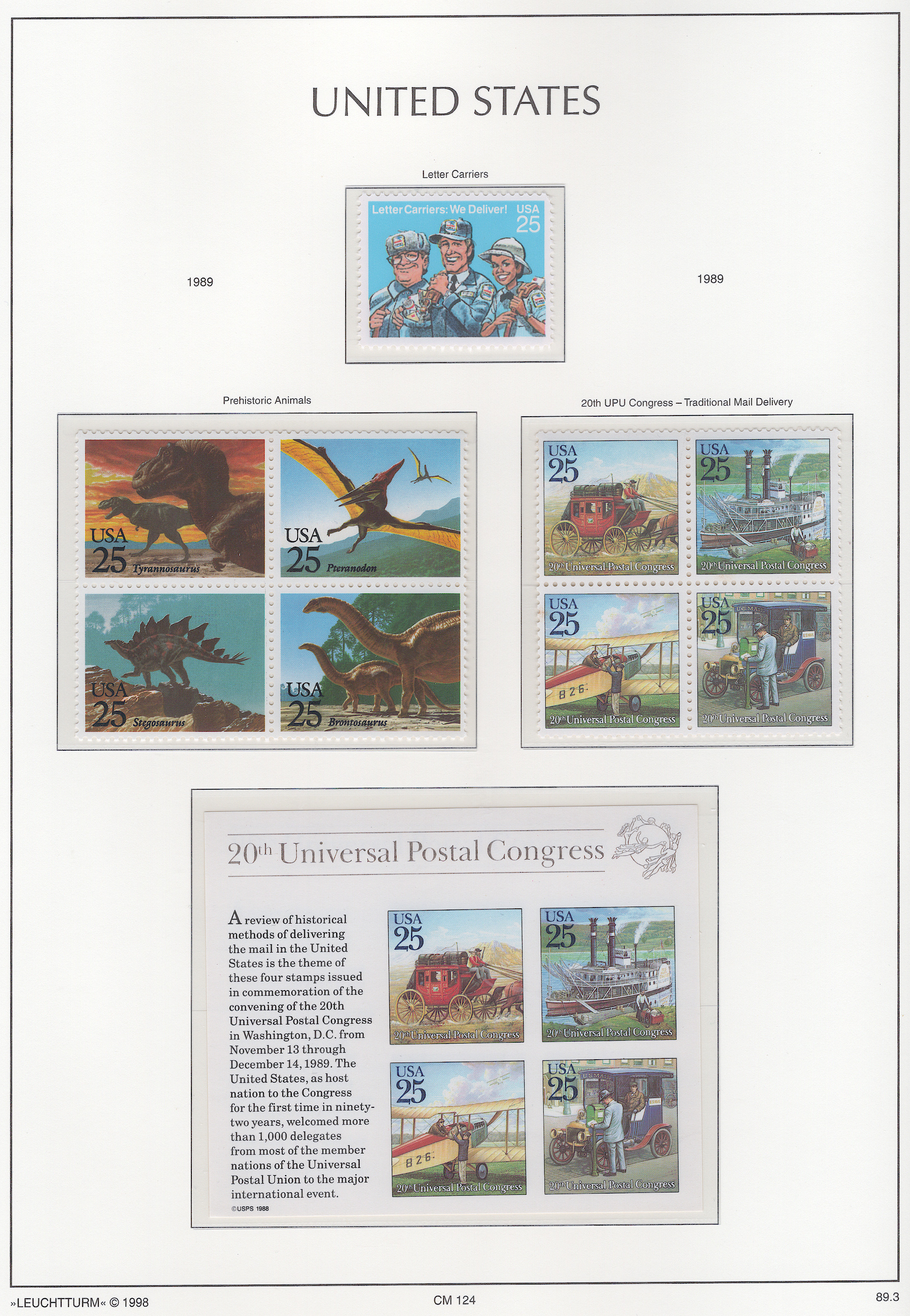
The Universal Postal Union is an organization that decides on postal policies among its members, official postal services from countries around the world. Headquarted in Bern, Switzerland, it began in 1874 and became a specialized agency of the United Nations in 1948.
When national postal services began, there were difficulties delivering mail from one country to another since the sender’s country was paid the postage and the deliverying country wasn’t paid anything. Each country had to negotiate with each other country for them to accept and deliver each other’s mail, including how much of the postage the delivering country might receive in payment. Because some countries didn’t have agreements with the recipient’s country, a letter might be routed through a common country that did have an agreement – it could involve multiple countries. This would sometimes require the sending postal service to add stamps from the intermediary country.
In 1863, Montgomery Blair, the postmaster general of the U.S. convened a meeting in Paris of postmasters general from many countries, an international postal congress to discuss how to simplify the situation and resolve many problems. Nothing was decided at that congress, so Heinrich von Stephan, the postmaster general of Germany, organized another meeting in 1874 in Bern. From this meeting, the General Postal Union was founded, which was renamed four years later to the Universal Postal Union. No longer would countries need to have agreements with each other. Instead, all members agreed to the same procedures: a uniform flat rate for mailing letters internationally; the sending country keeps all of the funds for the stamps; no additional stamps from intermediary or receiving countries; and international mail would be handled the same as local mail.
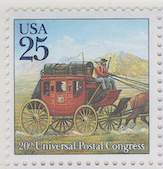
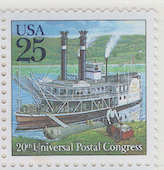
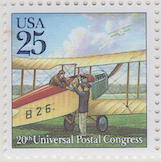
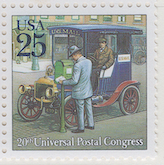
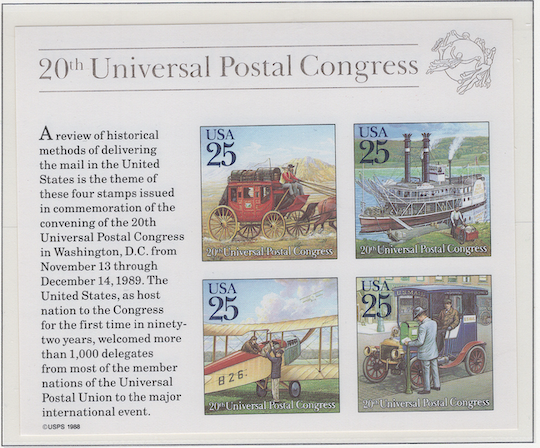
Every four years there is a meeting of representatives of member states, usually postmasters general, called a Universal Postal Congress. At these meetings, procedures for handling mail and rates are discussed, along with sharing ideas on new methods and technology. The imperforated stamps in the souvenir sheet and the set of four identical, but perforated states commemorate the twentieth Congress, which was held for the first time in the U.S. – in Washington, D.C.
Note
I like that the stamps on this souvenir sheet are not perforated and that a separate set with the same design was issued with perforations. I think souvenir sheets should be like that, with imperforated stamps. It makes it more like a souvenir sheet that just a small sheet of stamps. The normal sheet stamps still allow the public to use the stamps without having to deal with cutting stamps out of a souvenir sheet.
Contains 10 spots: own 10 – 10 unused, 0 used.
Page is finished.
Album or Web Page Last changed Jul 25, 2025
Stamp Details
The table below lists information about the stamps shown on this page of Lighthouse’s stamp album. For more details about a particular stamp, click on its description. That will take you to the related web page of Colnect.
spot |
own |
catalog |
subject |
description |
comment |
|---|---|---|---|---|---|
✓ |
2420 |
25c (aug 1989) |
Dinosaurs
✓ |
2422 |
25c (oct 1989) |
|||
✓ |
2423 |
25c (oct 1989) |
|||
✓ |
2424 |
25c (oct 1989) |
|||
✓ |
2425 |
25c (oct 1989) |
Transportation
✓ |
2434 |
25c (nov 1989) |
|||
✓ |
2435 |
25c (nov 1989) |
|||
✓ |
2436 |
25c (nov 1989) |
|||
✓ |
2437 |
25c (nov 1989) |
Souvenir Sheet
✓ |
2438 |
$1 (nov 1989) |
Footnotes
Spot refers to the postion of the stamp on the album page (e.g., 3.2 indicates row 3, position 2).
Amt. is an abbreviation for the face amount of the stamp.
Own indicates the stamp status: ✓ for unused; ✗ for used or canceled; ⭑ signifies I ordered one; ; ✨ indicates it was bought recently; ✠ means an auction bid is pending; and ◎ is used, and it costs too much for unused.
To search by catalog number, go to the search box and enter it in the catalog number box. However, it’s a bit broken; I need to fix it.









