Spain
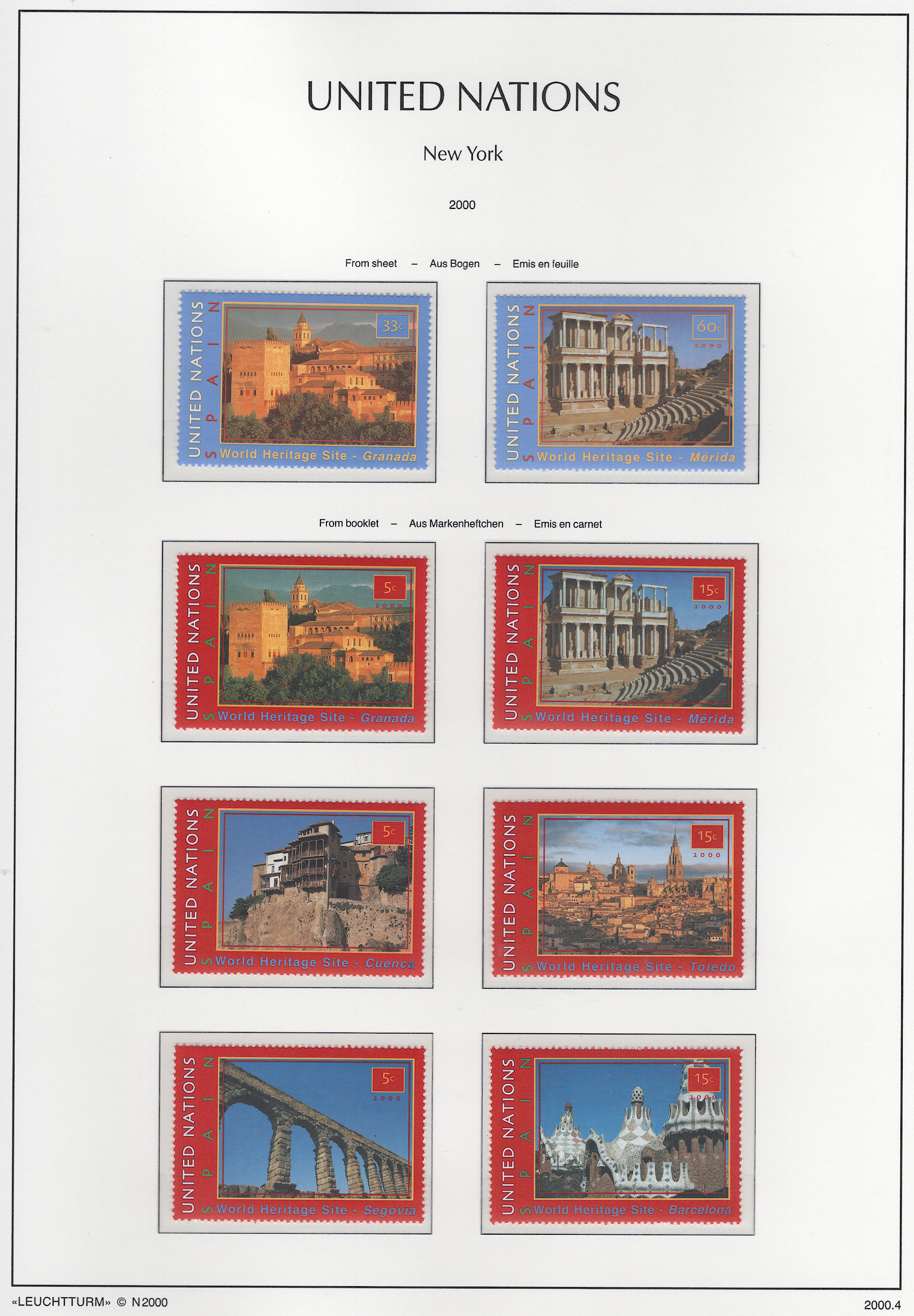
Spain has fifty World Heritage sites, including some located on islands in the Mediterranean Sea and on the Canary Islands in the Atlantic Ocean. These stamps commemorate just six of them. The first two stamps were sold in sheets of individual stamps. Whereas the other six were sold in a booklet with images and text describing the sites.
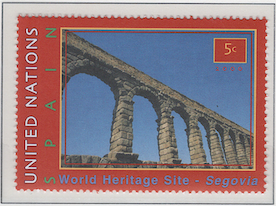
Segovia Aqueduct
The Aqueduct of Segovia is a public water system built by the Romans around 100 c.e. to transport water from a river fifteen kilometers away to provide fresh water to residents of the city. You can see an image of the aqueduct on one of the stamps here. It’s the largest such system and was in use until 1973. The strength and longevity of the Roman empire was a result of providing public works to the people in lands they conquered. Life was generally better after a city or territory joined the Roman empire.
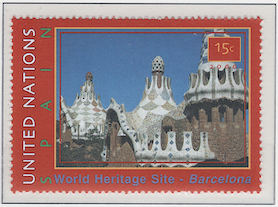
Works of Gaudí
Antoni Gaudí i Cornet was a Catalan architect from the 19th Century. Seven of this his works are World Heritage sites, located primarily in Barcelona. His style is unlike any other architects, although it was influenced by Oriental structures and the new Gothic art movement. His use of materials, including wrought iron, ceramics, and stained glass are unique. Some of his projects were so elaborate that they took decades to complete. For instance, the Sagrada Família (Holy Family) cathedral in Barcelona began in the 1880s and is still not finished. Gaudí worked on it until 1926 when he died – he’s buried in a crypt there. I visited the cathedral in 2006. It was consecrated by the Pope in 2010.
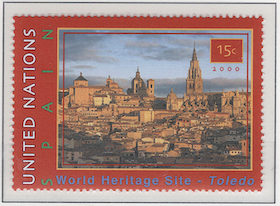
Toledo
The city of Toledo, located in the center of Spain, was first settled by Rome in the first century b.c.e. The name of the city comes from a Hebrew word for migration since many Jews migrated there after destruction of Jerusalem by the Roman Empire in the year 70 c.e. It was declared a World Heritage site for the history and architecture, which can be seen on the stamp commemorating the site.
Alhambra
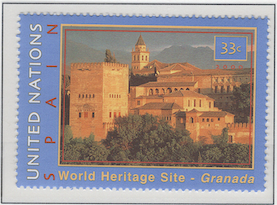
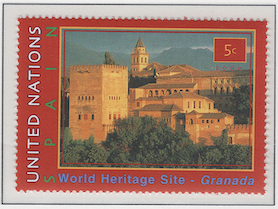
The Alhambra was an Arab palace and fortress located in Grenada from the 13th Century when the Arabs ruled the Iberian Peninsula. It was taken back from the Arabs and became the royal court of King Ferdinand and Queen Isabella in 1492. This is where Christopher Columbus’ expedition to the West was approved by the Queen. In 1828, Washington Irving visited and wrote the Tales of the Alhambra, bringing it to the attention of the modern world.
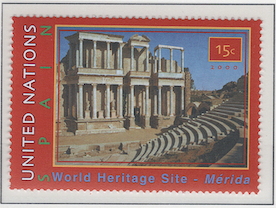
Mérida
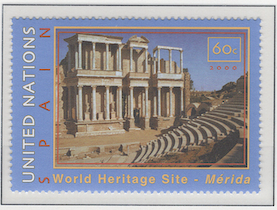
Mérida was settled in the 1st Century by the Romans. It has all of the usual public works for which Rome was known: it has an arena, a theater (shown in the stamp), an aqueduct, and temples dedicated to the Roman gods. Built in subsequent centuries, under Christendom, there is a basilica and a cathedral.
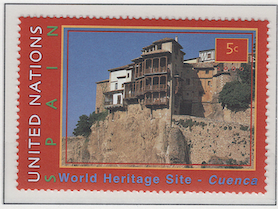
Cuenca
Cuenca is a city located next to a gorge made by two rivers cutting into the rocks. It’s sometimes referred to as the eagle’s next because of being located so high and right on the edge of a cliff looking down on the gorge. The territory was part of the Roman empire, but the city wasn’t settled until the Muslims conquered the area in the 8th Century, building a fortress. The city is ancient and spectacular to see.
Note
The two stamps that were issued in sheets and not part of the booklet are identical to two from the booklet, except that they have different face amounts. That’s the usual distinction. These two, though, have a different border color. I don’t like design overall, but appreciate that they used at least a different color.
Contains 8 spots: own 8 – 8 unused, 0 used.
Page is finished.
Album or Web Page Last changed Nov 25, 2025
Stamp Details
The table below lists information about the stamps shown on this page of Lighthouse’s stamp album. For more details about a particular stamp, click on its description. That will take you to the related web page of Colnect.
spot |
own |
catalog |
subject |
description |
comment |
World Heritage Site
✓ |
784 |
33 (oct 2000) |
|||
✓ |
785 |
60 (oct 2000) |
|||
✓ |
786a |
5 (oct 2000) |
|||
✓ |
786d |
15 (oct 2000) |
|||
✓ |
786b |
5 (oct 2000) |
|||
✓ |
786e |
15 (oct 2000) |
|||
✓ |
786c |
5 (oct 2000) |
|||
✓ |
786f |
15 (oct 2000) |
Footnotes
Spot refers to the postion of the stamp on the album page (e.g., 3.2 indicates row 3, position 2).
Amt. is an abbreviation for the face amount of the stamp.
Own indicates the stamp status: ✓ for unused; ✗ for used or canceled; ⭑ signifies I ordered one; ; ✨ indicates it was bought recently; ✠ means an auction bid is pending; and ◎ is used, and it costs too much for unused.
To search by catalog number, go to the search box and enter it in the catalog number box. However, it’s a bit broken; I need to fix it.








No Covers Found.