Antonio Canova
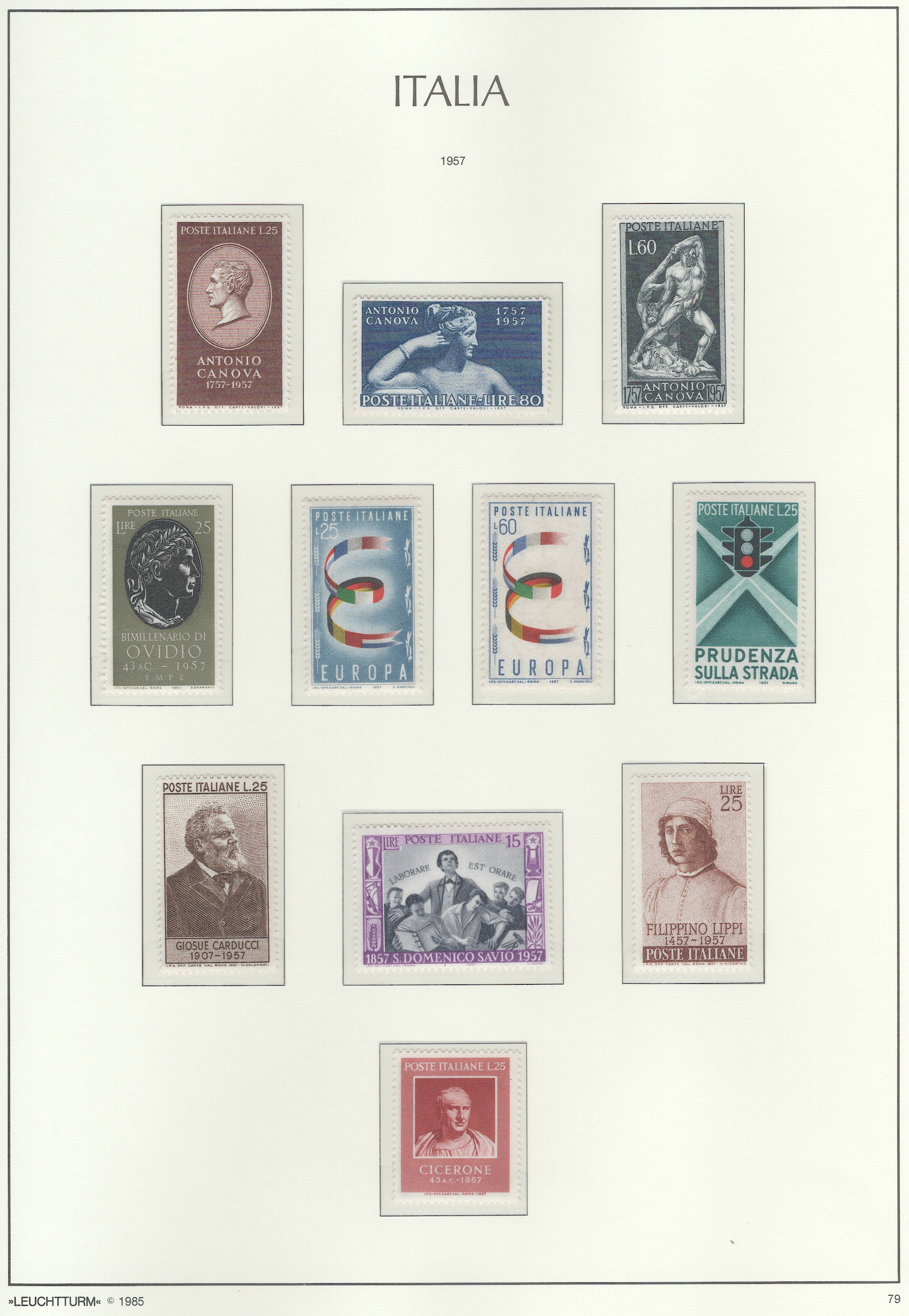
On November 1, 1757, Antonio Canova was born in Possagno, a town in the Republic of Venice. His father, a stonecutter, died in 1761. A year later, his grandfather Pasino, a stonemason who made altars, took over his care. As a result, Canova was making clay models and carving marble before he was ten. He went on to study at the Accademia di Belle Arti di Venezia (the Academy of Fine Arts of Venice) and opened his own studio in 1779.
Canova arrived in Rome on December 28, 1780. In 1781, the Venetian ambassador Girolamo Zulian hired him to make Theseus and the Minotaur. The first people to see it were sure it was a copy of a Greek original, and were shocked to learn it was a new work. His tomb for Clement XIV, finished in 1787, made him the best known living artist of his time. He worked in the Neoclassical style, which drew on ancient Greek and Roman sculpture.
By 1800, Canova was the most celebrated artist in Europe, with patrons in France, England, Russia, Austria and Holland. Napoleon and his family were among them. Napoleon wanted to be shown in a French general’s uniform for his statue, Napoleon as Mars the Peacemaker. Canova refused and insisted on a reference to Mars, the Roman god of war. Basically, the sculptor decided how the emperor would look. He also made Venus Victrix, a portrait of Napoleon’s sister Pauline, and began The Three Graces in 1814.
In 1815, Pope Pius VII sent Canova to Paris to recover art that Napoleon had taken from Italy. He got a good part of it back, though some pieces were too large or too hard to track down, e.g., Veronese’s The Wedding at Cana. In 1820, he made a statue of George Washington for North Carolina. It was destroyed in a fire in 1831. Canova designed, paid for and partly built the Tempio Canoviano (the Canova Temple) in Possagno, laying the foundation stone on July 11, 1819. He died in Venice on October 13, 2022 – no, see below.
Note
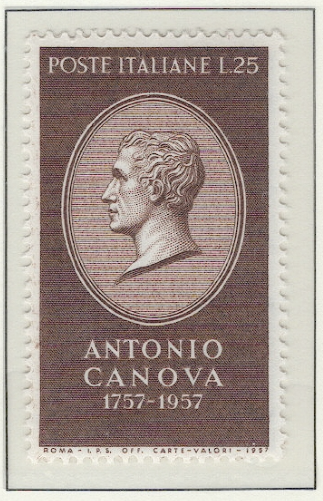
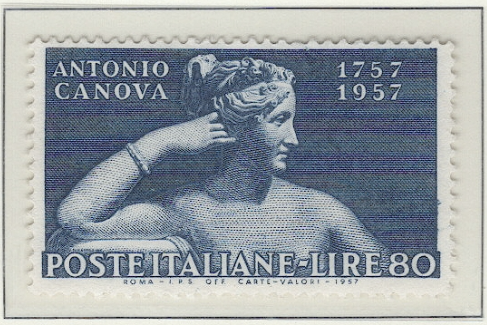
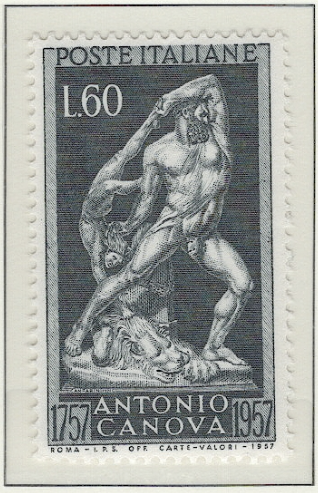
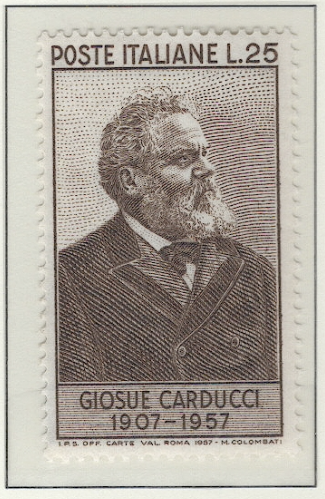
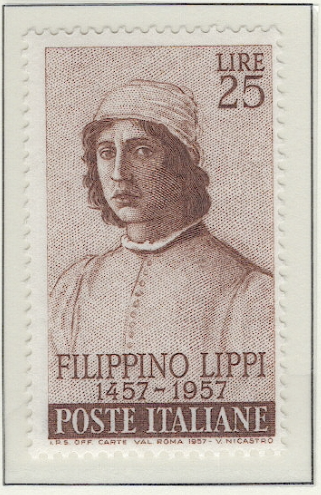
I wrote about Antonio Canova because I like the statues shown in two of the stamps for him on the top row of this album page. I also like this style of stamp design. The style is similar to those on the third row of Carducci and Flippino Lippi, for which two streets in Milan are named that I know.
Contains 11 spots: own 11 – 11 unused, 0 used.
Page is finished.
Album or Web Page Last changed Jan 1, 2023
Stamp Details
The table below lists information about the stamps shown on this page of Lighthouse’s stamp album. For more details about a particular stamp, click on its description. That will take you to the related web page of Colnect.
spot |
own |
catalog |
subject |
description |
comment |
|---|---|---|---|---|---|
✓ |
812 |
25₤ (jul 1957) |
|||
✓ |
813 |
60₤ (jul 1957) |
|||
✓ |
814 |
80₤ (jul 1957) |
Europa CEPT
✓ |
809 |
25₤ (jun 1957) |
|||
✓ |
817 |
25₤ (sep 1957) |
Other
✓ |
818 |
60₤ (sep 1957) |
|||
✓ |
815 |
25₤ (aug 1957) |
|||
✓ |
819 |
25₤ (oct 1957) |
|||
✓ |
822 |
15₤ (dec 1957) |
|||
✓ |
820 |
25₤ (nov 1957) |
|||
✓ |
821 |
25₤ (nov 1957) |
Footnotes
Spot refers to the postion of the stamp on the album page (e.g., 3.2 indicates row 3, position 2).
Amt. is an abbreviation for the face amount of the stamp.
Own indicates the stamp status: ✓ for unused; ✗ for used or canceled; ⭑ signifies I ordered one; ; ✨ indicates it was bought recently; ✠ means an auction bid is pending; and ◎ is used, and it costs too much for unused.
To search by catalog number, go to the search box and enter it in the catalog number box. However, it’s a bit broken; I need to fix it.










