Japan
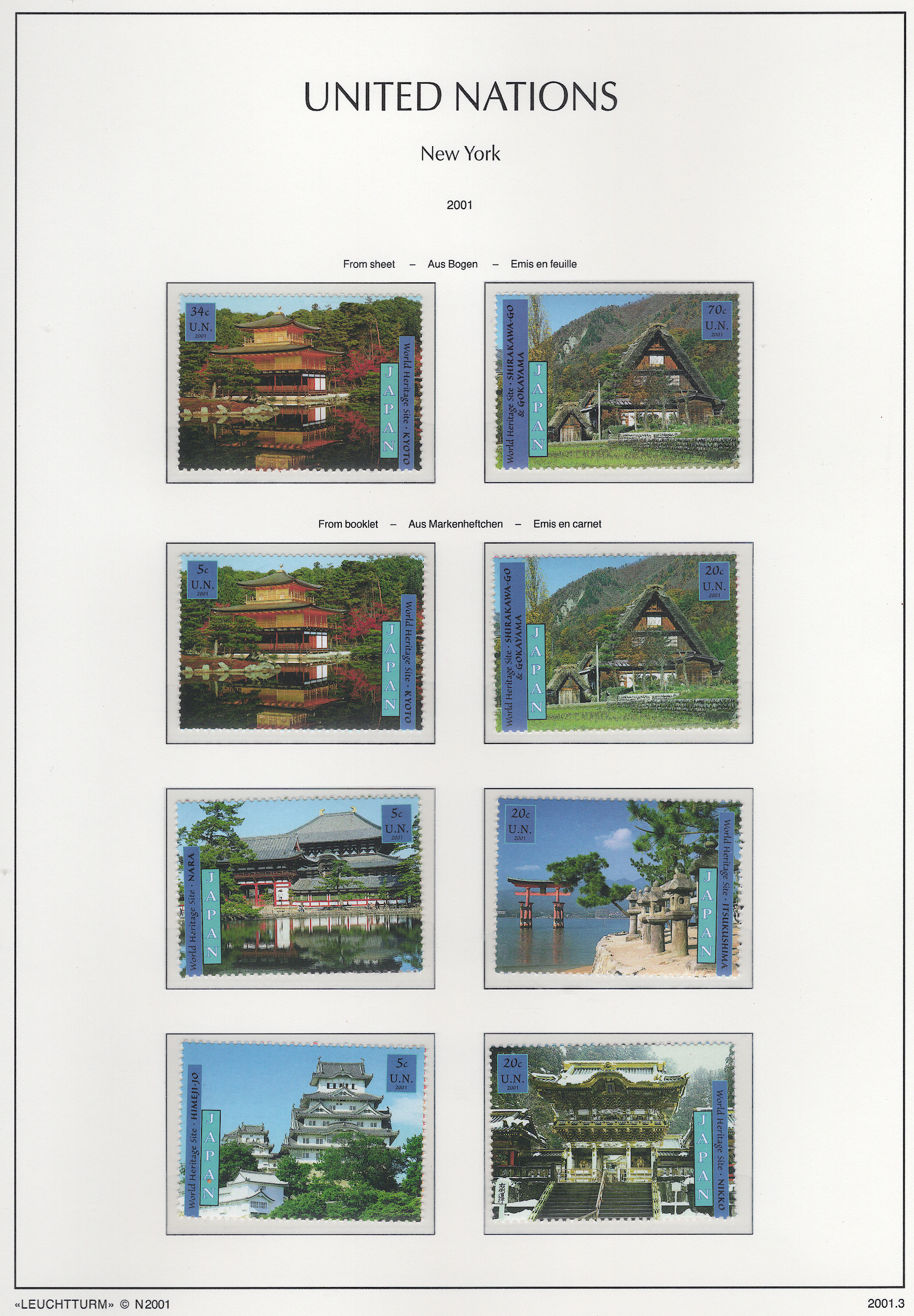
Japan has twenty-six World Heritage sites. These stamps commemorate just six of them. The first two stamps were sold in sheets of individual stamps. Whereas the other six were sold in a booklet with images and text describing the sites.
Himeji Castle
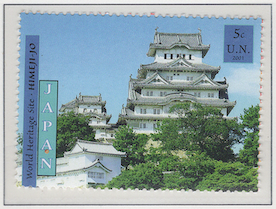
Himeji Castle, also known as the White Heron Castle can be seen in one of these stamps, the tall white compound structure. It was built in the Fourteenth Century and is the largest castle in Japan, having survived earthquakes and bombings in World War II. It has almost three million visitors a year and was renovated about ten years ago. It’s an extensive fortress on a hill with several buildings, surrounded by a moat.
Nikkō
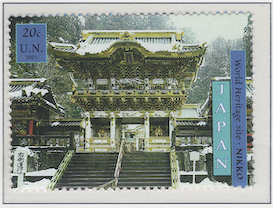
The shrines and temples of Nikkō were built from the Eighth to the Seventeen Centuries. In the stamp related to this area is the Yomeimon gate at Nikko Toshogu. The temples contain artwork including the original carving of three wise monkeys: hear no evil, see no evil, speak no evil.
Nara
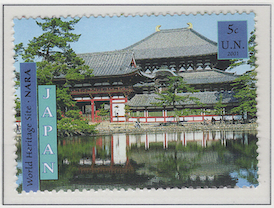
The World Heritage site of Nara include five temples and a shrine. It also includes the Heijō Palace was an imperial residence in the Eighth Century. Also, there’s the Kasugayama Primeval Forest, which is over six-hundred acres of woods that have been protected from hunting and other intrusions since the Ninth Century. As a result, there are many unique species of animals, insects, and vegetation.
Itsukushima Shrine
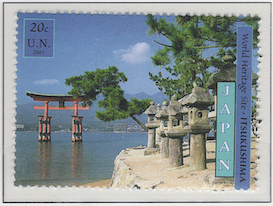
The Itsukushima Shinto shrine site includes many buildings and other structures from as far back as the Sixth Century. The stamp here with the red structure in the water is a torii, which is a type gate, or rather a marker to indicate one is entering sacred land.
Kyoto
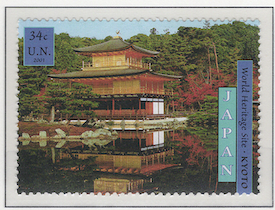
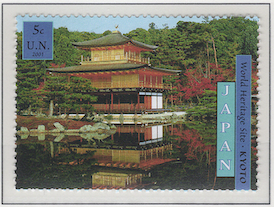
In Kyoto there are three Shinto shrines, thirteen Buddhist temples, and an imperial castle that are part of the World Heritage site designation. In the image for this stamp, you can see the Kinkaku-ji with gilded outer walls – known also as the Golden Pavilion.
Shirakawa-gō and Gokayama
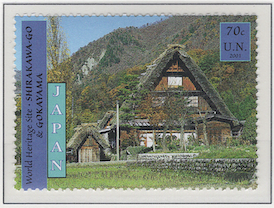
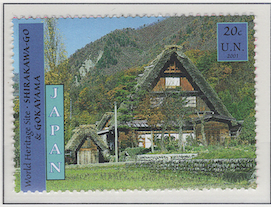
The villages of Shirakawa-gō and Gokayama are located in the mountains of central Japan. The houses there have steep roofs – similar to those in Switzerland, but these roofs are thatched. You can see a few of them in the stamp here. The people there are known for growing mulberry trees and silkworms.
Note
As a European-American, I’m very familiar with many of the World Heritage sites in Europe and the U.S. So I find it particularly informative that the U.N. issued stamps commemorating sites in Japan and elsewhere. Again, I just wish they wouldn’t use photographs but would instead have artists design them like they did for the Japanese Peace Bell stamp.
Contains 8 spots: own 8 – 8 unused, 0 used.
Page is finished.
Album or Web Page Last changed Dec 5, 2025
Stamp Details
The table below lists information about the stamps shown on this page of Lighthouse’s stamp album. For more details about a particular stamp, click on its description. That will take you to the related web page of Colnect.
spot |
own |
catalog |
subject |
description |
comment |
World Heritage Site
✓ |
805 |
34 (aug 2001) |
|||
✓ |
806 |
70 (aug 2001) |
|||
✓ |
807a |
5 (aug 2001) |
|||
✓ |
807d |
20 (aug 2001) |
|||
✓ |
807b |
5 (aug 2001) |
|||
✓ |
807e |
20 (aug 2001) |
|||
✓ |
807c |
5 (aug 2001) |
|||
✓ |
807f |
20 (aug 2001) |
Footnotes
Spot refers to the postion of the stamp on the album page (e.g., 3.2 indicates row 3, position 2).
Amt. is an abbreviation for the face amount of the stamp.
Own indicates the stamp status: ✓ for unused; ✗ for used or canceled; ⭑ signifies I ordered one; ; ✨ indicates it was bought recently; ✠ means an auction bid is pending; and ◎ is used, and it costs too much for unused.
To search by catalog number, go to the search box and enter it in the catalog number box. However, it’s a bit broken; I need to fix it.








No Covers Found.