Particular Services
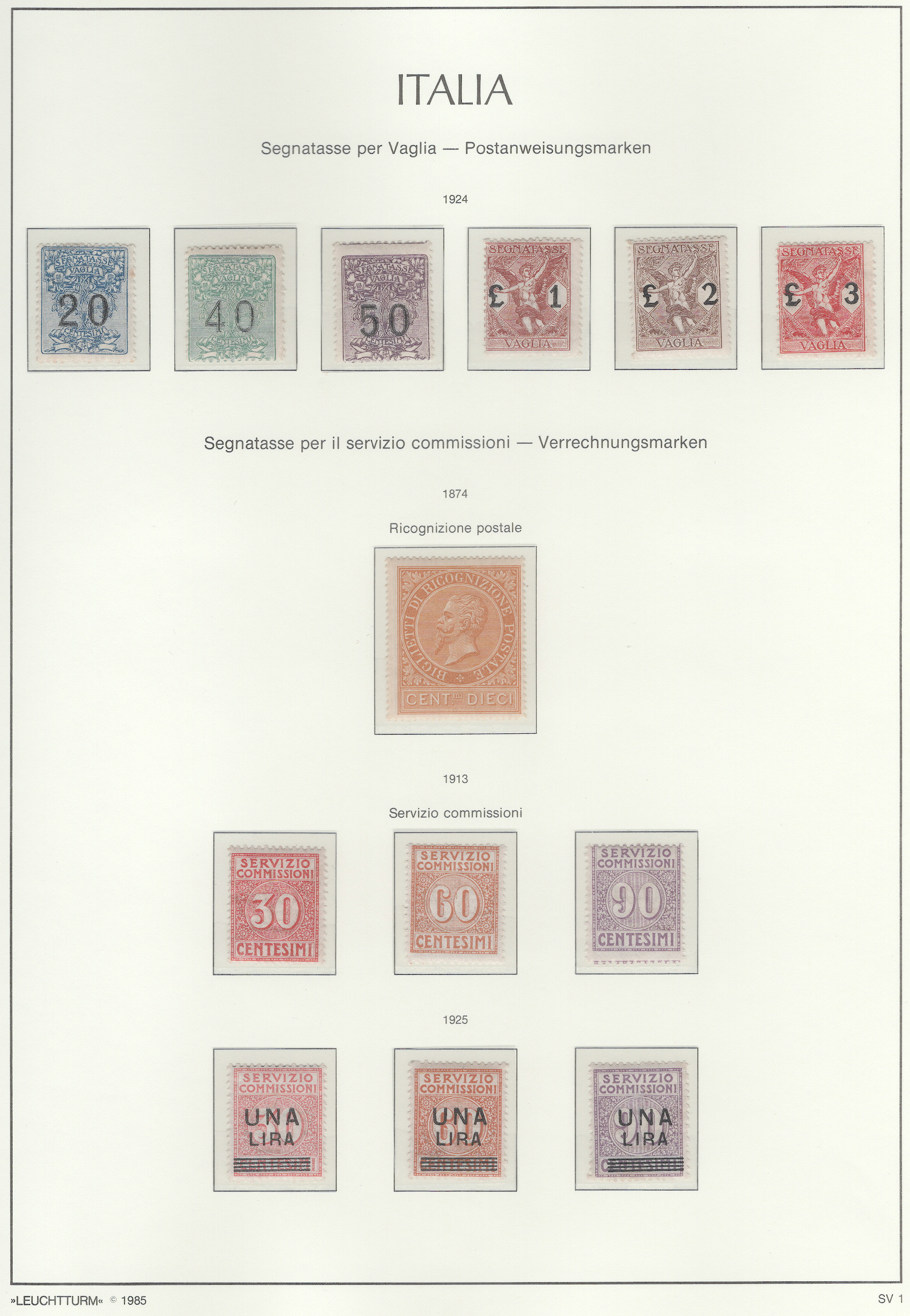
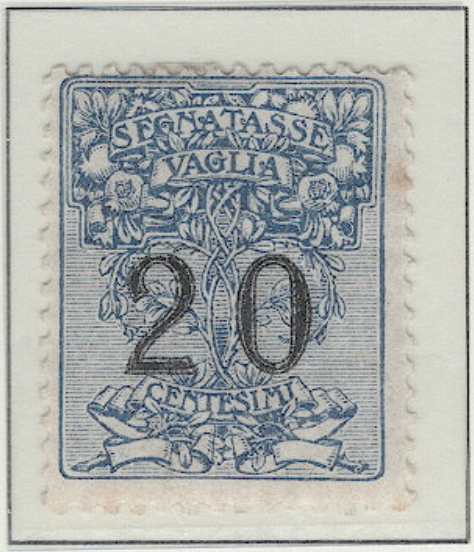
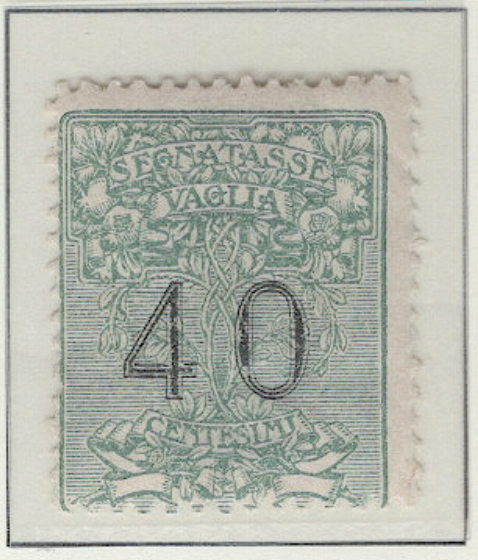
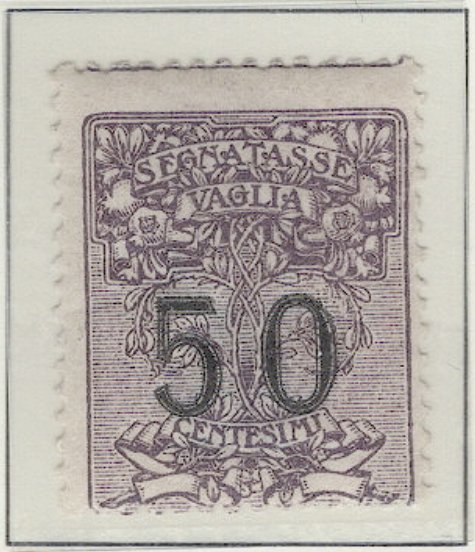
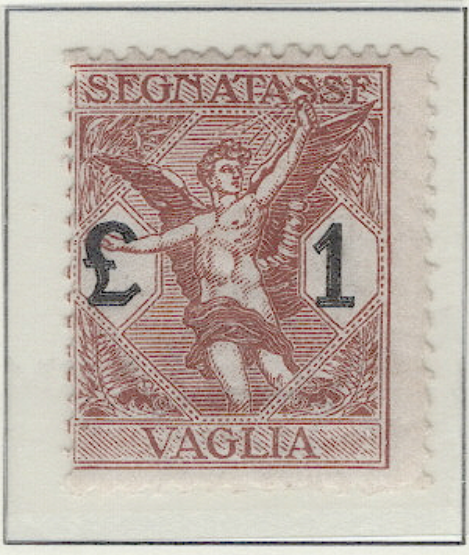
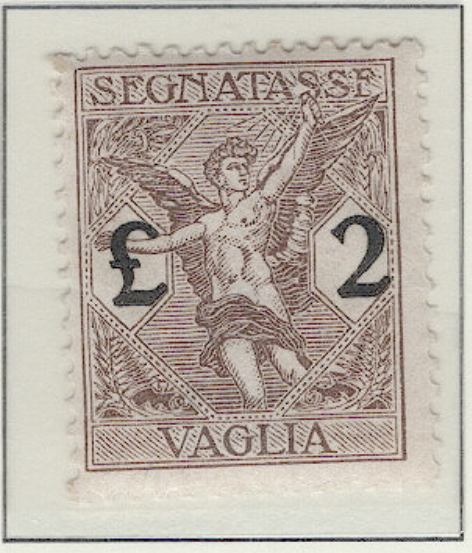
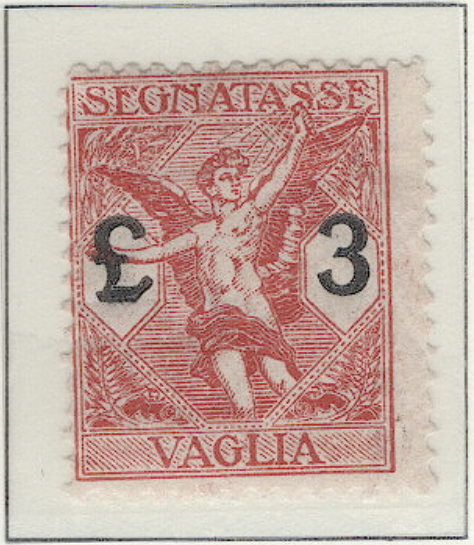
There are three types of stamps on this page. The first type are called in Italian, Segnatasse per Valglia – which literally and vaguely translates to sign of tax for valuable thing. They’re stamps to be attached to a post office money order, to indicate that the required service charge has been paid.
The basic procedure was for someone who wanted to send money to someone else (e.g., a family member, a vendor), to go to their local post office in Italy and deposit the money for whatever amount they want to send. They would then be given a money order for that amount, to assign it to whomever. A postal worker would take one of these stamps, which the sender would have to buy for the face amount, and attach it to the money order to validate it. Then the sender would mail it to the recipient – another stamp for the envelop – perhaps along with a cover letter. The envelop would be delivered to the recipient wherever they were in Italy. That person would then go to their local post office to get the cash for the postal money order.
Compared to methods that are available to us today for transfering money, the method of late 19th Century Italy seems like a protracted process. But at that time, it was quick and more secure than mailing cash in the mail or traveling across the peninsula to deliver the money in person.
Incidentally, this service start in the early 1870s. It wasn’t until 1924 that the post office decided to issue a stamp specifically for postal money orders. Before then, they first used regular postage stamps. In 1875 they started using the service stamps, shown at the top of Album Page S1.
Recognition
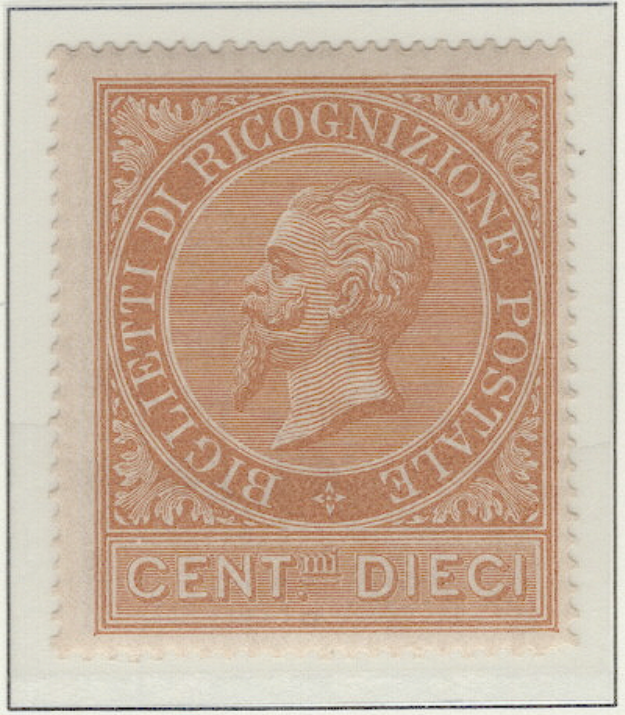
The second type of stamp on this page is the large one by itself, on the second row. It relates in part to postal money orders. It’s from 1874 and was used for recognizione postale (i.e., postal recognition) documents. I had to do some searching on the web to find information on this: my Italian stamp catalogs where not helpful.
When someone would come into an Italian post office with a money order they had received in the mail, looking to cash it, there were concerns that it might have been stolen. In those times, very few people had any kind of identification to prove they were the person named on the money order. To solve this problem, the Italian post office started issuing identification documents. Getting one was easy if the postmaster of your local post office knew you: he would just sign your document attesting to your identity. However, if he didn’t know you, you would have to bring with you to the post office two people who knew you and who the postmaster knew. They would sign the document vouching for you, and then the postmaster would sign to approve your identity document. You would then be able to use that recognition document to prove your identity when cashing money orders or receiving freight from the post office.
Getting back to the stamp and related ones: when you would get a postal recognition document, it required this stamp. It was the fee you had to pay. When they first started using this document, it was a booklet that included information on the person’s identity and ten perforated pages like coupons with ten-cent stamps on each page – more fees. When you would go to the post office to cash in a money order, or to pick-up a package, or something else that required identification, a postal worker would remove one of these coupons to include with his paperwork as proof that he had confirmed your identity. As a result, after using all ten of these coupons, you had to go back to the post office to get a new recognition document, requiring another recognition stamp. You can see why there weren’t many people who had these documents. Since it was for a time the only identifcation document the government issued, you can also see why hardly any Italians had any form of identification.
The purpose of this document was to ensure against cashing stolen money orders. However, this identity document could also be stolen, thus negating its purpose. But there was less likelihood of that. Plus, the postmasters probably remembered each of the few people who went to the trouble and expense of parading his friends in front of him. In 1913, though, they added photographs to the document. Starting in 1923, they stopped including coupons in the booklets. Incidentally, these postal recognition booklets were eventually replaced by Italian identity booklets. Those paper identity documents were replaced only in recent years with plastic identity cards the size of credit cards.
Commissioned Services
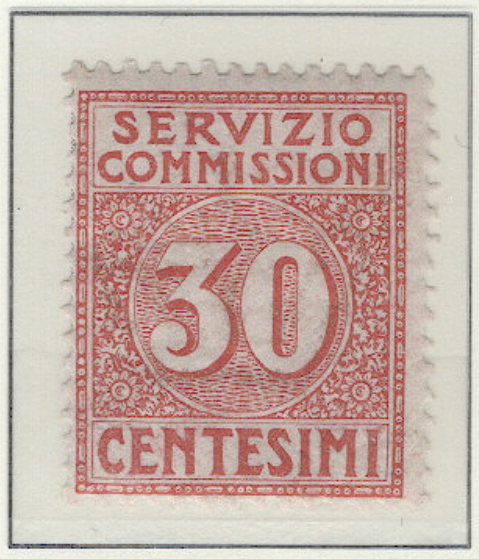
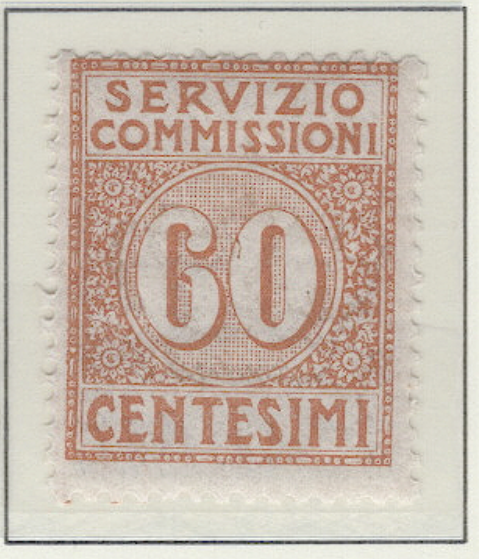
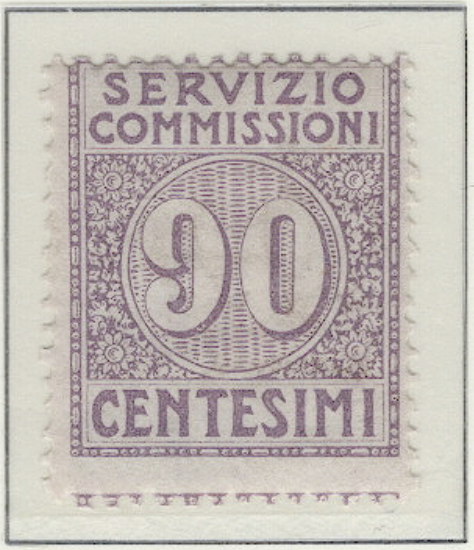
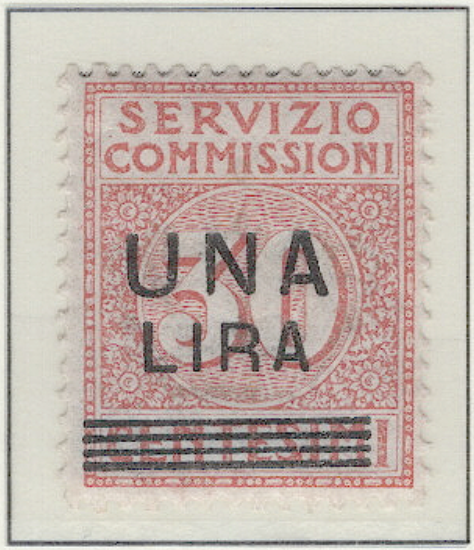
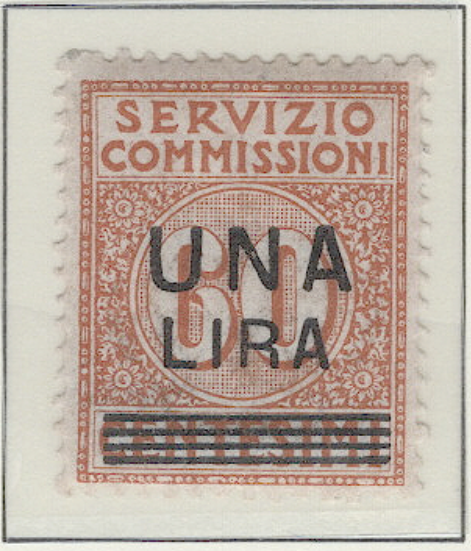
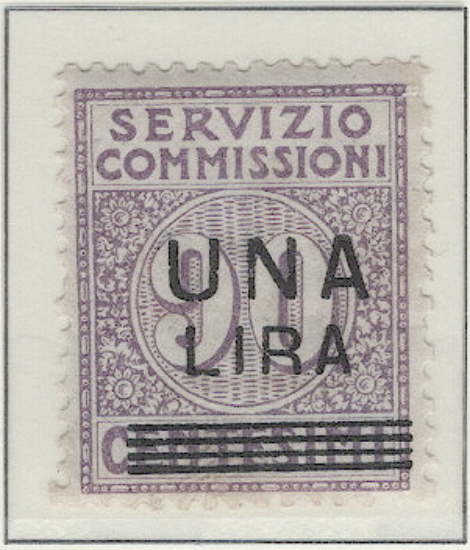
The third and last type of stamps on this album page were used for a commissioned service that the post office conducted for the public. So far, I have been unable to determine what was that service. Once I do, I’ll update this page. Whatever it was, they first issued in 1913 three stamps to be used for paying the fee for the service. In 1925, they raised the charge to a flat one lira and overprinted the stamps they had in stock with that amount, as you can see on the last row here.
Note
Since I’ve been researching the purposes of these stamps, I’ve become interested in them and have started buying them. I received the set of stamps, on the second to last row, this past month and the one at the bottom, which didn’t cost as much.
The large stamp in the middle is a little expensive, but I found one for sale in Rome for about a third of the lowest price at other stores. I’m pleased with that purchase: I thought it might be many months before I’d be able to buy it. I’m also pleased that it wasn’t long ago that this page was blank, and then had only one or two stamps on it. I thought it was destined to be spare for quite a long time. But soon it will be completed.
Contains 13 spots: own 13 – 13 unused, 0 used.
Page is finished.
Album or Web Page Last changed Jan 18, 2023
Stamp Details
The table below lists information about the stamps shown on this page of Lighthouse’s stamp album. For more details about a particular stamp, click on its description. That will take you to the related web page of Colnect.
spot |
own |
catalog |
subject |
description |
comment |
Money Order Stamps
✓ |
SV1 |
20c (jul 1924) |
|||
✓ |
SV2 |
40c (jul 1924) |
|||
✓ |
SV3 |
50c (jul 1924) |
|||
✓ |
SV4 |
1₤ (jul 1924) |
|||
✓ |
SV5 |
2₤ (jul 1924) |
|||
✓ |
SV6 |
3₤ (jul 1924) |
Postal Recognition Stamp
✓ |
RP1 |
10c (jan 1874) |
Service Commission
✓ |
SC1 |
30c (jul 1913) |
|||
✓ |
SC2 |
60c (jul 1913) |
|||
✓ |
SC3 |
90c (jul 1913) |
Service: Overprint Una Lira
✓ |
SC4 |
1₤ (apr 1925) |
|||
✓ |
SC5 |
1₤ (apr 1925) |
|||
✓ |
SC6 |
1₤ (apr 1925) |
Footnotes
Spot refers to the postion of the stamp on the album page (e.g., 3.2 indicates row 3, position 2).
Amt. is an abbreviation for the face amount of the stamp.
Own indicates the stamp status: ✓ for unused; ✗ for used or canceled; ⭑ signifies I ordered one; ; ✨ indicates it was bought recently; ✠ means an auction bid is pending; and ◎ is used, and it costs too much for unused.
To search by catalog number, go to the search box and enter it in the catalog number box. However, it’s a bit broken; I need to fix it.












