Annexation
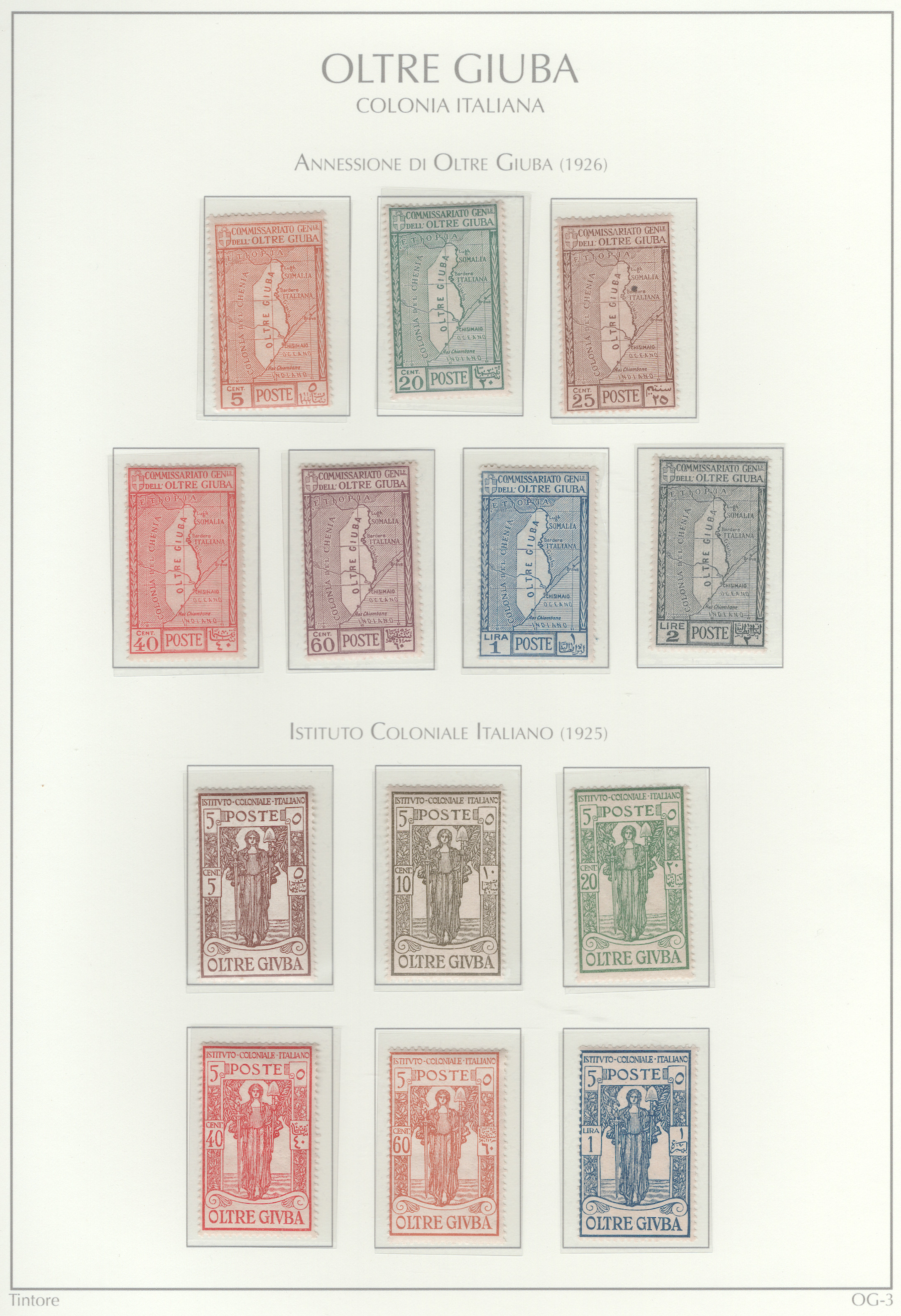
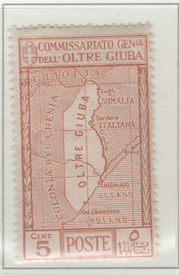
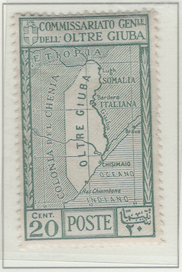
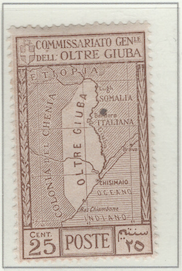
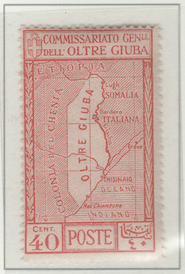
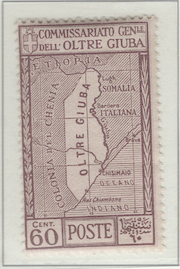
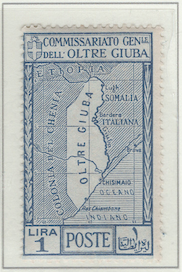
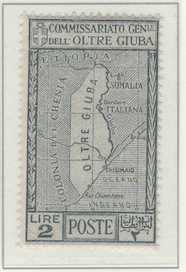
The Italian colonial region of east Africa was administered by a viceroy appointed by the king. That region was organized by six governorates. Those were composed of about forty commissariati or commissions. At the top of each of the stamps on the top two rows of this album page, are the words, Commissariato dell’Alto Giuba. They also show a map of Oltre Giuba (i.e., Jubaland). Basically, these stamps are meant to make clear that the land shown on the map is now part of Italy’s east Africa colonies as the Commission of Jubaland.
Italian Colonial Institute
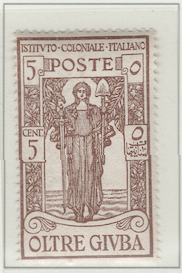
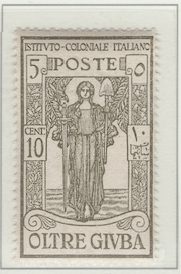
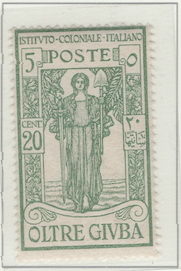
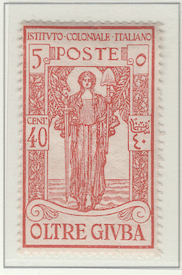
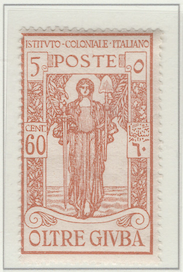
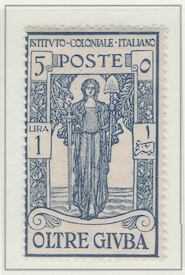
The Istituto Coloniale Italiano (Italian Colonial Institute) was an organization that worked on informing the Italian public about the colonies. It was meant to provide news and to encourage Italians to migrate to them. It was founded in 1908 in Rome by a group of politicians, diplomats, professors, and explorers of the time who had an interest in Africa and the expansion of Italy.
In the late 1920s, the Institute became part of the Fascists agenda to build an Italian empire. They changed their name first to the Fascist Colonial Institute, and in the late 1930s to the Fascist Institute of Italian Africa. After the second world war and the loss of the colonies, the Institute changed its agenda to focus on the rights of Italians living and working in the former colonies. It went through a couple more name changes and more reorganization over the decades that followed, but it continues today as the Italian-African Institute.
Note
This page is finished. It’s about a full as can be regarding the layout. I could possibly redraw the boxes around the stamps to be not as high, but the widths are fine. Probably I should take more care in putting the stamps in the mounts: they’re a little off-kilter.
Contains 13 spots: own 13 – 13 unused, 0 used.
Page is finished.
Album or Web Page Last changed Dec 15, 2024
Stamp Details
The table below lists information about the stamps shown on this page of Lighthouse’s stamp album. For more details about a particular stamp, click on its description. That will take you to the related web page of Colnect.
spot |
own |
catalog |
subject |
description |
comment |
Annexation
✓ |
29 |
5c (apr 1926) |
|||
✓ |
30 |
20c (apr 1926) |
|||
✓ |
31 |
25c (apr 1926) |
|||
✓ |
32 |
40c (apr 1926) |
|||
✓ |
33 |
60c (apr 1926) |
|||
✓ |
34 |
1₤ (apr 1926) |
|||
✓ |
35 |
2₤ (apr 1926) |
Pro Italian Colonial Institute
✓ |
36 |
5+5c (jun 1926) |
|||
✓ |
37 |
10+5c (jun 1926) |
|||
✓ |
38 |
20+5c (jun 1926) |
|||
✓ |
39 |
40+5c (jun 1926) |
|||
✓ |
40 |
60+5c (jun 1926) |
|||
✓ |
41 |
1+0.05₤ (jun 1926) |
Footnotes
Spot refers to the postion of the stamp on the album page (e.g., 3.2 indicates row 3, position 2).
Amt. is an abbreviation for the face amount of the stamp.
Own indicates the stamp status: ✓ for unused; ✗ for used or canceled; ⭑ signifies I ordered one; ; ✨ indicates it was bought recently; ✠ means an auction bid is pending; and ◎ is used, and it costs too much for unused.
To search by catalog number, go to the search box and enter it in the catalog number box. However, it’s a bit broken; I need to fix it.












