Langley & Sikorsky
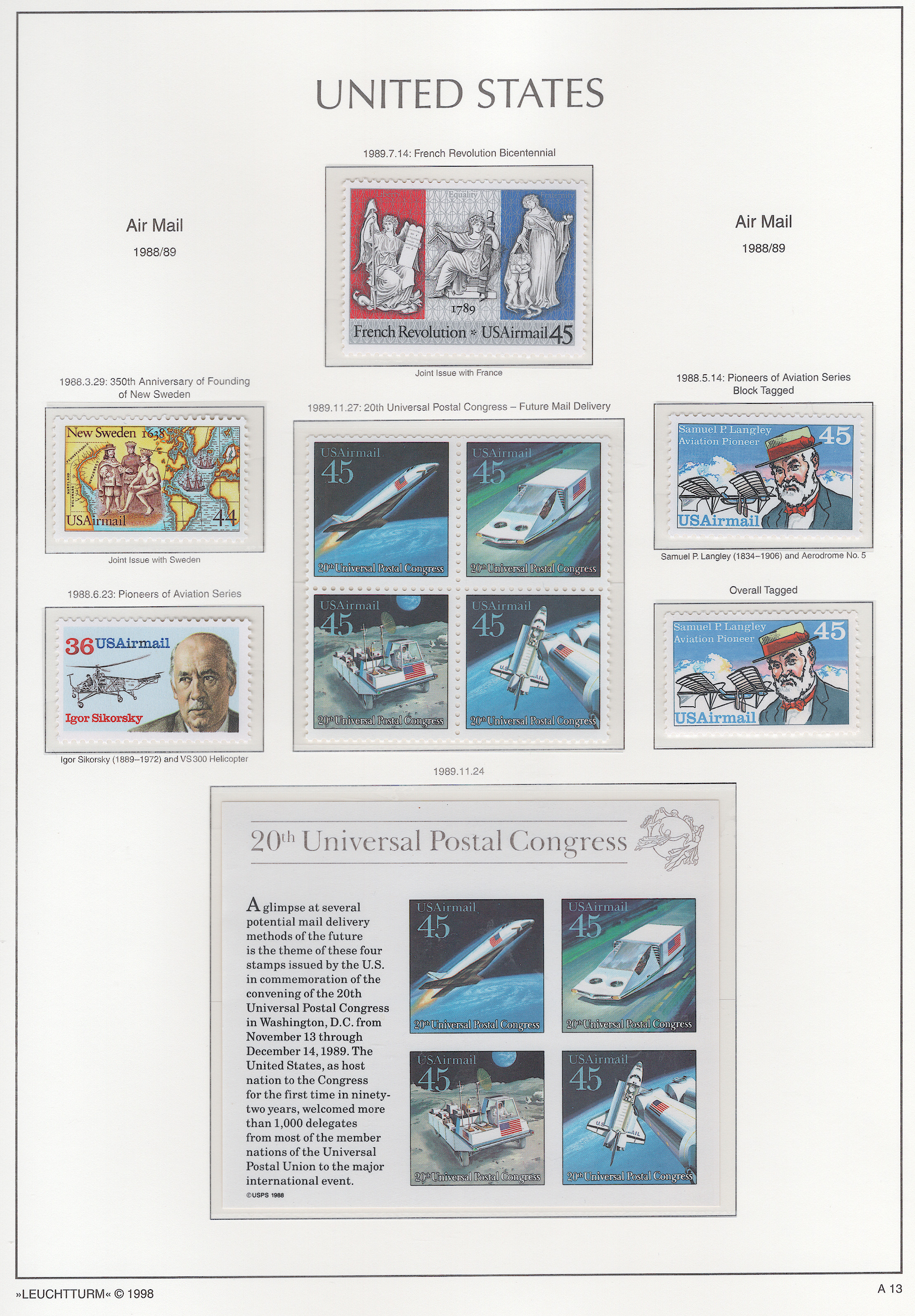
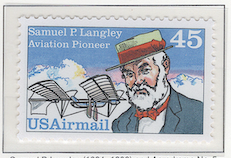
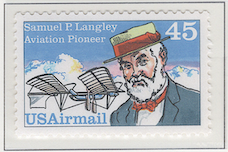
On this album page there are stamps commemorating two aviation pioneers. I had thought to write about one of them, but couldn’t resist saying something about each of them. As I’m researching these and other aviation pioneers, I’m realizing that there were many people who contribute to the advancement of science and new technology – even the invention of airplanes.
Samuel Langley was aviation pioneer, astronomer, physicist from the late part of the Nineteenth Century. He lived at a time when theories about how to design an airplane were being proven with models, minature unmanned planes. The most successful attempts were gliders, and some used rubber bands. In the late 1880s, while Langley was an administraotr at the Smithsonian Institute, he built a model plane that had a steam engine. Starting in 1898, he began designing an Aerodrome, a manned plane that used a catapult to initiate flight without wind to assist. He had many failed attempts, but by 1914 it was able to fly a few hundred feet, eleven years after the Wright Brothers’ first successful flight. Nevertheless, the Smithsonia hung Langley’s plane in their museum and claimed he had made the first successful unmanned flight.
Igor Sikorsky was a Russian American aviation engineer from the Ukraine, from early part of the Twentieth Century. He designed many airplanes, taking them on test flights. He’s perhaps most well known for having designed the first successful helicopters. As an aviation engineer, Sikorsky was very successful. He started designing helecopters in 1909, but given the state of the art of engines and metals, he soon realized it was too soon to build one successfully. So he focused on fixed wing airplanes.
Sikorsky designed a few airplanes while living Ukraine. After a mishap with an engine, part of his designs focused on safety and sustainability in the event of engine failure. From 1912 to 1914, Sikorsky was building large manned-planes that successfully flew – also in contradiction to the Smithsonian’s claim about Langley. At the start of the Russian Revolution, Sikorsky emigrated to the U.S. where he designed over forty successful airplanes. In 1939, he built the first success helecopter and in 1942 the first mass produced helicopter – although it was rough and would need to be improved upon.
Note
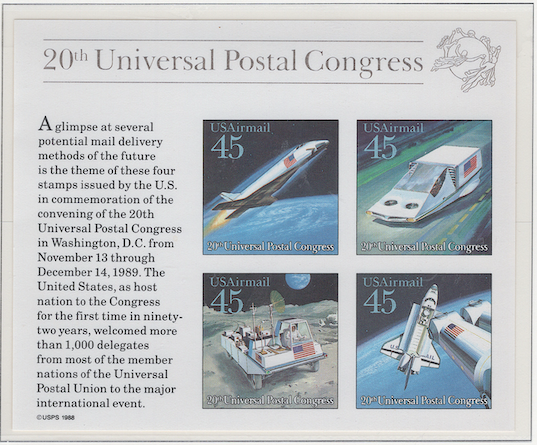
This page seems to be amateurishly organized. The layout seems almost haphazard. I appreciate that it’s difficult to fit a block of four stamps and a souvenir sheet on the same page as a few other stamps, but maybe two or three of the indivual stamps could have been moved to the next page. I would have preferred the Langley and Sikorsky stamps together on the same row. I’m ever able to design a page, and cut and place stamp mounts, as well as Leuchtturn overall, I’ll redesign this page and the next to my liking.
Contains 10 spots: own 10 – 10 unused, 0 used.
Page is finished.
Album or Web Page Last changed Jul 22, 2025
Stamp Details
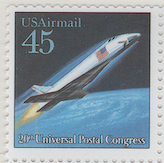
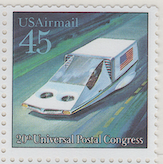
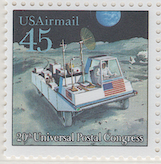
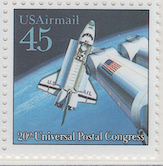
The table below lists information about the stamps shown on this page of Lighthouse’s stamp album. For more details about a particular stamp, click on its description. That will take you to the related web page of Colnect.
spot |
own |
catalog |
subject |
description |
comment |
|---|---|---|---|---|---|
✓ |
C120 |
45¢ (jul 1989) |
|||
✓ |
C117 |
44¢ (mar 1988) |
|||
✓ |
C119 |
36¢ (jun 1988) |
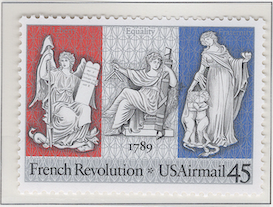
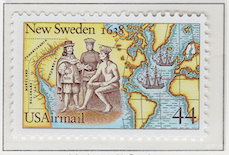
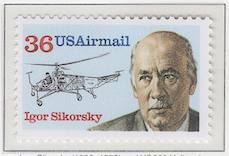
Space Exploration
✓ |
C122 |
45¢ (nov 1989) |
|||
✓ |
C123 |
45¢ (nov 1989) |
|||
✓ |
C124 |
45¢ (nov 1989) |
|||
✓ |
C125 |
45¢ (nov 1989) |
Famous Americans
✓ |
C118 |
45¢ (may 1988) |
|||
✓ |
C118a |
45¢ (may 1988) |
500 Years of Europeans in America
✓ |
C126 |
4*45¢ (nov 1989) |
Footnotes
Spot refers to the postion of the stamp on the album page (e.g., 3.2 indicates row 3, position 2).
Amt. is an abbreviation for the face amount of the stamp.
Own indicates the stamp status: ✓ for unused; ✗ for used or canceled; ⭑ signifies I ordered one; ; ✨ indicates it was bought recently; ✠ means an auction bid is pending; and ◎ is used, and it costs too much for unused.
To search by catalog number, go to the search box and enter it in the catalog number box. However, it’s a bit broken; I need to fix it.









