Wright Brothers
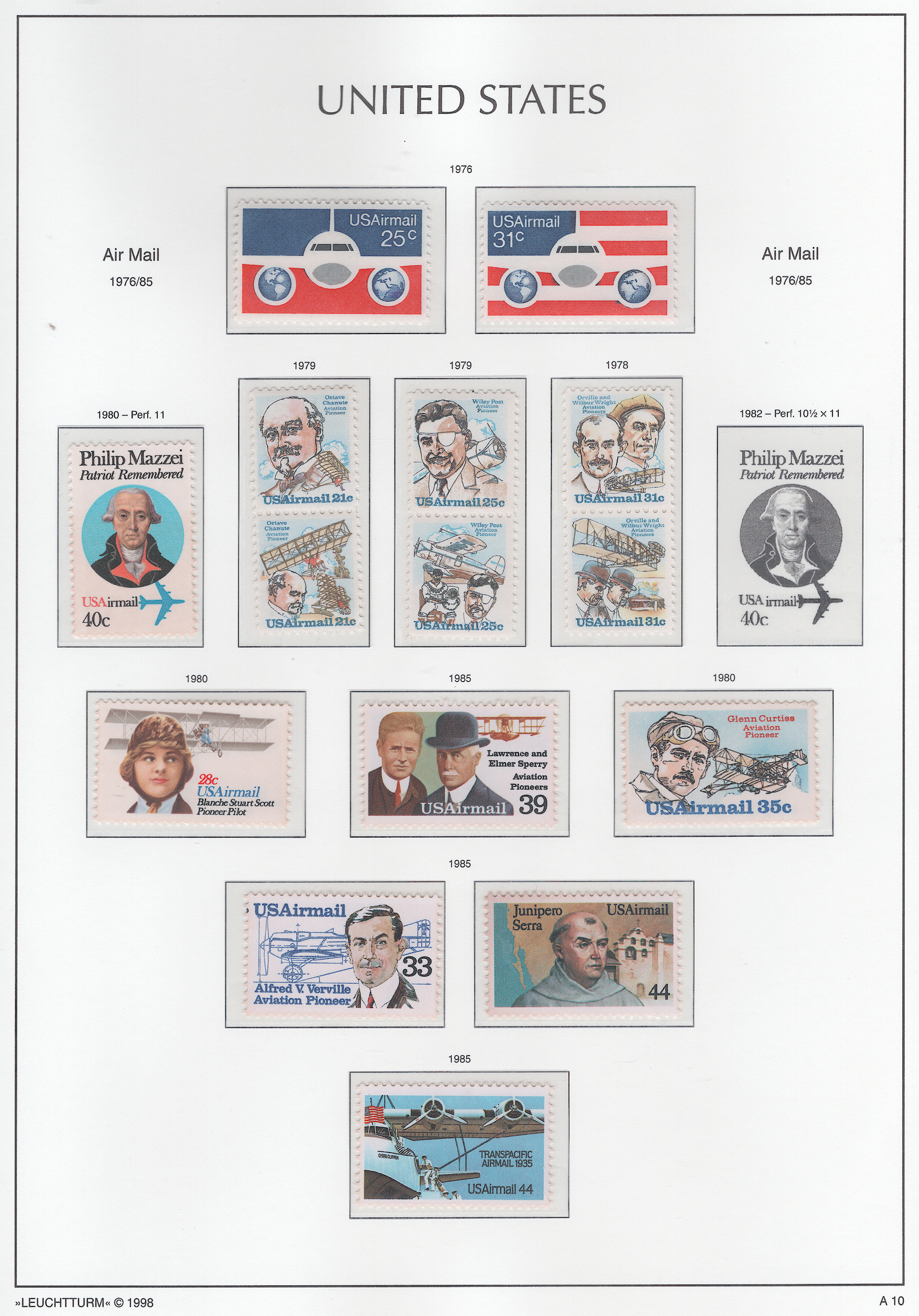
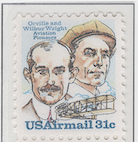
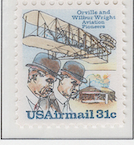
Wilbur Wright and Orville Wright, known as the Wright Brothers were born in the late 1800s and were primarily from Dayton, Ohio. By nature, they were engineers and industrious. Although they were four years apart and had a few siblings, the two of them were close given their mechanical acumen.
As teenagers, they designed and built a printing press and started a couple weekly newspapers. One was edited by Wilbur, the elder brother, and the other was edited by Paul Laurence Dunbar a friend of theirs from Dayton. That business went pretty well for a while, but it wasn’t their calling.
With the invention of the safety bicycle – a bicycle that used a drive chain (see the Penny-Farthing album page) – bicycles became very popular. The Wright brothers decided in 1892 to start a business designing and building bicycles. They were fairly successful for many years running the Wright Cycle Company.
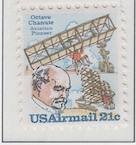
In 1896, the French engineer, Octave Chanute, working with several other engineers, created gliders with some success. The Secretary of the Smithsonian Institute, Samuel Langley the same year designed a steam powered, unmanned glider. Most of all, the work of the German aeronautics engineer, Otto Lilienthal fascinated the Wright Brothers. However, when Lilienthal died that year while trying to fly a glider, they were moved to continue his work.
Using the money they were earning from their bicycle business, they began researching and experimenting to one day make a heavier-than-air, engine-powered manned aircraft – as opposed to a balloon, which is made lighter than normal air. They built several manned gliders, using Lilienthal’s designs and concepts as a starting point. They experimented with different materials, various wing designs, several ideas for small engines and propellers, various rudders and controls – using what they learned from designing and making bicycles. They wrote many articles and papers on what they learned and interacted with many others in the U.S. and in Europe that were working on meeting the challenge to invent an airplane. After about seven years, on December 17, 1903 in North Carolina, Orville flew the Wright Flyer for a short, sustainable flight. There’s a great photograph of this world changing event.

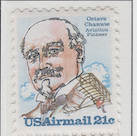
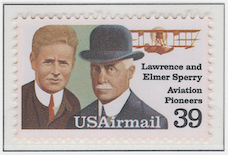
You can see a pair of stamps of Chanute on the second row on this album page. On the same row is a pair of stamps of the Wright Brothers. There are other stamps commemorating the Wright brothers: one from 1928 (see the bottom of page 28); another from 1949 (see the end of the second row of page A6).
Note
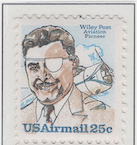
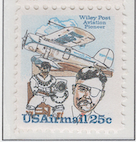
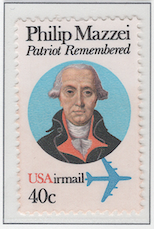
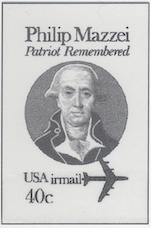
This page is missing one stamp, the second stamp of Philip Mazzei. It’s almost identical to the first one on that same row, except that the perforation is little different, and the USA in red is printed too high; the A of USA isn’t in line with the text, irmail to complete the word.
Contains 16 spots: own 15 – 15 unused, 0 used.
Album or Web Page Last changed May 14, 2025
Stamp Details
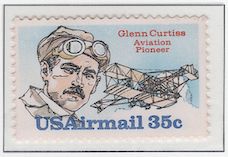
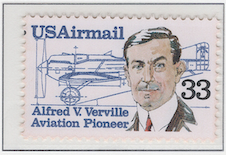
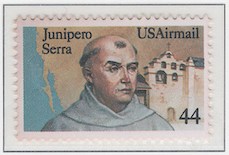
The table below lists information about the stamps shown on this page of Lighthouse’s stamp album. For more details about a particular stamp, click on its description. That will take you to the related web page of Colnect.
spot |
own |
catalog |
subject |
description |
comment |
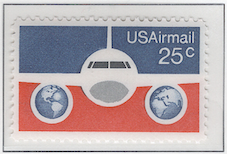
Other Air Mail
✓ |
C89 |
25¢ (jan 1976) |
|||
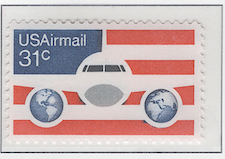
✓ |
C90 |
31¢ (jan 1976) |
Aviators & Aviation
✓ |
C93 |
21¢ (mar 1979) |
|||
✓ |
C94 |
21¢ (mar 1979) |
|||
✓ |
C95 |
25¢ (nov 1979) |
|||
✓ |
C96 |
25¢ (nov 1979) |
|||
✓ |
C91 |
31¢ (sep 1978) |
|||
✓ |
C92 |
31¢ (sep 1978) |
U.S. Revolution Heroes
✓ |
C98 |
40¢ (oct 1980) |
|||
C98A |
40¢ (oct 1982) |
Aviators & Aviation
✓ |
C99 |
28¢ (dec 1980) |
|||
✓ |
C114 |
39¢ (feb 1985) |
|||
✓ |
C100 |
35¢ (dec 1980) |
|||
✓ |
C113 |
33¢ (feb 1985) |
Other Air Mail
✓ |
C116 |
44¢ (aug 1985) |
|||
✓ |
C115 |
44¢ (feb 1985) |
Footnotes
Spot refers to the postion of the stamp on the album page (e.g., 3.2 indicates row 3, position 2).
Amt. is an abbreviation for the face amount of the stamp.
Own indicates the stamp status: ✓ for unused; ✗ for used or canceled; ⭑ signifies I ordered one; ; ✨ indicates it was bought recently; ✠ means an auction bid is pending; and ◎ is used, and it costs too much for unused.
To search by catalog number, go to the search box and enter it in the catalog number box. However, it’s a bit broken; I need to fix it.















