Greece
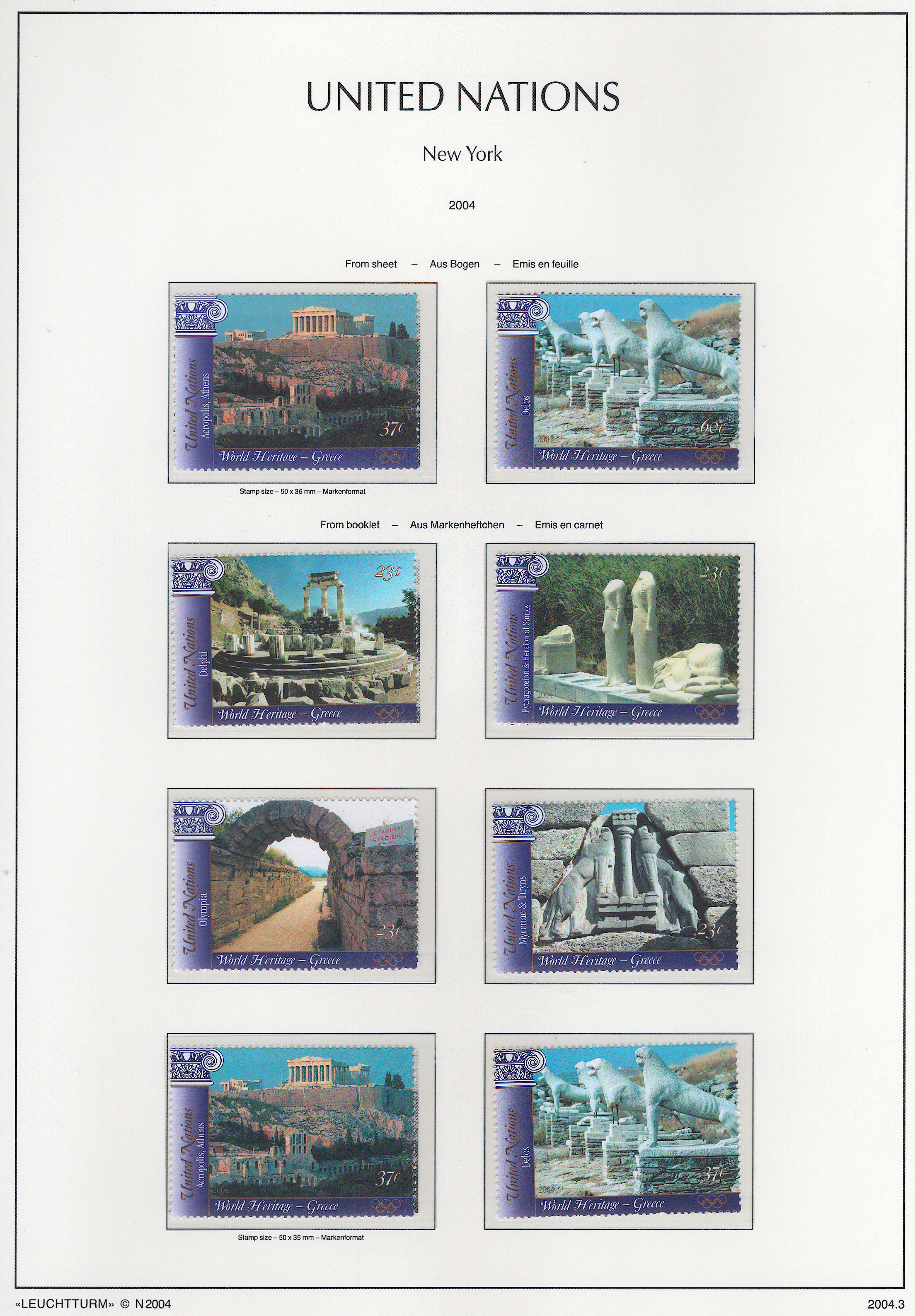
Greece has twenty World Heritage sites. These stamps commemorate just six of them. The first two stamps were sold in sheets of individual stamps. Whereas the other six were sold in a booklet with images and text describing the sites.
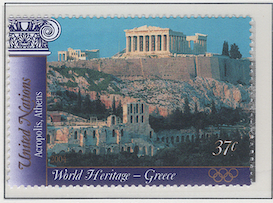
Acropolis of Athens
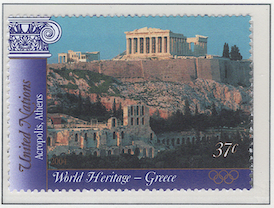
The Acropolis in Athens is an ancient citidel built at the top of a rocky hill, above Athens. The name means, highest city in Greek. There are artifacts that were found there from thousands of years ago. The ruins of most of the remaining buildings were constructed in the 400s b.c.e. I’ve been to Athens and their acropolis. It’s spectacular, although there is plenty of debris. I wish there was a way to restore it. I would like to see how it originally looked.
Delos
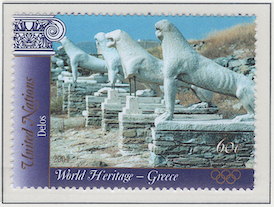
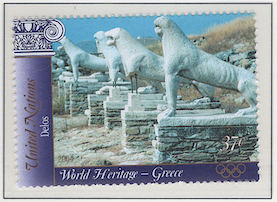
Delos is a small Greek island with a history and archaelogical finds date back thousands of years, over a thousand years before the origin of Greek mythology. It was made a World Heritage site because it conveyed the image of a great cosmopolitan Mediterranean port, and because of its influence on Greek architecture. The stamp for this site shows statues of lions, known as the Terrace of the Lions from 600 b.c.e.
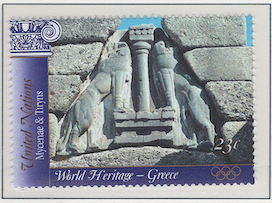
Mycenae & Tiryns
Mycenae and Tiryns are neighboring cities in ancient Greece. Mycenae was the headquarters of the military at the time. Tiryns was said to have been the home of Hercules, the half man and half god, son of Zeus. The stamp for this site shows a column with two carved lions, called the Lion Gate.
Delphi
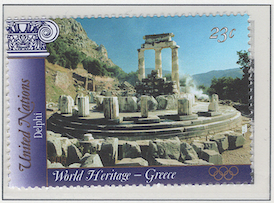
The Delphi is an ancient place of worship. It was considered to be the center of the world by the anciennt Greeks. Delphi was the name of a she-serpent god – her name is derived from womb. She along with the serpeant god, Python lived there – his name is derived from to rot. Delphi was meant to be a great oracle the Greeks consulted. There are still ruins of temples, a theater, and a race course. In the picture shown on the stamp for this site, is the center point which is known as the navel of Delphi.
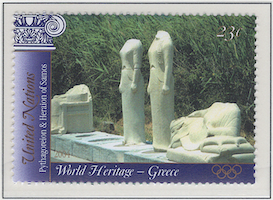
Samos
The island of Samos is located in the eastern part of the Aegian Sea, not far from the coast of Turkey. The Greek geometrist, Pythagoras was from Samos. It has special meaning to me as my step-father’s family came from there – his parents were born in Samos. I remember as a boy two things that I didn’t understand at the time: his brother-in-law used to make snide remarks about him and sister having descended from Samos; and his aunt used liked Turkish music – she had secretively several Turkish 78-records. The criticism seems to have stemmed from a prejudice of Samos being in part and at times a Turkish island: the Greeks don’t generally like Turks. The aunt like Turkish music because she lived most of her life in a semi-Turkish or at least a Turkish influence commmunity. She was secreative because she knew that other Greeks didn’t approve. It’s interesting what we’re able to deduce decades later.
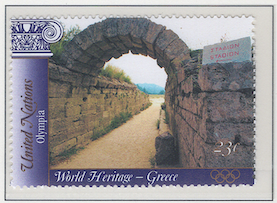
Olympia
Olympia was an ancient religious site dating back nearly three thousand years. It’s also the site of the famous, original Olympic Games. The stamp commemorating Olympia shows a walk way with an arch that leads to the entrance of the stadium where the games were performed. This entrance was for the atheletes who competed.
Note
These stamps could have a better design. I don’t particularly like stamps that are primarily photographs. They could eliminate the column on the left border to be able to show more of the site. They could alsoo get an artist to draw something to highlight the grandeur of places depicted. This would especially be good for showing ruins.
Contains 8 spots: own 8 – 8 unused, 0 used.
Page is finished.
Album or Web Page Last changed Nov 17, 2025
Stamp Details
The table below lists information about the stamps shown on this page of Lighthouse’s stamp album. For more details about a particular stamp, click on its description. That will take you to the related web page of Colnect.
spot |
own |
catalog |
subject |
description |
comment |
World Heritage Site
✓ |
866 |
37 (aug 2004) |
|||
✓ |
867 |
60 (aug 2004) |
|||
✓ |
868a |
23 (aug 2004) |
|||
✓ |
868b |
23 (aug 2004) |
|||
✓ |
868c |
23 (aug 2004) |
|||
✓ |
868d |
23 (aug 2004) |
|||
✓ |
868f |
37 (aug 2004) |
|||
✓ |
868e |
37 (aug 2004) |
Footnotes
Spot refers to the postion of the stamp on the album page (e.g., 3.2 indicates row 3, position 2).
Amt. is an abbreviation for the face amount of the stamp.
Own indicates the stamp status: ✓ for unused; ✗ for used or canceled; ⭑ signifies I ordered one; ; ✨ indicates it was bought recently; ✠ means an auction bid is pending; and ◎ is used, and it costs too much for unused.
To search by catalog number, go to the search box and enter it in the catalog number box. However, it’s a bit broken; I need to fix it.








No Covers Found.