Republic of China
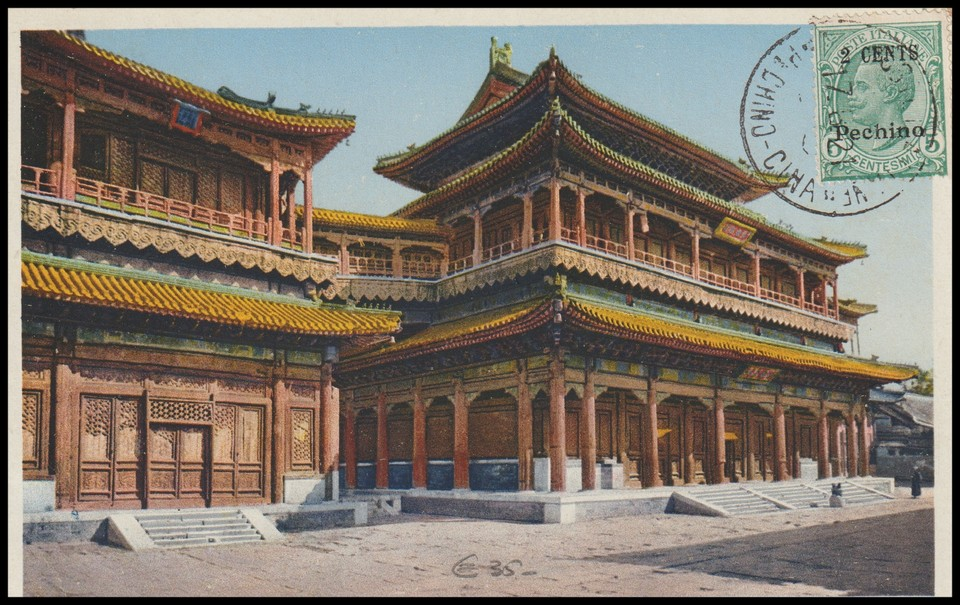
The Republic of China began in 1912, when the Xinhai Revolution ended about 2,000 years of imperial rule. It started on October 10, 1911, with an uprising in Wuchang, and on January 1, 1912, Sun Yat-sen was elected the first provisional president. However, real power sat with Yuan Shikai, who controlled the Beiyang Army, so Sun agreed to let Yuan lead a government in Beijing. Yuan dissolved the Kuomintang (the Chinese Nationalist Party) in 1913, declared himself emperor in December 1915, and gave that up in March 1916 under pressure from rebellion. After he died that June, warlords fought over the Beijing government. Italy was already in China by then. After the Boxer Rebellion, it received a small concession in Tianjin on September 7, 1901. In 1917, Italy opened post offices there and in Beijing (Pechino in Italian), and their stamps were regular Italian stamps overprinted with the city names. In 1918, some were overprinted again with values in Chinese currency. Meanwhile, Sun built a rival government in Guangzhou with Soviet help, and in 1926 Chiang Kai-shek launched the Northern Expedition against the northern warlords.
By 1928, all of China was at least nominally under Chiang’s Nationalist government in Nanjing, and Italy’s ties to it were unusually close in the early 1930s. Galeazzo Ciano, Mussolini’s son-in-law, was the Italian consul in Shanghai from 1930 to 1933. Italy then sent an air mission to China under General Roberto Lordi, and in 1934 a joint Sino-Italian aircraft factory was set up in Nanchang. However, Japan seized Manchuria on September 18, 1931, and open war began on July 7, 1937. Nanjing fell that December, so the government moved to Chongqing. Italy eventually sided with Japan by recognizing its puppet governments in Manchuria and Nanjing, so China cut off relations in July 1941. On December 9, 1941, China declared war on Italy, Germany and Japan. After Italy’s armistice with the Allies, Japan occupied the Italian concession in Tianjin on September 10, 1943. Japan surrendered in 1945 and the civil war resumed in 1946. On February 10, 1947, Italy formally returned the concession to the Republic of China. The Communists took Beijing in January 1949 and founded the People’s Republic of China on October 1, 1949, and on December 7, 1949, Chiang proclaimed Taipei the temporary capital of the Republic of China.
On Taiwan, the Kuomintang ruled as a one-party state under martial law, which followed the February 28, 1947 incident, in which many Taiwanese were killed and thousands imprisoned. The government carried out land reform in the 1950s, and the economy grew into one of the Four Asian Tigers. In 1971, the United Nations gave China’s seat to the People’s Republic. Chiang died on April 5, 1975, and martial law ended in 1987 under his son Chiang Ching-kuo. His successor Lee Teng-hui was the first native Taiwanese president, and the first direct presidential election was held in 1996. In 2000, Chen Shui-bian of the Democratic Progressive Party won, ending the Kuomintang’s long run as the ruling party. Since then, the presidency has passed to Ma Ying-jeou in 2008, Tsai Ing-wen in 2016 and William Lai Ching-te in January 2024.
Note
This is another set of expansion pages. I recently designed these pages as part of my attempt to create all of the album pages I need for all of the remaining Italian stamp there were. I’m starting to think I’m being naive in thinking it’s possible to do this. I’m not allowing for errors and oddities. I’m not including stamps used in Italy that were issued by occupying troops – except for the Italian Socialist Republic, which was controled by the Germans. I’m pretty sure I have all of the stamps from Italian post offices abroad. But every time I think I’m almost finished adding pages, I discover some occupied territory where Italians were selling stamps in their name and with the king’s image on them.
For now, I keep plodding along in the hopes it’ll end soon. I’m not even printing the pages yet. I’ll do that later. Then I’ll mount the stamps and scan the pages to repost here. I don’t have many of the stamps for these new albums, just a few of most of them. Some I suspect are quite expensive. So I may never have them. Maybe my heirs will complete the albums. That’s every collector’s dream and false illusion. It never happens. We’re just temporary curators. Our heirs only sell our collections, not continue them.
Contains 0 spots: own 0 – 0 unused, 0 used.
Page is finished.
remaining stamps & stories in sub-album
page |
story |
note |
used |
need |
ordered |
|---|---|---|---|---|---|
18 |
|||||
14 |