The Air Mail Act of 1930
In the 1920s, there were many small airlines, some providing passenger service, and most providing cargo and mail service within their regions. There were only a few that provided air service to longer router crossing several states, or even had aircraft for longer routes. Because of the Great Depression, at the end of the 1920s and the start of the 1930s, most airlines were faltering and would not survive financially. Air mail service was expensive and used only by the rich. Plus, it was becoming very unreliable: sometimes taking longer than ground transpotation.
Given the situation, the U.S. Congress and President Herbert Hoover passed and signed the Air Mail Act of 1930. The Act empowered the U.S. Postmaster General – at that time, it was Walter Folger Brown – to negotiate and award exclusive contracts to financially stable airlines for providing dependable and regular mail service across the country.
The Act of 1930 allowed Brown to structure the contracts for fixed payments per flight, regardless of how much mail was carried – previous contracts were based on the weight of the mail carried. This was a subsidy that paid more funds to the airlines to ensure that mail service would become dependable, regardless of how few letters were sent each day. Otherwise, air mail might have to wait a couple of days until there was enough mail to justify a flight. It also meant that airlines could profit by having larger aircraft that had a cabin for passengers and had a cargo hold for mail. This led to the expansion of passenger travel in the U.S. This was Brown’s intention and why he awarded contracts only to air carriers with larger planes that had the latest technology for navigation and safety. In hand with these requirements, Brown awarded contracts only to firms with the financial stability and size to be able to handle the routes he would assign them. Only three airlines received contracts from him for the whole country.
This technocratic method was not very democratic and it was questionable as to whether it was capitalistic. It excluded the smaller airlines from participating, many of which either went out of business or merged into the larger airlines. It wasn’t based on market forces, other than which companies had achieved the size and financial strength during more free market times. However, within two years, as a result of the new program, the amount of money paid for air mail postage stamps doubled. The number of passengers, though, tripled – including the same for the amount of miles traveled and the number of airline employees. It was a success for the country and the public and for the Post Office.
Nevertheless, in 1934, during the Franklin Roosevelt administration, members of Congress, the press, and the public complained that the contract awarding process was unfair and there may have been some abuse. This air mail scandal led to the cancelation of the contracts. At first, the U.S. Army Air Corps were assigned the duty of deliverying the mail. They were very inefficient and didn’t have the aircraft to handle the load. It led to disruption in mail service and the deaths of several pilots who crashed because of unfamiliarity of the cargo (i.e., misbalanced loads). In response, a new act of Congress was passed and new long-term contracts were given to supposedly new airlines. In essence, the three airlines were reconfigured and renamed – with some spinning off aircraft manufacturing (e.g., Boeing). The result was that five airlines were awarded contracts. They would become known as American Airlines, Northwest Airlines, Eastern Airlines, United Airlines, and what would become, Transworld Airlines. The Air Mail Acts of 1930 and 1934 solidified the airline industry in the U.S.
The Curtiss Jenny
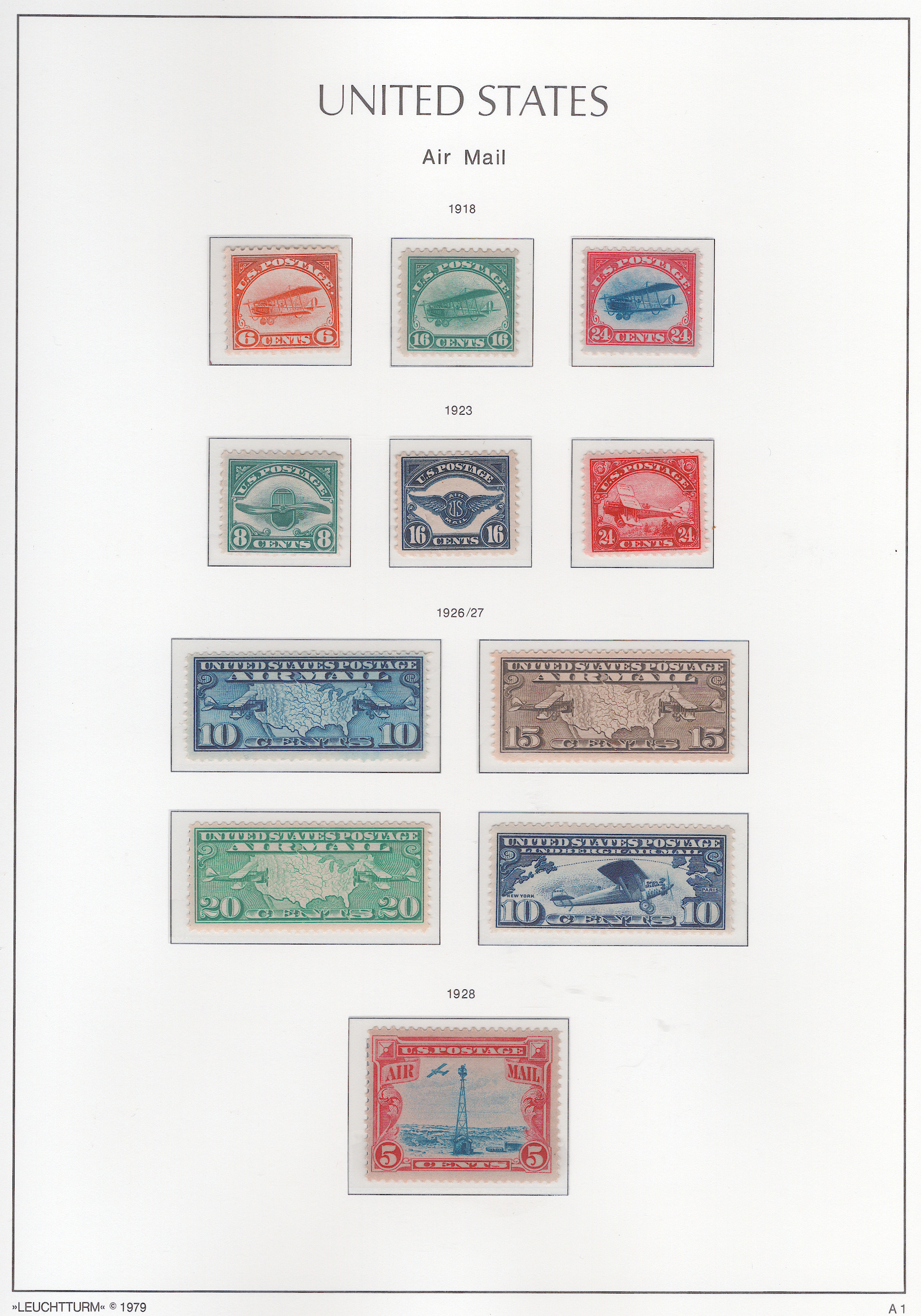
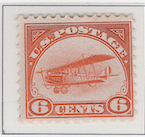
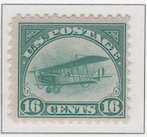
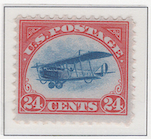
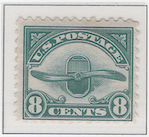
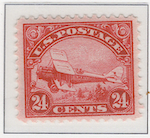
The Curtiss JN airplanes – known as the Jenny from the slurring of the two letters of the model – were built by the Glenn Curtiss Aeroplane Company. The planes shown in the three stamps on the top row are of a Curtiss JN-4, an improved model. Originally, the planes were built and used for training new pilots, it being a simple design – much like dingy row boats are used to learn basic boating, and day sailers are used to train someone in the basics of sailing. With some modifications, the planes were used by the U.S. Post Office for the first air mail delivery service.
The first flight providing U.S. mail service was in May 1918 from Washington, D.C. to New York, stopping in Philadelphia – I guess to refuel. President Woodrow Wilson, the Postmaster General, Albert Burleson, and future president Franklin Roosevelt – he was then Assistant Secretary of the Navy – were there for the inaugeral flight of air mail service. However, the pilot got lost in a fog and it ended quickly. Two days later they tried again and were successful.
Notice the dates and face amounts of each of the first three stamps. The first stamp issued in May 1918 was catalog number C3, at a price of twenty-four cents: that was because the cost of mailing a letter was two cents, the additional cost of air mail service was set at twelve cents, and then for special delivery once the plane landed to the recipient was another ten cents – for a total of twenty-four cents.
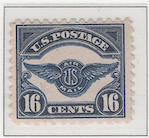
In July 1918, they lowered the price to a total of sixteen cents and issued a new stamp for that amount, catalog number C2 here – incidentally, catalog numbers are set sometime afterwards and not always based on date of issuance, but sometimes based on ascending amounts when the design is the same. In December 1918, a new stamp was issued when special delivery became optional: just six cents for a letter sent by airmail that would be delivered at the destination with the regular mail on the day the flight arrived.
Note
Although I have none of these stamps – they were too expensive for me when I was young and I only recently bought the album pages for these early air mail stamps – I purchased all of them this month. I’m waiting to receive them in the mail from the American Philatelic Society – I’ve been a member, incidentally, since 1985. APS has a store front on Hip Stamps’s site that I discovered last summer. It works pretty well and the prices are good.
Contains 11 spots: own 11 – 11 unused, 0 used.
Page is finished.
Album or Web Page Last changed Apr 4, 2025
Stamp Details
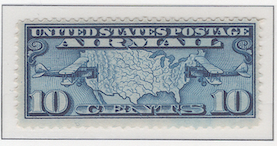
The table below lists information about the stamps shown on this page of Lighthouse’s stamp album. For more details about a particular stamp, click on its description. That will take you to the related web page of Colnect.
spot |
own |
catalog |
subject |
description |
comment |
|---|---|---|---|---|---|
✓ |
C1 |
6¢ (dec 1918) |
|||
✓ |
C2 |
16¢ (jul 1918) |
|||
✓ |
C3 |
24¢ (may 1918) |
|||
✓ |
C4 |
8¢ (aug 1923) |
|||
✓ |
C5 |
16¢ (aug 1923) |
|||
✓ |
C6 |
24¢ (aug 1923) |
|||
✓ |
C7 |
10¢ (feb 1926) |
|||
✓ |
C8 |
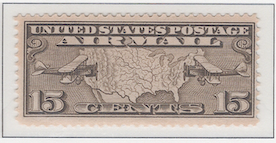
15¢ (sep 1926) |
|||
✓ |
C9 |
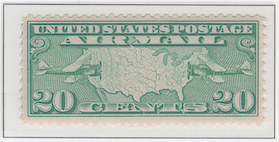
20¢ (jan 1927) |
|||
✓ |
C10 |
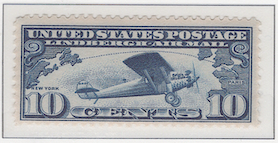
10¢ (jun 1927) |
|||
✓ |
C11 |
5¢ (jul 1928) |
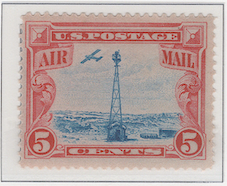
Footnotes
Spot refers to the postion of the stamp on the album page (e.g., 3.2 indicates row 3, position 2).
Amt. is an abbreviation for the face amount of the stamp.
Own indicates the stamp status: ✓ for unused; ✗ for used or canceled; ⭑ signifies I ordered one; ; ✨ indicates it was bought recently; ✠ means an auction bid is pending; and ◎ is used, and it costs too much for unused.
To search by catalog number, go to the search box and enter it in the catalog number box. However, it’s a bit broken; I need to fix it.










