Yugoslavian Scenes
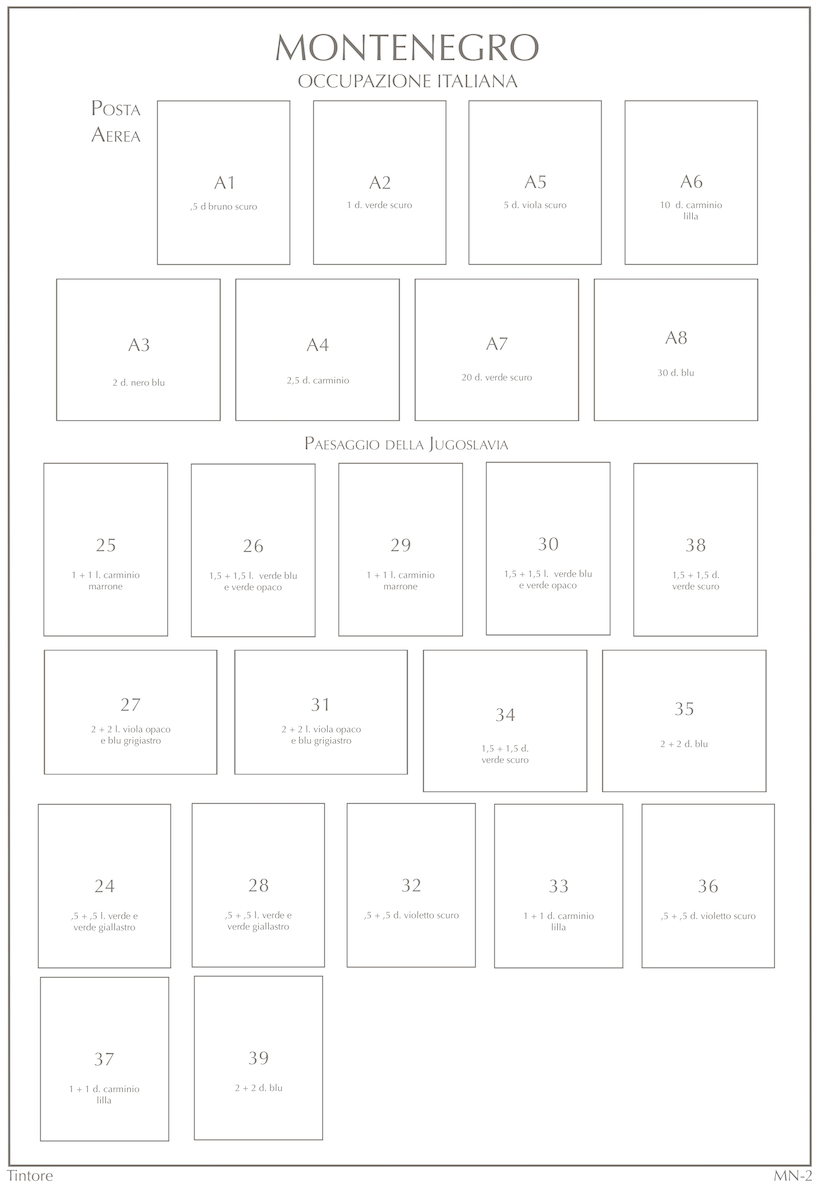
These stamps were originally made for use all over Yugoslavia, not just the Italian occupied zones. They include scenes elsewhere in the country. Here are some descriptions of just a few of the places depicted.
Rab Island
Rab (Arbe in Italian) is an island in the Adriatic Sea, just off the northern coast of Croatia. It is part of Primorje-Gorski Kotar County and is about 22 kilometers long, with an area of 93.6 square kilometers. The island was first mentioned in a Greek source from around 360 BC, which called it Arba. During the Middle Ages it was one of the Dalmatian city-states and later came under the Republic of Venice. After World War II it was part of Yugoslavia until Croatia became independent in 1991. Today it has about 7,100 inhabitants and is popular with tourists for its beaches and medieval festival.
St. John at Kaneo Church
The Church of St. John at Kaneo (Sveti Jovan Kaneo in Macedonian) is a Macedonian Orthodox church in the city of Ohrid, in what is now North Macedonia. It sits on a cliff over Kaneo Beach and looks out across Lake Ohrid. The church is dedicated to John of Patmos, the writer of Revelation, who is also called John the Theologian. It is typically dated to the 13th century and is built in the Middle-Byzantine style. Inside, a fresco of Saint Clement of Ohrid can be seen along with one of Saint Erasmus. Macedonia was one of the republics of Yugoslavia, which is why this church, now a symbol of Ohrid, belongs in the collection.
Sarajevo
Sarajevo is the capital of Bosnia and Herzegovina. It first drew the world’s attention in 1914, when the assassination of Archduke Franz Ferdinand there set off World War I. That ended Austro-Hungarian rule in Bosnia and led to the creation of the Kingdom of Yugoslavia. Under Socialist Yugoslavia the city grew from about 115,000 people after the war to over 429,000 by the end. The high point came with the 1984 Winter Olympics, held February 8 to 19. It was the first Winter Olympics in a Slavic-language country, and Yugoslavia won its first Winter medal there when Jure Franko took silver in the giant slalom. However, the Yugoslav Wars brought the longest siege of a capital city in modern history, lasting 1,425 days from April 1992, and the Olympic facilities were heavily damaged as well.
Note
The layout of this page is not very symetrical. Look at the fourth row. It has two stamps on the left of one size and two on the right of another size. Then I have two extra stamps by themselves, not centered on the bottom row. This is just a starting point. Once I get some of these stamps, I’ll redo the layout of all of the pages.
Contains 24 spots: own 0 – 0 unused, 0 used.
Stamp Details
The table below lists information about the stamps shown on this page of Lighthouse’s stamp album. For more details about a particular stamp, click on its description. That will take you to the related web page of Colnect.
spot |
own |
catalog |
subject |
description |
comment |
|---|---|---|---|---|---|
A1 |
0.50din (jun 1941) |
||||
A2 |
1din (jun 1941) |
||||
A5 |
5din (jun 1941) |
||||
A6 |
10din (jun 1941) |
||||
A3 |
2din (jun 1941) |
||||
A4 |
2.50din (jun 1941) |
||||
A7 |
20din (jun 1941) |
||||
A8 |
30din (jun 1941) |
||||
25 |
1+1₤ (jan 1942) |
||||
26 |
1.50+1.50₤ (jan 1942) |
||||
29 |
1+1₤ (jan 1942) |
||||
30 |
1.50+1.50₤ (jan 1942) |
||||
38 |
1.50+1.50din (jan 1942) |
||||
27 |
2+2₤ (jan 1942) |
||||
31 |
2+2₤ (jan 1942) |
||||
34 |
1.50+1.50din (jan 1942) |
||||
35 |
2+2din (jan 1942) |
||||
24 |
St. Peter Cemetery |
0.50+0.50₤ (jan 1942) |
|||
28 |
St. Peter Cemetery |
0.50+0.50₤ (jan 1942) |
|||
32 |
Ohrid Lake |
0.50+0.50din (jan 1942) |
|||
33 |
1+1din (jan 1942) |
||||
36 |
Ohrid Lake |
0.50+0.50din (jan 1942) |
|||
37 |
1+1din (jan 1942) |
||||
39 |
2+2din (jan 1942) |
Footnotes
Spot refers to the postion of the stamp on the album page (e.g., 3.2 indicates row 3, position 2).
Amt. is an abbreviation for the face amount of the stamp.
Own indicates the stamp status: ✓ for unused; ✗ for used or canceled; ⭑ signifies I ordered one; ; ✨ indicates it was bought recently; ✠ means an auction bid is pending; and ◎ is used, and it costs too much for unused.
To search by catalog number, go to the search box and enter it in the catalog number box. However, it’s a bit broken; I need to fix it.























