Bicentennial
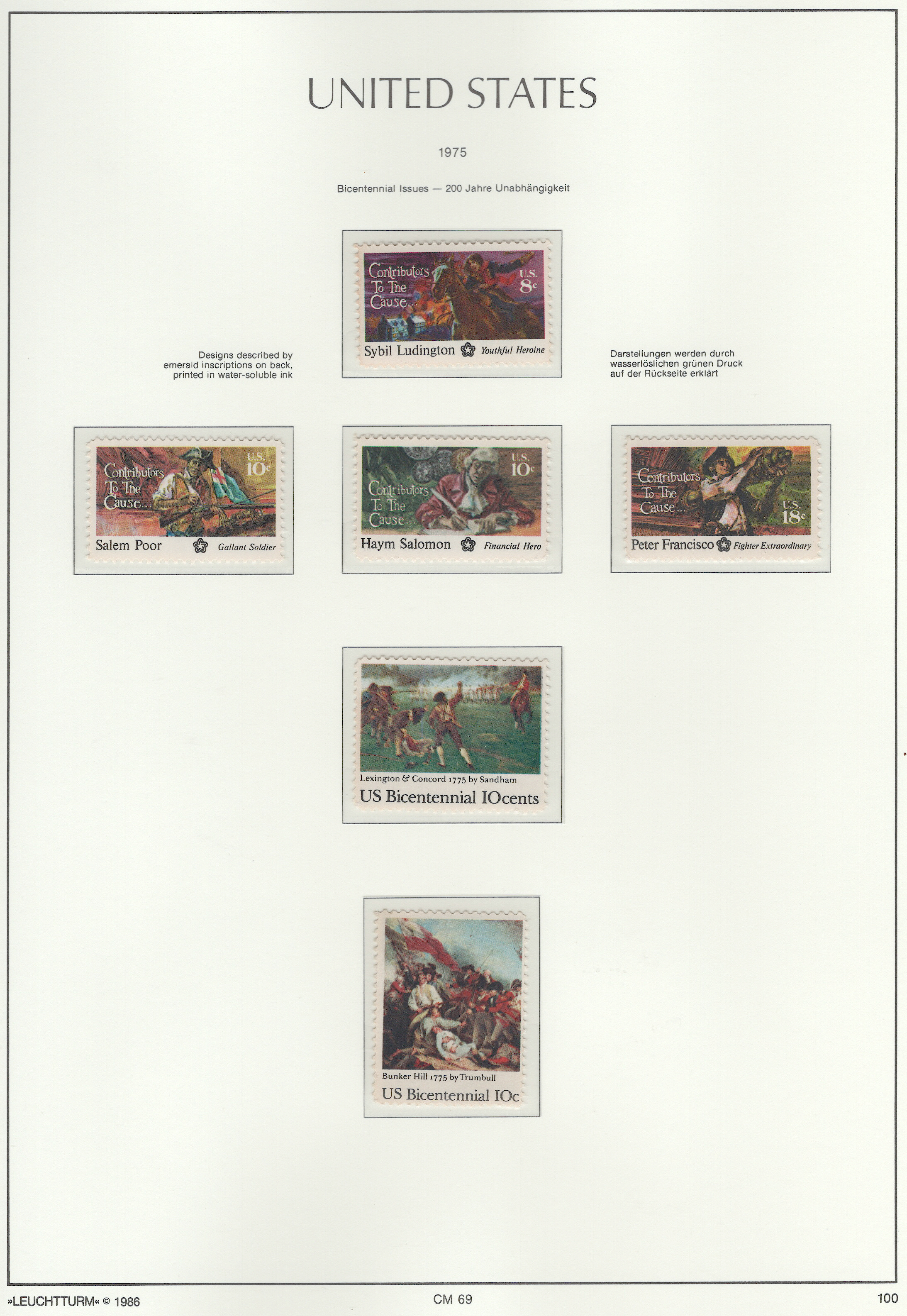
When I was a boy at school, I remember the teachers telling us about the coming of the bicentenial. Before then, I didn’t have much of a sense of history. Coming from Louisiana, I remembered hearing of the history of the U.S. Civil War. It started in 1861 and I was born in 1961, during the hundredth anniversary of that event. History classes on Christopher Columbus and the Civil War had penatrated my consciousness, but the start of the United State had some how evaded me at that age – until these stamps were issued and my teachers started talking about the bicentenial.
The stamp in the middle depicting a schene from the Battle of Lexington and Concord, is part of a larger painting by Henry Sandham. You can see more of this paintin, but not in multi-color, on a U.S. stamp from 1925, You see it on the Lexington-Concord album page, where a brief history of that battle is given.
Patriot Mix
The first set of stamps of the bicentenial were meant to show that average people, as well as people from diverse backgrounds contributed to the success of the American Revolution. The first stamp is Sybil Ludington, a girl who at the age of sixteen rode her horse forty miles to notify her father and his troops of an attack in their hometown in New York. She was called the girl version of Paul Revere. This story has been questioned since there is almost nothing to support it in contempoary accounts of the battle, only a comment in writting by her grandson long after her.
The second stamp is of an African American soldier, a former slave, Salem Poor. He managed to buy his freedom and joined the Continental Army. He fought at the Battle of Bunker Hill and in other battles.
The next stamp is of a Jewish American financier, Haym Salomon. Although he had only recently emigrated to the colonies from Eastern Europe at the start of the war, Saolomon helped financially. He loaned money to the Continental Army, as well as converted money and other assets from French donations into local currency for use in the war.
The last stamp is of a blacksmith named, Peter Francisco. He was a simple Portugese immigrant who was large and strong, as well as daring. He was very effective in many battles, including accounts of him carrying a heavy cannon out of a battlefield. In later years, he worked as Sergeant-at-Arms in the Virginia state senate. He reminds me of a lictor, a large man in the Roman army that was assigned to carry a huge fasces which was intimidating in battle and when accompanying Senators and leaders in public.
Note
I don’t like the artistic style of these stamps – they were painted by Neil Boyle – but they were instrumental in my education. I did like the two at the bottom depicting battles: one of Lexington & Concord and the other of Bunker Hill.
Contains 6 spots: own 6 – 6 unused, 0 used.
Page is finished.
Album or Web Page Last changed May 5, 2025
Stamp Details
The table below lists information about the stamps shown on this page of Lighthouse’s stamp album. For more details about a particular stamp, click on its description. That will take you to the related web page of Colnect.
spot |
own |
catalog |
subject |
description |
comment |
U.S. Revolution Heroes
✓ |
1559 |
8c (mar 1975) |
|||
✓ |
1560 |
10c (mar 1975) |
|||
✓ |
1561 |
10c (mar 1975) |
|||
✓ |
1562 |
18c (mar 1975) |


Battles & Wars
✓ |
1563 |
Birth of Liberty |
10c (apr 1975) |
||
✓ |
1564 |
Battle of Bunker Hill |
10c (jun 1975) |


Footnotes
Spot refers to the postion of the stamp on the album page (e.g., 3.2 indicates row 3, position 2).
Amt. is an abbreviation for the face amount of the stamp.
Own indicates the stamp status: ✓ for unused; ✗ for used or canceled; ⭑ signifies I ordered one; ; ✨ indicates it was bought recently; ✠ means an auction bid is pending; and ◎ is used, and it costs too much for unused.
To search by catalog number, go to the search box and enter it in the catalog number box. However, it’s a bit broken; I need to fix it.
remaining stamps & stories in sub-album
page |
story |
note |
used |
need |
ordered |
|---|---|---|---|---|---|
Letters (Definitives) |
✓ |
✓ |
1 |
||
Dix & Moller (Definitives) |
✓ |
✓ |
4 |
||
Main Page (Back Pages) |
✓ |
✓ |
1 |
- Declaration
- Maryland Flag
- California Flag
- New States
- Yorktown Surrender
- Independence
- Delaware Crossing
- Valley Forge
- Ochs
- Lafayette
- Pueblo Art
- Captain Cook
- Great Trees
- Owls
- Robert Kennedy
- Boston Statehouse
- Olympics 1980
- Wharton & Perkins
- Northwest People
- Edna St. Vincent Millay
- Siege of Yorktown
- Cacti
- Horatio Alger
- Frank Lloyd Wright
- State Birds
- Brown Pelican
- Cardinals
- Sweden Treaty
- Balloons
- Hawthorne
- Olympics 1984
- Herman Melville
- Scent Hounds
- Louisiana Worlds Fair
- Horses
- Martin Van Buren
- John Tyler
- Garfield & Arthur
- Calvin Coolidge