Slovenia Air
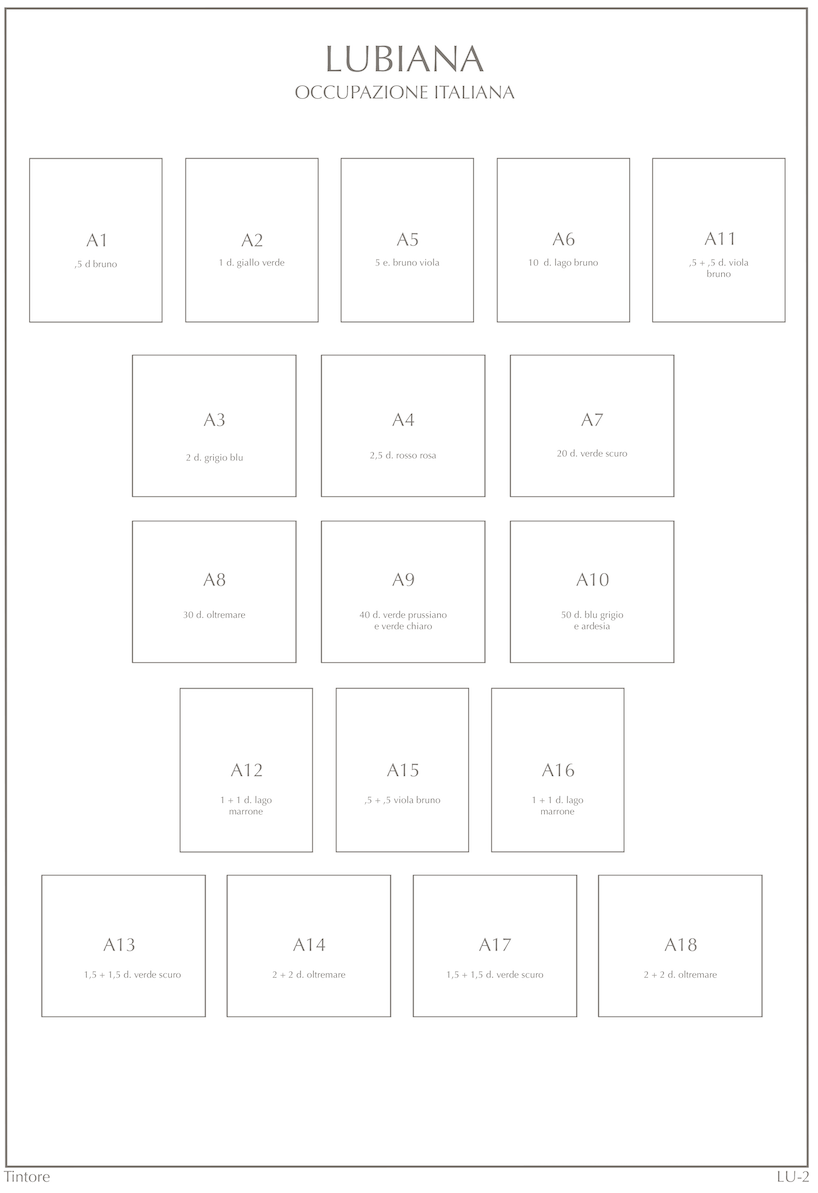
These stamps were used by the Italian occupying government in Slovenia in the early 1940s. They were Yugoslavian stamps, so they depict scenes outside of the Italian occupied area.
Sveti Jovan Church
I’m assuming this is the Church of St. John at Kaneo in Ohrid, which is the one most people mean. In the late 1930s Ohrid was part of the Vardar Banovina in the Kingdom of Yugoslavia. The church, built in the 13th century, sat on a cliff above Lake Ohrid and was still a working Orthodox church, though a small one. In April 1941, after Yugoslavia fell, the town came under Italian occupation as part of the territory attached to Italian-controlled Albania. Bulgaria took over the area after Italy capitulated in 1943. The church is not known to have been damaged in these years, so it was probably left alone while the town around it changed hands.
Rab Island
In the late 1930s Rab was a quiet Adriatic island in the Kingdom of Yugoslavia, known mostly for its old town, its pine woods and its beaches. It was also a small tourist spot. In 1936 King Edward VIII visited the island, which got it some attention abroad. After the invasion in April 1941, Italy occupied Rab and made it part of its Governorate of Dalmatia. In July 1942 the Italians opened a concentration camp there, mainly for Slovenes and Croats as well as some Jews, and conditions in it were very bad. The camp closed after Italy capitulated in September 1943, and the island then went through a period of German and partisan control.
Sarajevo
In the late 1930s Sarajevo was the main city of the Drina Banovina and one of the most mixed cities in Yugoslavia. Muslims, Orthodox Serbs, Catholic Croats and Sephardic Jews all lived there, and mosques, churches and synagogues stood close together. German troops entered the city on April 15, 1941, and it became part of the Independent State of Croatia, a puppet state run by the Ustaša. As a result, Serbs, Jews and Roma were persecuted, and most of the city’s Jewish community was killed during the war. Basically, the mixed city of the 1930s was largely gone by 1945, though the buildings themselves mostly survived.
Note
These stamps, if I had them, you would see that they’re overprinted with the text, R. Commissariato Civile Territori Sloveni occupati Lubiana, which is Italian for Royal Civil Government of the Slovenian Occupied Territories, Ljubljana. That’s a lot of text for such small stamps. It seems to have been the decision of a bureaucrat.
Contains 18 spots: own 0 – 0 unused, 0 used.
Stamp Details
The table below lists information about the stamps shown on this page of Lighthouse’s stamp album. For more details about a particular stamp, click on its description. That will take you to the related web page of Colnect.
spot |
own |
catalog |
subject |
description |
comment |
|---|---|---|---|---|---|
A1 |
0.5d (may 1941) |
||||
A2 |
1d (may 1941) |
||||
A5 |
5d (may 1941) |
||||
A6 |
10d (may 1941) |
||||
A11 |
0.5+0.5d (jun 1941) |
||||
A3 |
2d (may 1941) |
||||
A4 |
2.5d (may 1941) |
||||
A7 |
20d (may 1941) |
||||
A8 |
30d (may 1941) |
||||
A9 |
40d (may 1941) |
||||
A10 |
50d (may 1941) |
||||
A12 |
1+1d (jun 1941) |
||||
A15 |
0.5+0.5d (jan 1941) |
||||
A16 |
1+1d (jan 1941) |
||||
A13 |
1.5+1.5d (jun 1941) |
||||
A14 |
2+2d (jun 1941) |
||||
A17 |
1.5+1.5d (jan 1941) |
||||
A18 |
2+2d (jan 1941) |
Footnotes
Spot refers to the postion of the stamp on the album page (e.g., 3.2 indicates row 3, position 2).
Amt. is an abbreviation for the face amount of the stamp.
Own indicates the stamp status: ✓ for unused; ✗ for used or canceled; ⭑ signifies I ordered one; ; ✨ indicates it was bought recently; ✠ means an auction bid is pending; and ◎ is used, and it costs too much for unused.
To search by catalog number, go to the search box and enter it in the catalog number box. However, it’s a bit broken; I need to fix it.

















