Eritrea Fiftieth
On November 15, 1869, a local chief sold the land around the Bay of Assab to the Italian missionary Giuseppe Sapeto, who was acting for the Rubattino Shipping Company. The area was useful as a coaling station for ships using the new Suez Canal. In 1882 the Italian government took Assab over from the company, and after Egypt withdrew in February 1885 it added Massawa and most of the coastal lowlands. In 1889, after the death of Emperor Yohannes IV left a power vacuum, General Oreste Baratieri occupied the highlands and Italy proclaimed the colony of Italian Eritrea (Colonia Eritrea). The name comes from the Greek word for the Red Sea. That same year Menelik II of Shewa signed the Treaty of Wuchale, which recognized the Italian hold on the highland provinces in return for money and arms.
The Italians started building in 1888, and the railway reached Saati that year and Asmara in 1911. They also put money into farming, added city services in Asmara and Massawa, and hired many Eritreans for the police and public works. Thousands of Eritreans served in the Italian army as well, e.g., in Libya and in the two wars against Ethiopia. Factories followed, making things like pasta, cooking oil, tobacco and building materials, and by 1939 there were about 2,198 of them. The Italian population grew from 4,600 to 75,000 in five years, though the 1931 census had counted only 4,188 Italians out of 600,573 people.
After Mussolini came to power in 1922 the colony changed a lot. In May 1936 Eritrea was enlarged with parts of northern Ethiopia and merged with Italian Somaliland and the just-conquered Ethiopia into Italian East Africa (Africa Orientale Italiana). The Fascist government chose Eritrea as the industrial center of this empire, and Asmara got more than 400 new buildings in the art deco style, such as Cinema Impero, which opened in 1937. This all stopped when Italy entered World War II. In 1941, after the Battle of Keren, the British drove the Italians out and took over the administration of the country.
Note
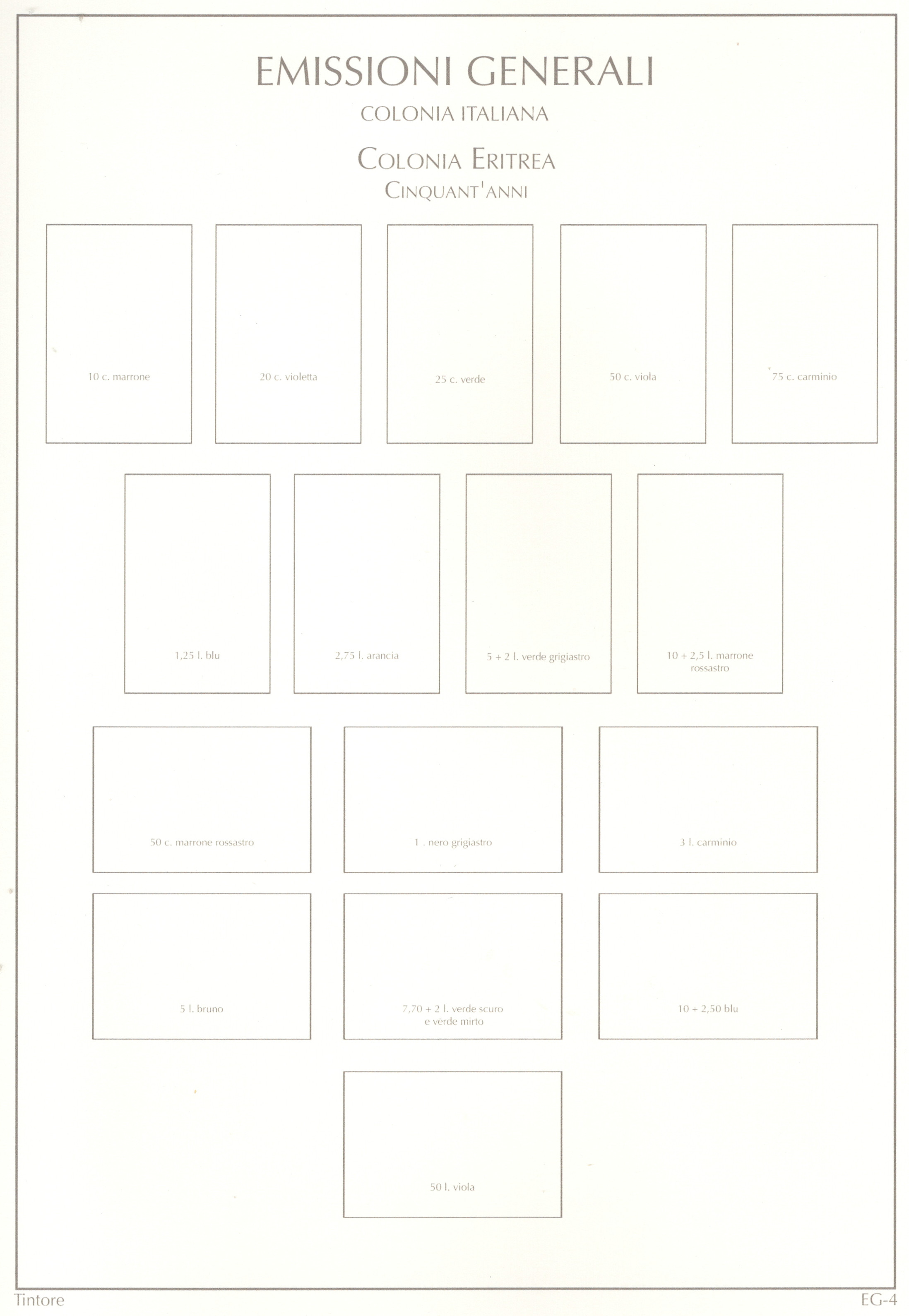
These stamps are meant to commemorate the fiftieth anniversary of the colonization of Erirtrea. They’re not expensive. I just don’t have them yet. This is a new album and album page.
Contains 16 spots: own 0 – 0 unused, 0 used.
Stamp Details
The table below lists information about the stamps shown on this page of Lighthouse’s stamp album. For more details about a particular stamp, click on its description. That will take you to the related web page of Colnect.
spot |
own |
catalog |
subject |
description |
comment |
Eritrea Colony - 50 Years
,23 |
10c (03 1933) |
||||
24 |
20c (03 1933) |
||||
25 |
25c (03 1933) |
||||
26 |
50c (03 1933) |
||||
27 |
75c (03 1933) |
||||
28 |
₤1.25 (03 1933) |
||||
29 |
₤2.75 (03 1933) |
||||
30 |
₤5+2 (03 1933) |
||||
31 |
₤10+2.5 (03 1933) |
Eritrea Colony - 50 Years (Air Mail)
A15 |
50c (03 1933) |
||||
A16 |
₤1 (03 1933) |
||||
A17 |
₤3 (03 1933) |
||||
A18 |
₤5 (03 1933) |
||||
A19 |
₤7.70+2 (03 1933) |
||||
A20 |
₤10+2.5 (03 1933) |
||||
A21 |
₤50 (06 1933) |
Footnotes
Spot refers to the postion of the stamp on the album page (e.g., 3.2 indicates row 3, position 2).
Amt. is an abbreviation for the face amount of the stamp.
Own indicates the stamp status: ✓ for unused; ✗ for used or canceled; ⭑ signifies I ordered one; ; ✨ indicates it was bought recently; ✠ means an auction bid is pending; and ◎ is used, and it costs too much for unused.
To search by catalog number, go to the search box and enter it in the catalog number box. However, it’s a bit broken; I need to fix it.















