Horses
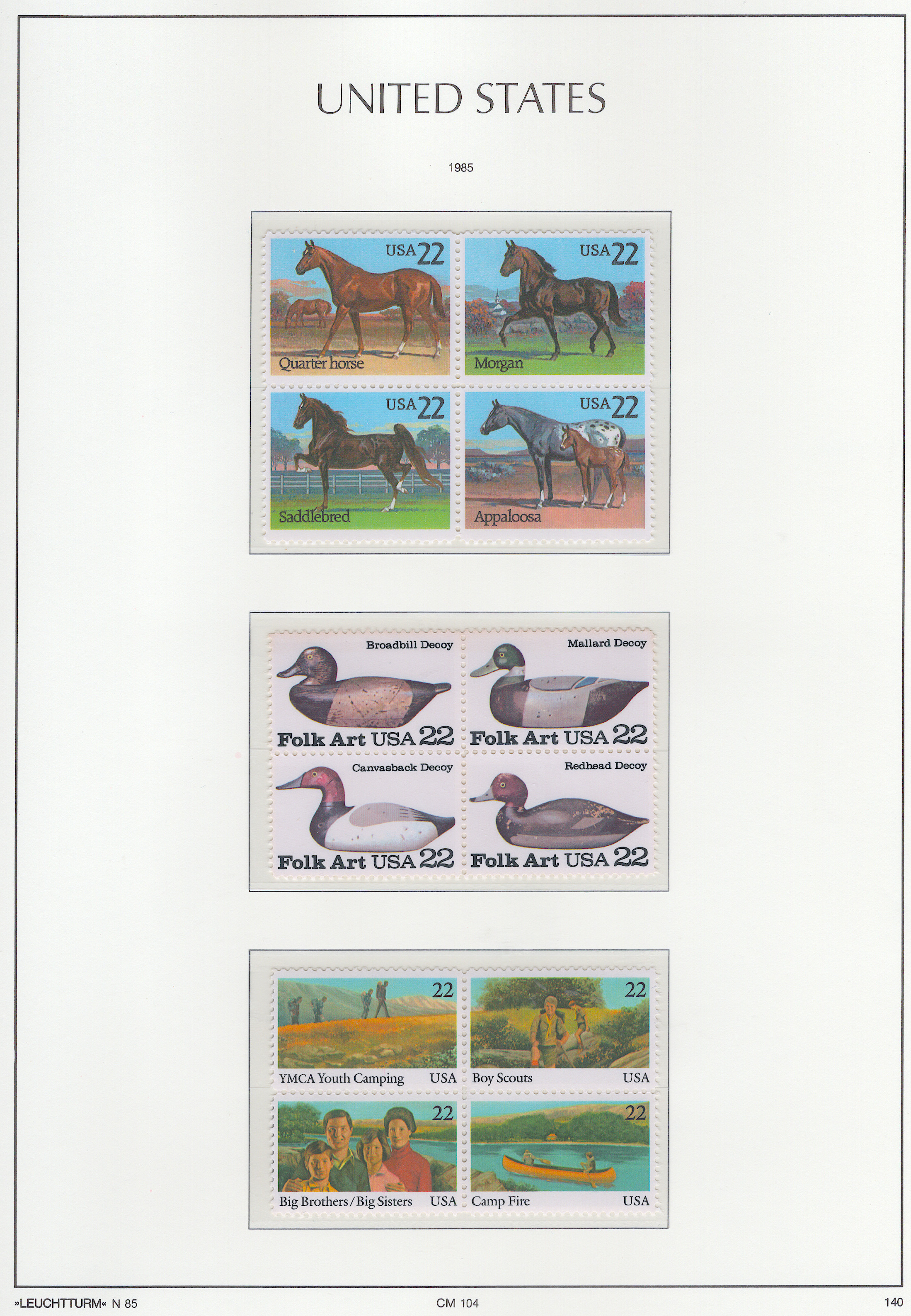
People began domesticating horses about six thousand years ago, so much so that all horses are either domesticated or, if found in the wild, they’re descended from domesticated ones. The set of stamps at the top of this album page show four horse breeds from North America – meaning, they were bred in North America.
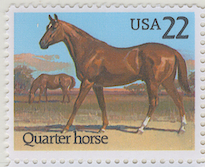
The first stamp shows the American Quarter Horse. This breed is most suited for horse racing since it’s fast for short distances, but not for sustained running. It’s named as such because it’s known for outperforming horses in a quarter-mile race.
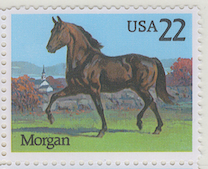
The Morgan Horse is named after one of it’s original breeders, Justin Morgan from the 18th Century. It’s a compact horse that was used to pull wagons by pioneers heading west, and it was used to pull carts in towns, and artillery a during the Civil War.
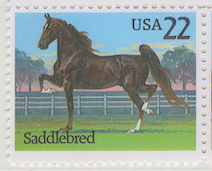
The third stamp is an American Saddlebred. It’s a tall, elegant horse that’s very popular, especially as a show horse. The breed was developed in the U.S. during the time of the American Revolution. One was given as a gift from the Continental Congress to Marie Antoinette, the then Queen of France.
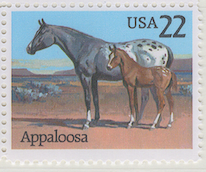
Perhaps the most distintive and diverse horse is the Appaloosa. It’s noted for color patterns that are unique to each horse. The colors include a deviations of gray and brown – varying in hue and darkness. The patterns can be simple spots of varioius sizes with some like a leopard, or large patches looking like a misplaced blanket or saddle. Their color and pattern diversity is what makes this breed so attractive.
Note
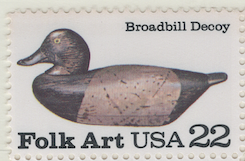
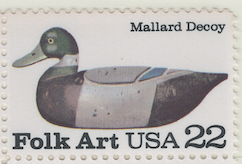
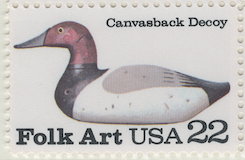
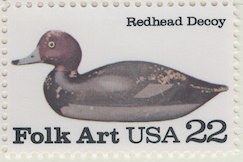
The second set of stamps show duck decoys, carved from wood. I own a Canada Goose decoy that was made in the late 1800s. It’s on one of the bookcases in my home office. I’ve tried carving duck decoys. I thought it would be a neat thing to do. However, I couldn’t do it. I have difficulty creating things that are three-dimensional and don’t follow straight, parallel and perpendicular lines. For instance, although I’ve built several bookcases, I had difficulty once making a corner bookcase with somewhat of rounded L-shaped shelves. It was disturbing to me to design and to cut the wood. The result was pretty bad.
Contains 12 spots: own 12 – 12 unused, 0 used.
Page is finished.
Album or Web Page Last changed May 22, 2025
Stamp Details
The table below lists information about the stamps shown on this page of Lighthouse’s stamp album. For more details about a particular stamp, click on its description. That will take you to the related web page of Colnect.
spot |
own |
catalog |
subject |
description |
comment |
Horses & Equestrian Activities
✓ |
2155 |
22c (sep 1985) |
|||
✓ |
2156 |
22c (sep 1985) |
|||
✓ |
2157 |
22c (sep 1985) |
|||
✓ |
2158 |
22c (sep 1985) |
Folk Art
✓ |
2138 |
22c (mar 1985) |
|||
✓ |
2139 |
22c (mar 1985) |
|||
✓ |
2140 |
22c (mar 1985) |
|||
✓ |
2141 |
22c (mar 1985) |
Scouts & Other Youth Organizations
✓ |
2160 |
22c (oct 1985) |
|||
✓ |
2161 |
22c (oct 1985) |
|||
✓ |
2162 |
22c (oct 1985) |
|||
✓ |
2163 |
22c (oct 1985) |
Footnotes
Spot refers to the postion of the stamp on the album page (e.g., 3.2 indicates row 3, position 2).
Amt. is an abbreviation for the face amount of the stamp.
Own indicates the stamp status: ✓ for unused; ✗ for used or canceled; ⭑ signifies I ordered one; ; ✨ indicates it was bought recently; ✠ means an auction bid is pending; and ◎ is used, and it costs too much for unused.
To search by catalog number, go to the search box and enter it in the catalog number box. However, it’s a bit broken; I need to fix it.











