Germany
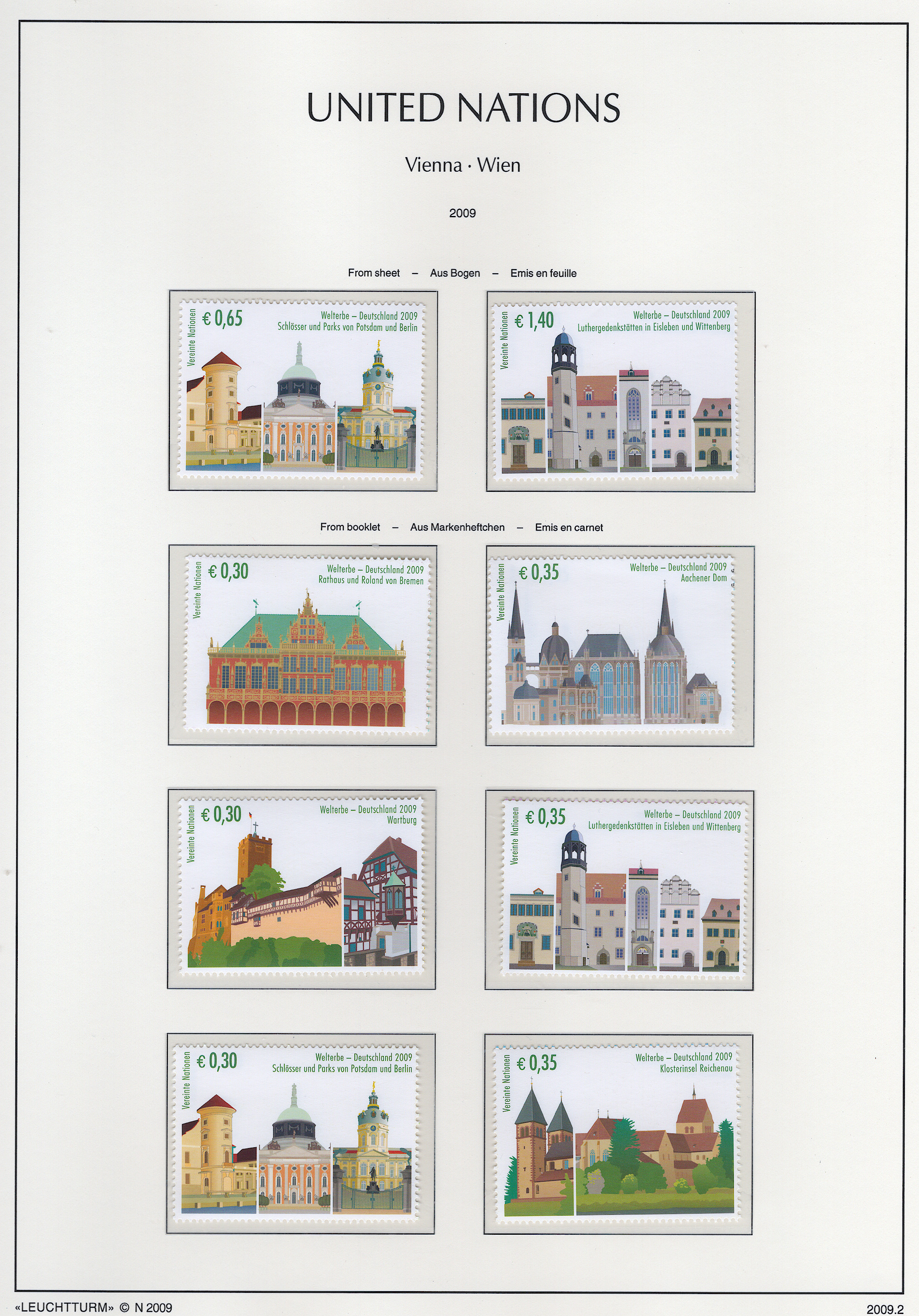
Germany has fifty-five World Heritage sites. These stamps commemorate just six of them. The first two stamps were sold in sheets of individual stamps. Whereas the other six were sold in a booklet with images and text describing the sites.
Aachen
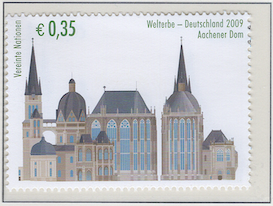
Aachen is the first site in Germany. It’s located in the western border, next to Belgium and the Netherlands. The city itself was first build under Charlemagne in the 790s c.e. Charlemagne was later buried in Aachen, in the Palatine Chapel – which is part of the Aaachen Catheral. The cathedral is shown in the stamp for Aaachen; the chapel is the structure with the dome roof. The cathedral was at one time his palace and as a cathedral was where his successors were crown in coronation ceremonies.
Bremen
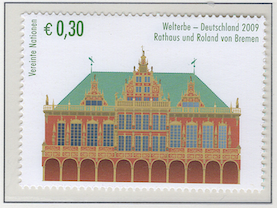
Bremen is a port city located in northern Germany. The Bremen City Hall, shown in the stamp for Bremen, and the statue of Roland were designated as World Heritage sites. The building was made a site because of its outstanding architecture and as an example of the development of civic autonomy in the Holy Roman Empire. Roland was one of twelve knights under Charlemagne. Statues of him were found in many cities in Germany, but the Breman one is the last still standing.
Wartburg
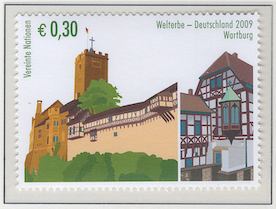
The Wartburg is located in the center of Germany. It’s where Martin Luther translated the New Testament of the Bible into German. The castle in Wartburg was named a World Heritage Site because it’s considered an outstanding monument of the Feudal Period in Central Europe. You can see the castle from two angles in the stamp here.
Berlin & Potsdam
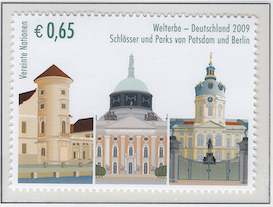
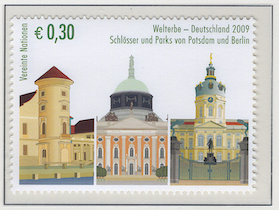
Berlin is the capital of Germany. Potsdam is the capital of Brandenburg. The palaces and other structures of both Berlin and Potsdam built during the Prussian monarchies are the reasons for them included as World Heritage sites. Berlin Museum Island includes five museums built in the late 19th and early 20th Centuries. Besides the museums being included as sites, the contents of the museums are examples of archaeology and the development of civilization.
Reichenau Island
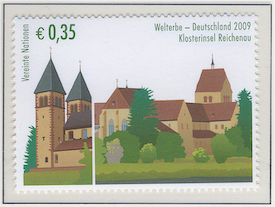
Reichenau Island is an island in Lake Constance in southern Germany. There’s an abbey on the island, founded in 724 c.e. It was a religious, cultural, and academic center. For this reason and because of the architecture and art work, it was made a World Heritage Site. The stamp of the monastic island of Reichenau shows the churches there, Saints Peter and Paul built in 799, and to Saint George built in 896.
Wittenberg & Eisleben
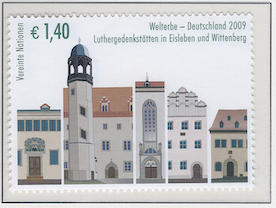
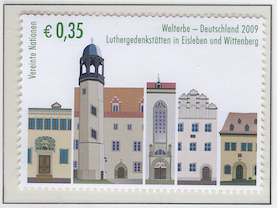
Wittenberg is in Saxony along the river Elbe. The city is where Martin Luther and others developed the first protestant Christian religion. Eisleben is also in Saxony and is where Luther was born and died. Because of the architecture and art, and especially because of the significance to the starting of Protestantism, structures in Wittenberg and Eisleben are World Heritiage sites.
Note
For all of the other World Heritage Site stamps, the ones that were primarily included in booklets by the U.N. post offices, I complained that they were not well designed. They have too much clutter with their borders and they’re photographs of the sites – and not good photos. The only ones that have good photos are the ones for Egypt. These stamps of Germany are artist drawings. They’re much better than the others. They show how the sites look and do it cleanly. They’re much better than photos. I hope they’ll follow this style for future World Heritage Site stamps.
Contains 8 spots: own 8 – 8 unused, 0 used.
Page is finished.
Album or Web Page Last changed Nov 21, 2025
Stamp Details
The table below lists information about the stamps shown on this page of Lighthouse’s stamp album. For more details about a particular stamp, click on its description. That will take you to the related web page of Colnect.
spot |
own |
catalog |
subject |
description |
comment |
World Heritage Site
✓ |
442 |
0.65 (may 2009) |
|||
✓ |
443 |
1.40 (may 2009) |
|||
✓ |
444a |
0.30 (may 2009) |
|||
✓ |
444d |
0.35 (may 2009) |
|||
✓ |
444b |
0.30 (may 2009) |
|||
✓ |
444e |
0.35 (may 2009) |
|||
✓ |
444c |
0.30 (may 2009) |
|||
✓ |
444f |
0.35 (may 2009) |
Footnotes
Spot refers to the postion of the stamp on the album page (e.g., 3.2 indicates row 3, position 2).
Amt. is an abbreviation for the face amount of the stamp.
Own indicates the stamp status: ✓ for unused; ✗ for used or canceled; ⭑ signifies I ordered one; ; ✨ indicates it was bought recently; ✠ means an auction bid is pending; and ◎ is used, and it costs too much for unused.
To search by catalog number, go to the search box and enter it in the catalog number box. However, it’s a bit broken; I need to fix it.








No Covers Found.