Arthur Fiedler
Arthur Fiedler was born in Boston, Massachusetts on December 17, 1894, to Austrian-Jewish immigrants. His father was a violinist in the Boston Symphony Orchestra and his mother was a pianist. The family moved to Vienna in 1910 and then to Berlin, where he studied violin at the Royal Academy of Music from 1911 to 1915. He returned to Boston early in World War I and joined the Boston Symphony Orchestra as a violinist in 1915. In 1924 he formed the Boston Sinfonietta, a chamber orchestra made up of members of the orchestra, and began giving free outdoor concerts.
In 1930 he was appointed the 18th conductor of the Boston Pops, the orchestra’s lighter-music ensemble. Most earlier conductors treated the post as a step in their careers. However, Fiedler stayed for nearly 50 years. Under him the Pops began recording for RCA Victor in July 1935, and it reportedly made more recordings than any other orchestra. These included “Jalousie,” which sold over a million copies, and the first complete recording of Gershwin’s Rhapsody in Blue. He mixed classical pieces with Broadway and film music, and he even recorded arrangements of Beatles songs. His last album was devoted to disco. He led the San Francisco Pops for 26 summers as well, beginning in 1949.
Fiedler also made the Pops familiar to people who never attended a concert. He conducted the opening ceremonies of Walt Disney World in 1971 and appeared regularly on the PBS series Evening at Pops. On July 4, 1976, he led the 1812 Overture at the Hatch Memorial Shell on the Charles River in Boston, with fireworks overhead, as part of the Bicentennial celebration. He received the Presidential Medal of Freedom from Gerald Ford on January 10, 1977. He died on July 10, 1979, at his home in Brookline, Massachusetts, shortly after opening his 50th season with the Pops. John Williams succeeded him as the 19th conductor.
Note
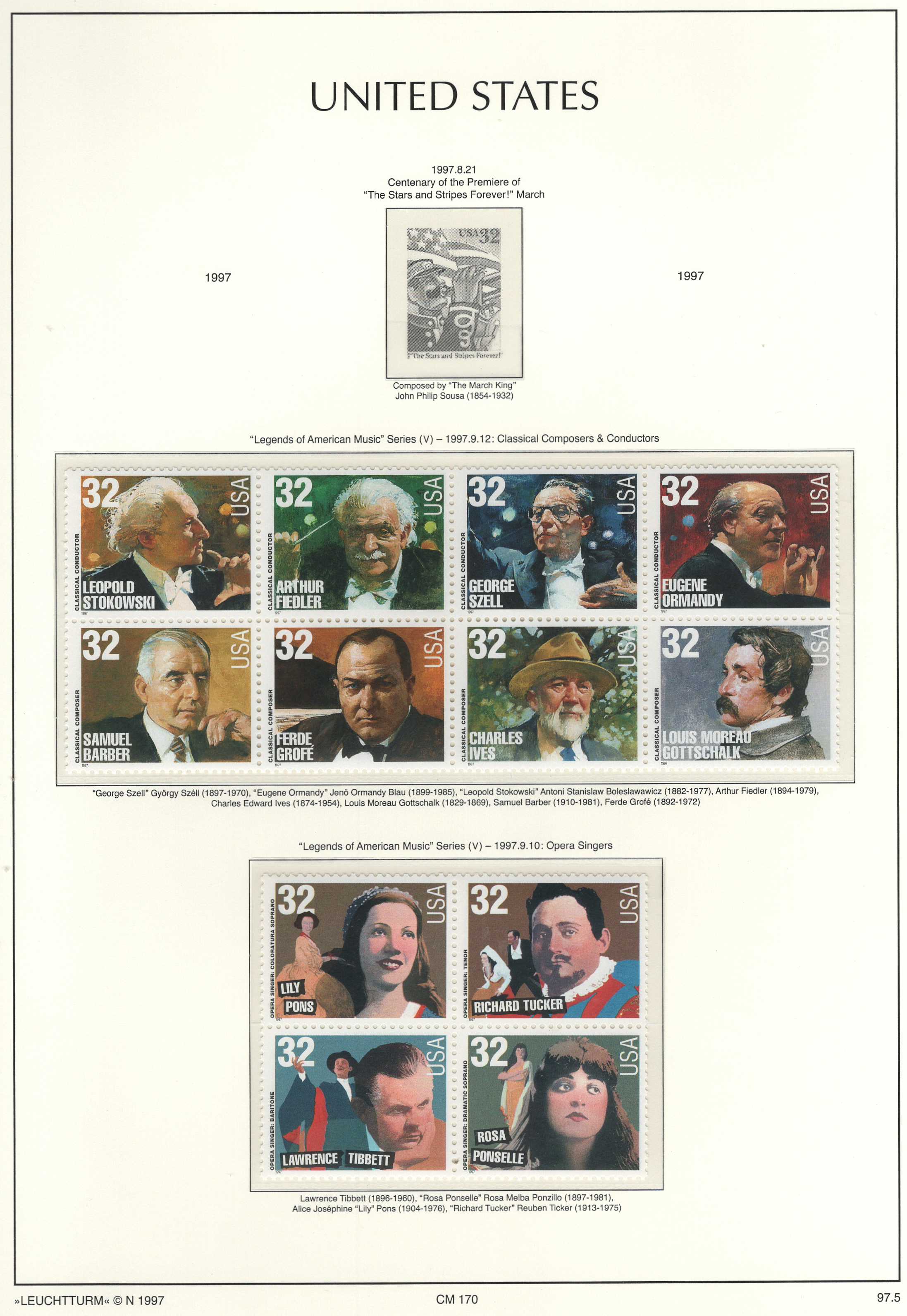
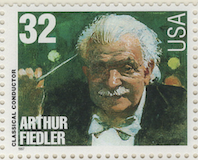
The second stamp on the second row is in memory of Arthur Fiedler, the orchestral conductor of the Boston Pops. Having spent my early teen years in the Boston area, I’m quite familiar for him. I liked listening to his performances on the local public broadcasting television station (i.e., WGBH). Now, though, I’m not a fan of popular music arranged for symphony orchestras.
It’s moderately pleasant to take a popular tune and make it into classical music. It’s a cute idea to do once, but it becomes too much after that. A symphony is a complex musical composition that’s communicates a range of emotions, even if it returns to an underlying theme (e.g., Beetovens’s Fifth Symphony telegraphing ‘V’ for victory). In literature and films, there are many examples of short-stories or books that were stretched into longer productions (i.e, The Hobbit made into a series of three movies). It’s too much and not how the original artist intended it. It’s disturbing and wearing to me.
Contains 13 spots: own 12 – 12 unused, 0 used.
Stamp Details
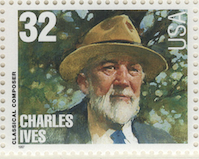
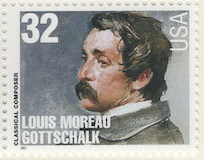
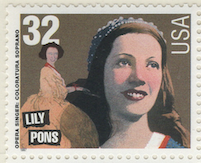
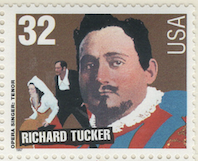
The table below lists information about the stamps shown on this page of Lighthouse’s stamp album. For more details about a particular stamp, click on its description. That will take you to the related web page of Colnect.
spot |
own |
catalog |
subject |
description |
comment |
|---|---|---|---|---|---|
3153 |
Stars & Stripes Forever |
32¢ (08 1997) |
|||
✓ |
3158 |
32¢ (09 1997) |
|||
✓ |
3159 |
32¢ (09 1997) |
|||
✓ |
3160 |
32¢ (09 1997) |
|||
✓ |
3161 |
32¢ (09 1997) |
|||
✓ |
3162 |
32¢ (09 1997) |
|||
✓ |
3163 |
32¢ (09 1997) |
|||
✓ |
3164 |
32¢ (09 1997) |
|||
✓ |
3165 |
32¢ (09 1997) |
|||
✓ |
3154 |
32¢ (09 1997) |
|||
✓ |
3155 |
32¢ (09 1997) |
|||
✓ |
3156 |
32¢ (09 1997) |
|||
✓ |
3157 |
32¢ (09 1997) |
Footnotes
Spot refers to the postion of the stamp on the album page (e.g., 3.2 indicates row 3, position 2).
Amt. is an abbreviation for the face amount of the stamp.
Own indicates the stamp status: ✓ for unused; ✗ for used or canceled; ⭑ signifies I ordered one; ; ✨ indicates it was bought recently; ✠ means an auction bid is pending; and ◎ is used, and it costs too much for unused.
To search by catalog number, go to the search box and enter it in the catalog number box. However, it’s a bit broken; I need to fix it.












