Owls
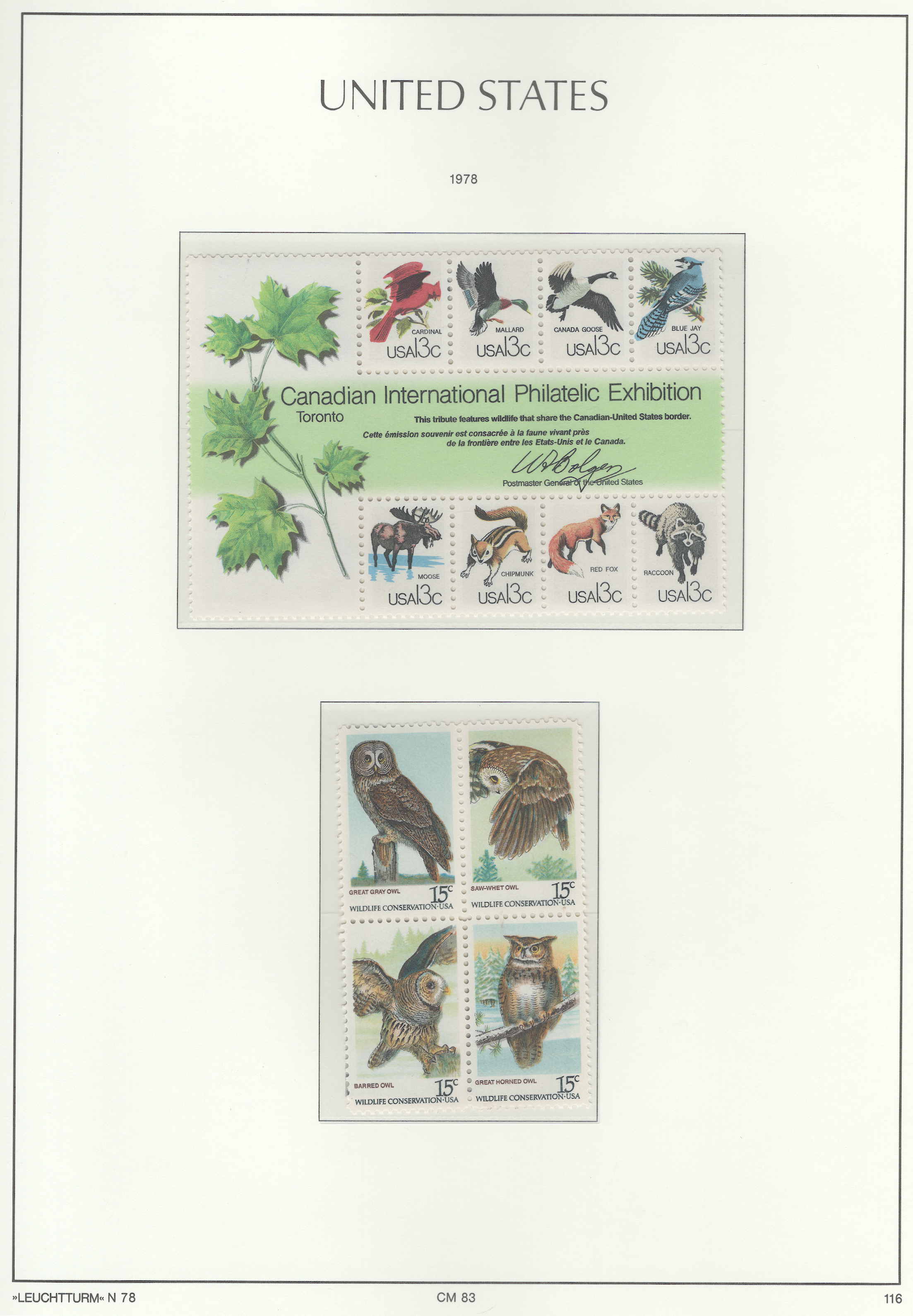
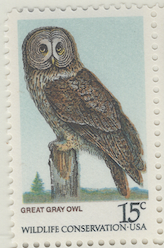
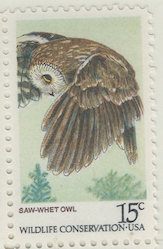
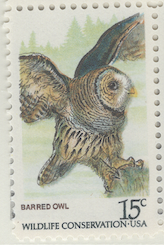
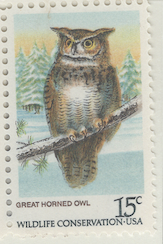
The set of four stamps at the bottom show owls from North America. There’s the Great Gray Owl, the Saw-Whet Owl, and the Barred Owl. The last one is the Great Horned Owl, also known at the Tiger Owl.
Great Horned Owl
The Great Horned Owl has large and strong talons, that can exert three-hundred pounds of pressure per square inch, for catching rodents and rabbits. They also have a strong and sharp beak for killing and tearing the flesh of prey.
Most birds have eyes on the sides of their head to be able to watch for predators and other things on their sides and behind them. To see forward, they have to turn their head. The eyes of the Great Horned Owl face forward, like most owls. Plus, it can see well in the dark for attacking prey at night. However, it can rotate its neck two-hundred seventy degrees, to be able to check quietly its surrounding.
Of particular interest are the Great Horned Owl’s ears: besides being ten times more sensitive than human ears, they’re asymmetrical; they aren’t in line with each other. This is why you sometimes see them tilting their head while perched. The advantage of this is that it allows them to triangulate the location of prey in the dark. As it silently swoops down to catch prey on the ground, it senses it’s precise as it gets closer, even when the prey is in the grass, under dead leaves, or under the snow.
Note
It’s probably obvious, but I love birds. I’m not a bird watcher. I don’t go looking for birds. Instead, I’m a bird appreciator and bird noticer: I notice birds when the appear or fly by. That’s why I focused on one of the birds, the Great Horned Owl on this page. I’ve seen one where I lived for a short time in our backyard. It was bigger than I expected and completely silent when it flies. Even if one is in a tree near you, it’s difficult to spot them. They stay so still, they’re so quiet, and they’re so well camouflaged in the darkness.
Contains 12 spots: own 12 – 12 unused, 0 used.
Page is finished.
Album or Web Page Last changed May 11, 2025
Stamp Details
The table below lists information about the stamps shown on this page of Lighthouse’s stamp album. For more details about a particular stamp, click on its description. That will take you to the related web page of Colnect.
spot |
own |
catalog |
subject |
description |
comment |
Souvenir Sheet
✓ |
1757a |
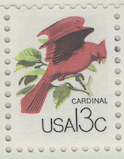
Northern Cardinal |
13c (jun 1978) |
||
✓ |
1757b |
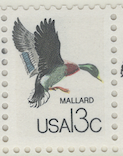
Mallard |
13c (jun 1978) |
||
✓ |
1757c |
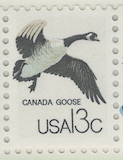
Canada Goose |
13c (jun 1978) |
||
✓ |
1757d |
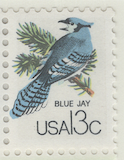
Blue Jay |
13c (jun 1978) |
||
✓ |
1757e |
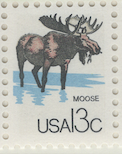
Moose |
13c (jun 1978) |
||
✓ |
1757f |
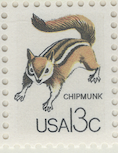
Least Chipmunk |
13c (jun 1978) |
||
✓ |
1757g |
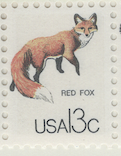
Red Fox |
13c (jun 1978) |
||
✓ |
1757h |
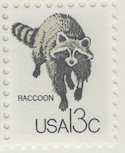
Raccoon |
13c (jun 1978) |
Owls
✓ |
1760 |
Great Grey Owl |
15c (aug 1978) |
||
✓ |
1761 |
Northern Saw-whet Owl |
15c (aug 1978) |
||
✓ |
1762 |
Barred Owl |
15c (aug 1978) |
||
✓ |
1763 |
Great Horned Owl |
15c (aug 1978) |
Footnotes
Spot refers to the postion of the stamp on the album page (e.g., 3.2 indicates row 3, position 2).
Amt. is an abbreviation for the face amount of the stamp.
Own indicates the stamp status: ✓ for unused; ✗ for used or canceled; ⭑ signifies I ordered one; ; ✨ indicates it was bought recently; ✠ means an auction bid is pending; and ◎ is used, and it costs too much for unused.
To search by catalog number, go to the search box and enter it in the catalog number box. However, it’s a bit broken; I need to fix it.











