Egypt
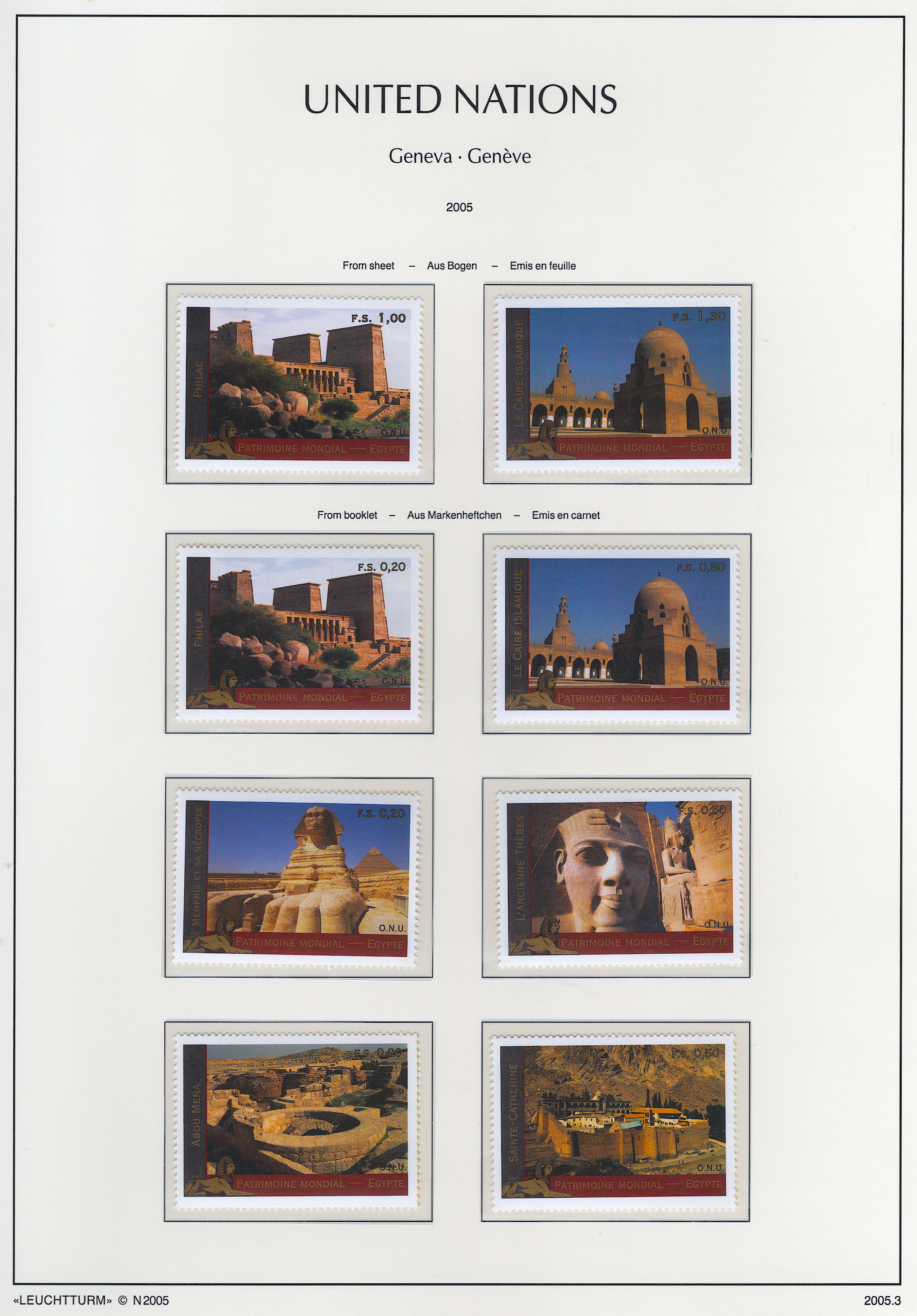
Egypt has seven World Heritage sites – and over thirty more pending. These stamps commemorate six of them. The first two stamps were sold in sheets of individual stamps. Whereas the other six were sold in a booklet with images and text describing the sites.
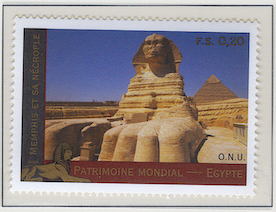
Memphite Necropolis
The stamps for Memphis, or rather Memphite Necropolis highlights several ancient funerary sites near the former capitol of Egypt, Memphis – now known as Giza. There are several pyramids and related ancient buildings that contain amazing art and other treasures.
Many of the valuable artifacts found in Memphite Necropolis, including the treasures of King Tutankhamun, are in the recently opened Grand Egyptian Museum. I saw the King Tut exhibit when it toured the U.S. in 1978. My Aunt Lydia took me to see it at the New Orleans Museum of Art.
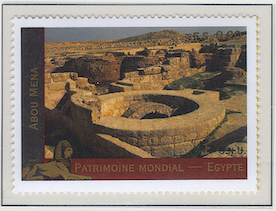
Abu Mena
Abu Mena was monastery complex and Christian pilgrimage centre in ancient Egypt. The ruins were designated a World Heritage site because of importance in early Christianity. Besides the basilica ruins and other structures, you can see in the stamp commemorating the site the remains of a bath house.
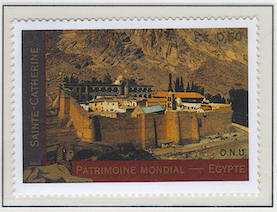
St. Catherine’s Monastery
Saint Catherine’s Monastery is a Christian monastery located in the Sinai Peninsula, at the base of Mount Sinai. Built in mid-500s b.c.e. under Byzantine emperor Justinian I, it’s the oldest continuously in use monastery.
The site of the monastery iis supposedly where Moses claimed to have seen God in the persona of a burning bush. St. Catherine of Alexandria is said to have died there in the 4th Century and has been buried in the monastery.
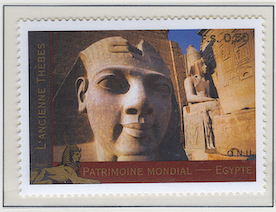
Thebes
Thebes was an ancient Egyptian city along the Nile river near Nubia. It was the capital of Egypt at one time and along a main trade route, as well as a religious center of the time. The stamp for Thebes shows some of the spectacular structures that can be found there today.
Abu Simbel
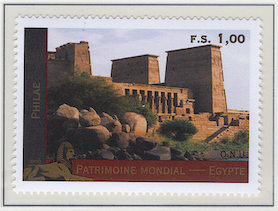
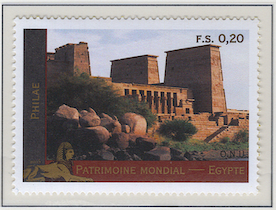
Abu Simbel includes two temples that were carved out of the rock face of a mountainside. They depict Pharaoh Ramesses II and Nefertari. The stamp for this site shows the Philae temple.
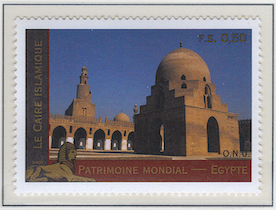
Historic Cairo
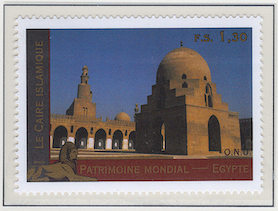
Historic or Islamic Cairo was established during the Muslim conquest in 641 c.e. This includes the Citadel of Cairo <https://en.wikipedia.org/wiki/Cairo_Citadel>, which I think is shown in the stamp commemorating the site.
Note
I have generally two complaints about this series of World Heritage Sites, issued in booklets. First, I’m not sure I see the advantage of issuing them in booklets. Of course, it’s hypocritical of me since it’s the U.N.’s attempt to provide stories with the stamps – something I’m doing here. My second complaint is that artists drawings would be better than photos. These stamps for Egypt, though, are the exception. The photos are good choices in presenting the sites. So maybe I have no complaints about this batch.
Contains 8 spots: own 8 – 8 unused, 0 used.
Page is finished.
Album or Web Page Last changed Nov 19, 2025
Stamp Details
The table below lists information about the stamps shown on this page of Lighthouse’s stamp album. For more details about a particular stamp, click on its description. That will take you to the related web page of Colnect.
spot |
own |
catalog |
subject |
description |
comment |
World Heritage Site
✓ |
444 |
1 (aug 2005) |
|||
✓ |
445 |
1.30 (aug 2005) |
|||
✓ |
446b |
0.20 (aug 2005) |
|||
✓ |
446e |
0.50 (aug 2005) |
|||
✓ |
446a |
0.20 (aug 2005) |
|||
✓ |
446d |
0.50 (aug 2005) |
|||
✓ |
446c |
0.20 (aug 2005) |
|||
✓ |
446f |
0.50 (aug 2005) |
Footnotes
Spot refers to the postion of the stamp on the album page (e.g., 3.2 indicates row 3, position 2).
Amt. is an abbreviation for the face amount of the stamp.
Own indicates the stamp status: ✓ for unused; ✗ for used or canceled; ⭑ signifies I ordered one; ; ✨ indicates it was bought recently; ✠ means an auction bid is pending; and ◎ is used, and it costs too much for unused.
To search by catalog number, go to the search box and enter it in the catalog number box. However, it’s a bit broken; I need to fix it.








No Covers Found.