Italy
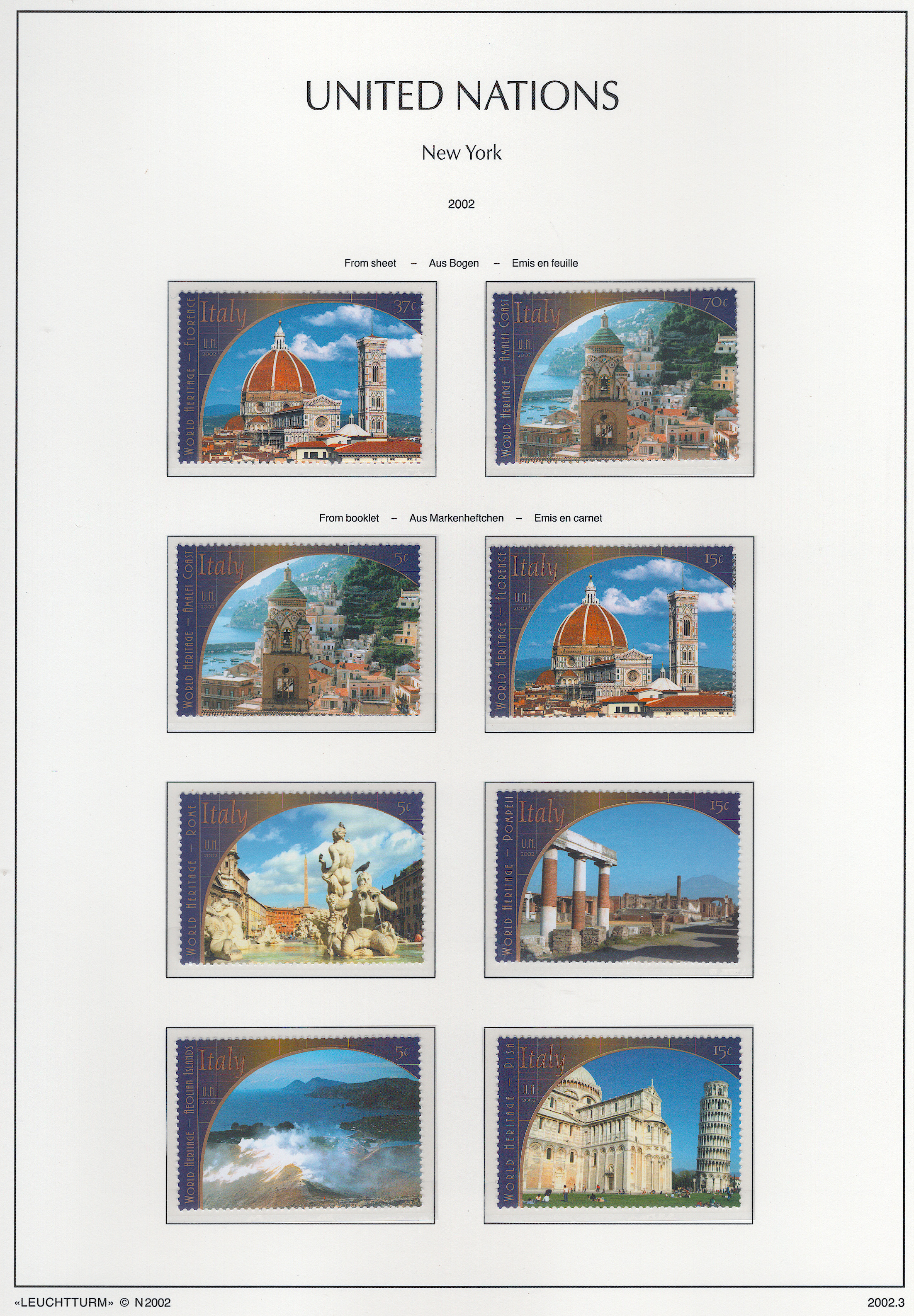
In 1972, an international treaty was signed and ratified by almost all of the U.N. member states for the protection and promotion of landmarks and other treasures having cultural, historical, or scientific significance. World Heritage sites are nominated by member states, chosen by a designated committee and administered by UNESCO.
Italy has the most World Heritage sites. These stamps commemorate just six of the sixty-one sites in Italy. The first two stamps were sold in sheets of individual statmps. Whereas the other six were sold in a booklet with images and text describing the sites.
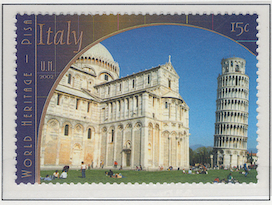
Pisa
The stamp commemorating Pisa, Italy shows the cathedral and the famous leaning tower. The city is located by the mouth of the Arno river which empties into the Ligurian Sea. I’ve been there a couple of times. There’s not much to see outside of the cathedral grounds. Still, it’s worth a quick visit to see the tower and all.
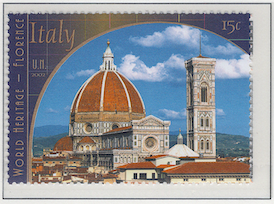
Firenze
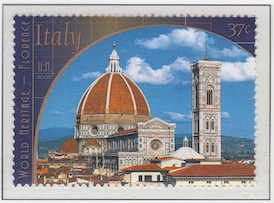
The stamp for Florence, or Firenze in Italian, shows the Duomo or cathedral, as well as the tower of the Palazzo Vecchio (i.e., the old palace) was the city hall. It was originally owned by the Medici Duke, but he moved. There’s plenty to see in Firenze, especially if you like art and museums.
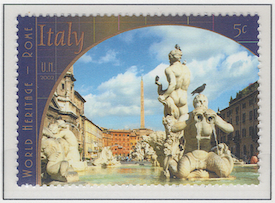
Fontana del Moro
In central Rome, in the Piazza Navona there’s the Fontana del Moro, a fountain statuary – you cans ee it in the stamp for the site. It was first created in the 1570s, but the addition of the main large statue in the middle was made about eighty years later by the sculptor, Bernini in the 1650s. You can see it in the image on the stamp, but it’s taken from behind it – I guess the U.N. didn’t want to show his genitals. That statue is an African man, called a Moro in Italian and a Moor at one time in English. I’ve seen this statuary and fountain a few times. It’s very impressive. There’s also a grand church in front of it that has some impressive art work.
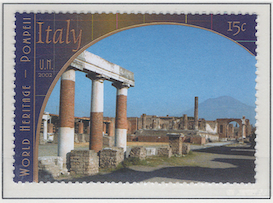
Pompeii
Pompeii was an ancient Roman city near Naples. In the year 79 c.e., the volcano of Mount Vesuvius, located on an island a few miles off the coast, erupted. The city was covered poisinous ash and other minerals more than a meter thick for over a day. Those who did not evacuate immediately were killed and the city was buried, making it a archeological treasure, a preserved community from Roman times. Because of this, it’s a World Heritage site.
Amalfi Coast
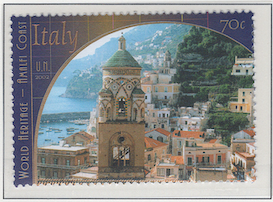
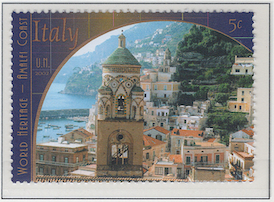
The Amalfi coast includes the towns of Amalfi and Positano. It’s located south of Naples and south of Sorrento. The area was long ago part of the Duchy of Malfi. The scenery is beautiful, many wealthy and famous people have homes along the waterfront – some are accessible only by boat given the steep cliffs. They’re known for originating the lemon liqueur called limoncello. It’s one of my favorite alcoholic drinks. My wife makes it: it’s the best limoncello I’ve tasked in Italy. Although it’s a beautiful area, I’m not sure why it qualifies as a World Heritage site.
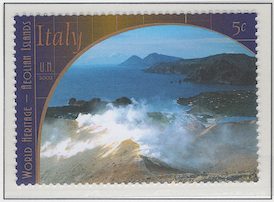
Aeolian Islands
The Aeolian Islands, Isole Eolie in Italian, are a set of islands north of the eastern end of Sicily, near Messina in the Tyrrhenian Sea. Their named after Aeolus, the Greek god of wind who controled travel of ships at sea. He and the islands are mentioned in Homer’s book, Odyssey. There’s not much on these small islands – at least not that I know about since I’ve never been there. UNESCO approved it because it saw it as “an outstanding record of volcanic island building and destruction, and ongoing volcanic phenomena”.
Note
Normally, I have to wait until I’m in the U.S. to buy stamps from the United Nations. Recently, I discovered that I can get some U.N. stamps, especially ones form the Geneva and Vienna post offices, from a stamp dealer in Milan. That has been convenient for getting the few I need to complete these albums as I add new pages. Of course, I can buy the latest stamps from the U.N. Post Office, directly.
Contains 8 spots: own 8 – 8 unused, 0 used.
Page is finished.
Album or Web Page Last changed Nov 17, 2025
Stamp Details
The table below lists information about the stamps shown on this page of Lighthouse’s stamp album. For more details about a particular stamp, click on its description. That will take you to the related web page of Colnect.
spot |
own |
catalog |
subject |
description |
comment |
World Heritage Site
✓ |
832 |
37 (aug 2002) |
|||
✓ |
833 |
70 (aug 2002) |
|||
✓ |
834a |
5 (aug 2002) |
|||
✓ |
834d |
15 (aug 2002) |
|||
✓ |
834c |
5 (aug 2002) |
|||
✓ |
834f |
15 (aug 2002) |
|||
✓ |
834b |
5 (aug 2002) |
|||
✓ |
834e |
15 (aug 2002) |
Footnotes
Spot refers to the postion of the stamp on the album page (e.g., 3.2 indicates row 3, position 2).
Amt. is an abbreviation for the face amount of the stamp.
Own indicates the stamp status: ✓ for unused; ✗ for used or canceled; ⭑ signifies I ordered one; ; ✨ indicates it was bought recently; ✠ means an auction bid is pending; and ◎ is used, and it costs too much for unused.
To search by catalog number, go to the search box and enter it in the catalog number box. However, it’s a bit broken; I need to fix it.








No Covers Found.