Fishing
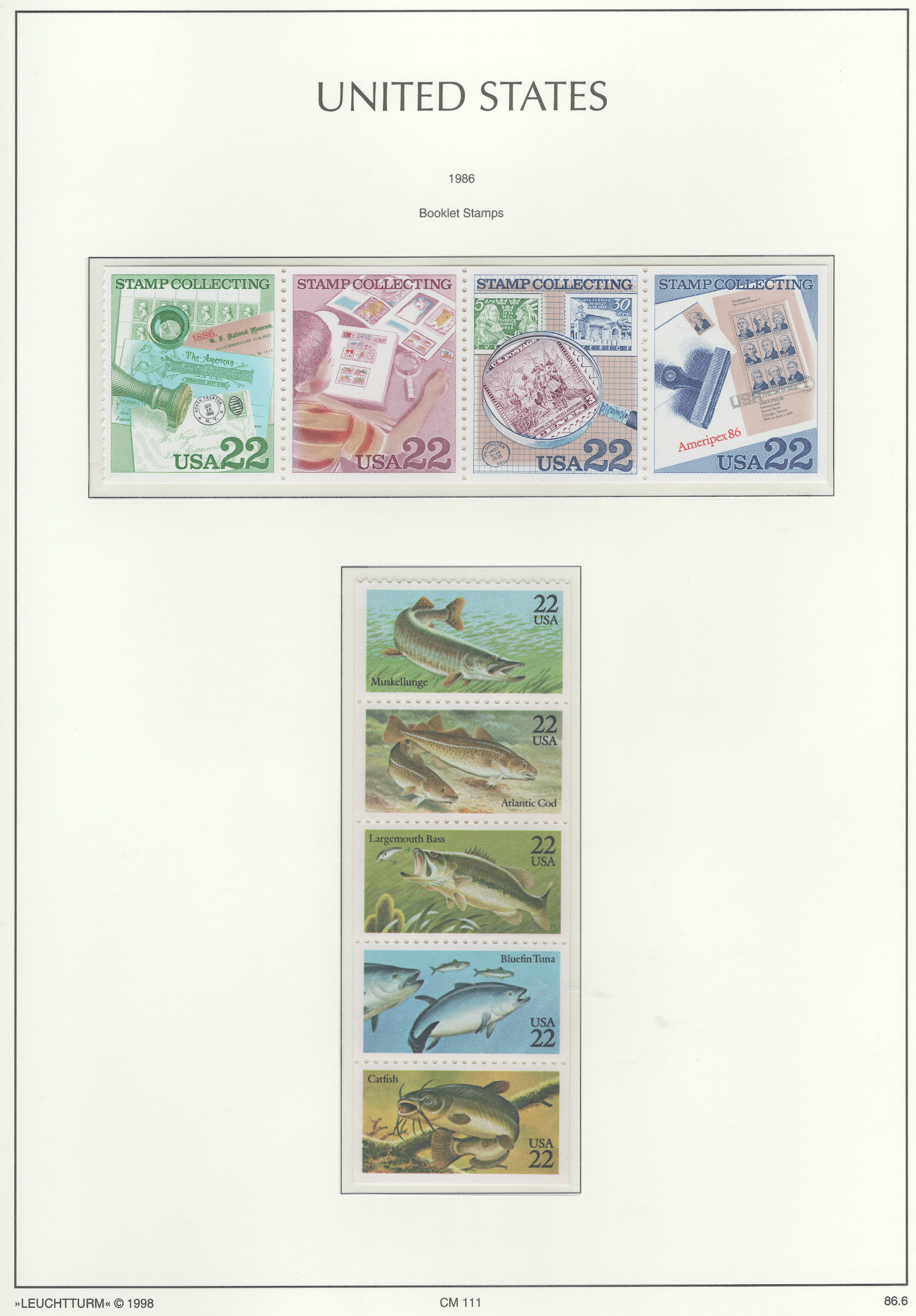
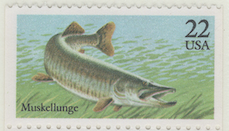
Muskellunge or Muskie is a fresh water fish, similar to a pike, that can grow to four-feet in length. They are known as ambush predators, hiding in the shadows or weeds waiting to strike smaller fish. In Maine, because they’re not native and so aggressive, fishermen are encouraged not to release any muskies they catch.
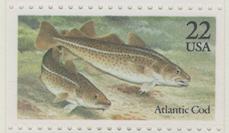
Atlantic Code are found in the North Atlantic, from the north east coast of the U.S. and across to the Bay of Biscay in France. They can live for twenty-five years and grow to four to six feet long. When I was a boy living in Peabody, near Boston, a few times I went with my uncle Steve Zolotas fishing in Cape Cod. We fished with heavy poles and live sea worms which scared me because they would bite your fingers when you’d put them on the hook. We would catch herring, mackerel, halibut, and cod.
I didn’t catch many fish, but one day I hooked a huge cod. I struggled to hang onto the pole. Accompanying us was a Portuguese man who worked for my uncle, but spoke very little English. My uncle had promised to give him all of the fish we caught that day. He became so excited about the large fish and was afraid I would lose it, he grabbed my line with his bare hands – not the pole, but the fishing line – and tried to pull the fish into the boat. Although my uncle kept telling him to leave it for me to fight, he didn’t understand. We saw it when it came to the surface – it was at least four-feet long. Unfortunately, he was pulling so hard and so fast that he ripped the hook out of the fish’s mouth as it was lifted from the water.
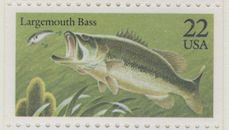
Largemouth Bass is a fresh water fish with olive colored scales with black spotches. Known most commonly in the U.S. as a black bass, in Louisiana where I was a boy, it’s known as a green trout, which I think it more fitting. They can live for fifteen years and grow to two-feet long. When I was a boy, I fished for them in a pirouge. They were one-pound in size where we fished, but my cousin Mark Liuzza and I one day caught two that were over four pounds each. Mark caught a five-pound one the year before. They’re fun to catch because when hooked, they jump out of the water and shake their head many times to try to free themselves from the hook.
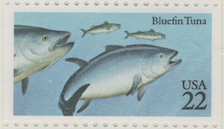
Atlantic Bluefin Tuna is a tuna found in the Atlantic Ocean, as well as the Mediterranean Sea. They can get huge: from three hundred to even fifteen hundred pounds. They are fished commercially all over the Atlantic.
Black Bullhead Catfish is a fresh water and brakcish water fish that feeds on almost anything, including vegatation, insects, and dead fish. Scaleless and mostly nocturnal, they can be particular dangerous like all catfish in that the primary fins near their mouth and above their head are particular sharp and hard like ice picks. They can nick you when trying to remove them from the hook or otherwise handle them.
Note
As a boy, I would have particularly liked these fish stamps since I loved to fish. Now that I’m older and no longer living in Louisiana, I rarely get to fish. I miss going out on the bayou in a pirouge in the morning and casting for green trout, listening to the sound of locust and being on the look-out fo alligators and water moccasins. I enjoyed the thrill of catching a fish, but often would release them because I didn’t want to have to clean them – that was a house rule at our family house, the Camp. My grandmother would fuss at me for letting them go and would say that she would clean mine if I’d just keep them. I still let them go. The fun was in fishing and catching fish, not cleaning or eating them.
Contains 9 spots: own 9 – 9 unused, 0 used.
Page is finished.
Album or Web Page Last changed Jul 20, 2025
Stamp Details
The table below lists information about the stamps shown on this page of Lighthouse’s stamp album. For more details about a particular stamp, click on its description. That will take you to the related web page of Colnect.
spot |
own |
catalog |
subject |
description |
comment |
Philately
✓ |
2198 |
22c (jan 1986) |
|||
✓ |
2199 |
22c (jan 1986) |
|||
✓ |
2200 |
22c (jan 1986) |
|||
✓ |
2201 |
22c (jan 1986) |
Fish & Fishing
✓ |
2205 |
Muskellunge |
22c (mar 1986) |
||
✓ |
2206 |
Atlantic Cod |
22c (mar 1986) |
||
✓ |
2207 |
Largemouth Bass |
22c (mar 1986) |
||
✓ |
2208 |
Atlantic Blue Fin Tuna |
22c (mar 1986) |
||
✓ |
2209 |
Black Bullhead Catfish |
22c (mar 1986) |
Footnotes
Spot refers to the postion of the stamp on the album page (e.g., 3.2 indicates row 3, position 2).
Amt. is an abbreviation for the face amount of the stamp.
Own indicates the stamp status: ✓ for unused; ✗ for used or canceled; ⭑ signifies I ordered one; ; ✨ indicates it was bought recently; ✠ means an auction bid is pending; and ◎ is used, and it costs too much for unused.
To search by catalog number, go to the search box and enter it in the catalog number box. However, it’s a bit broken; I need to fix it.








