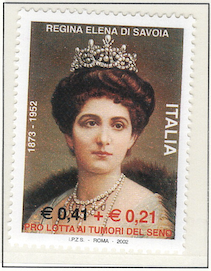
Regina Elena
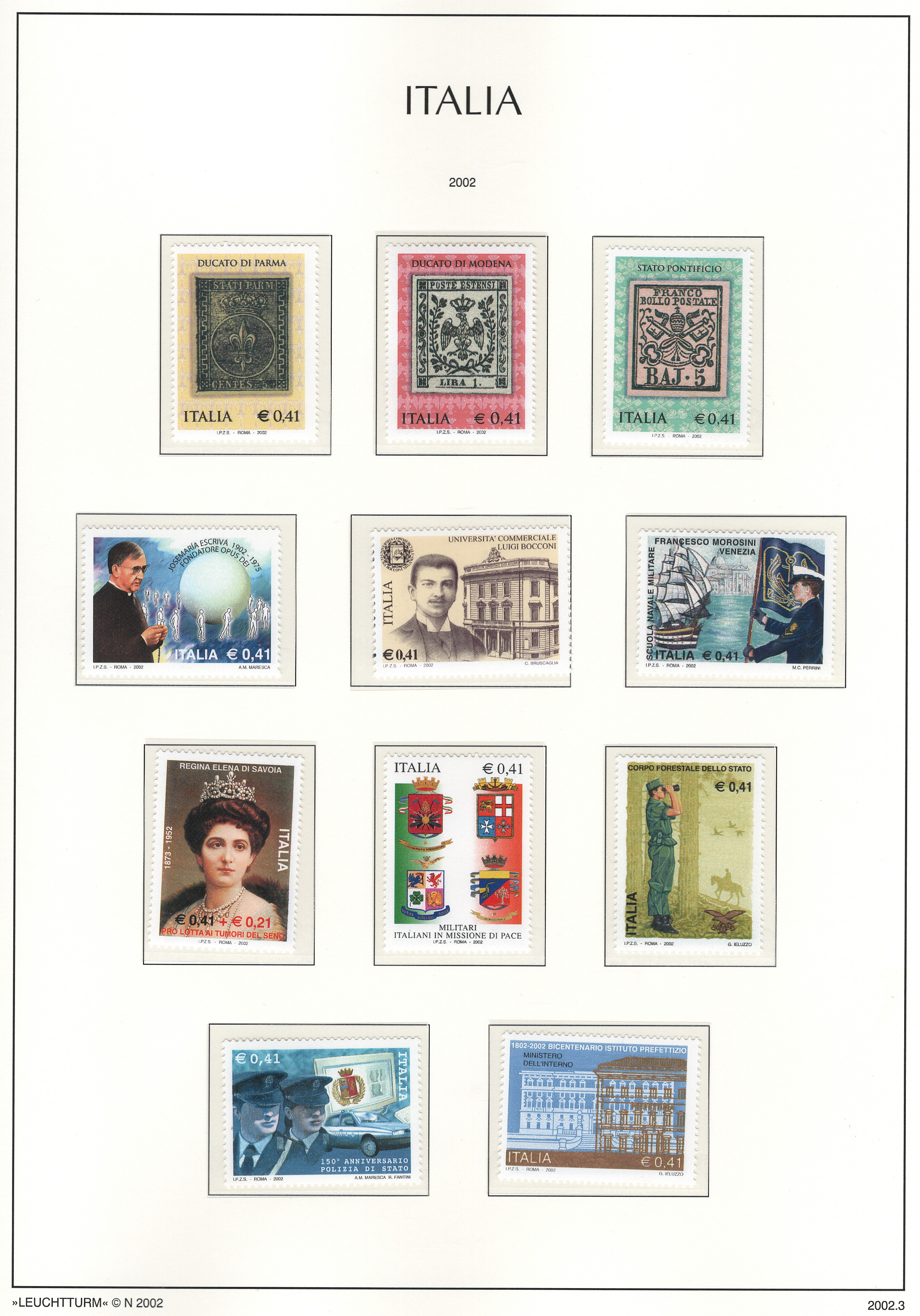
Elena of Montenegro was born on January 8, 1873 in Cetinje, then the capital of the Principality of Montenegro, as the daughter of King Nicholas I. She was educated at the Smolny Institute of Noble Maidens in Saint Petersburg until she was 18.
Queen Margherita of Savoy was worried about her only son’s marriage, and together with Francesco Crispi, who was of Albanian origin and wanted more Italian influence in the Balkans, she set up a meeting. Elena was presented to the prince at the opera in Venice in April 1895. After another meeting in Russia, at the coronation of Nicholas II, Victor Emmanuel formally asked her father for her hand, and they became engaged in Cetinje on August 18, 1896.
Elena was Orthodox, so she had to change religion. She landed in Bari with Victor Emmanuel on October 21, 1896 and converted to Catholicism at the basilica of St. Nicola (Saint Nicholas) before the wedding, though her father would have preferred that it happen afterwards. Her mother was so upset that she refused to attend the ceremony in Rome. At 180 cm, Elena was also quite a bit taller than her husband, who was 152 cm.
Victor Emmanuel became king on July 29, 1900, following the assassination of his father, and Elena became Queen of Italy. She was described as dignified but natural and simple, and she did not care for social life or public royal duties, preferring a quiet family life. The couple had five children: Yolanda, Mafalda, Umberto, Giovanna and Maria Francesca. Elena became best known for her charity work. After the Messina earthquake of December 28, 1908, she went to the scene, nursed the wounded herself on a hospital ship and organized a fundraiser in Rome, which made her more popular across the country. From 1911 to 1921 she was the first Inspector of the Voluntary Nurses for the Italian Red Cross, and she studied medicine and received an honorary degree. During World War I she worked as a nurse and turned the Quirinal Palace and Villa Margherita into hospitals, which ran from July 1915 until 1919. To raise money she came up with the “signed photograph,” sold at charity desks. In 1920 she founded the Elena di Savoia foundation, which gave scholarships to orphans of soldiers and railway workers. Pope Pius XI gave her the Golden Rose in 1930 and again in 1937.
Her later years as queen were much harder. She briefly held the titles of Empress of Ethiopia (from May 9, 1936) and Queen of the Albanians (from April 16, 1939) after Mussolini’s conquests, but both titles were dropped when her husband renounced them in 1943. In 1939 she wrote to six other European royal women, e.g., Queen Wilhelmina of the Netherlands, asking for their support in keeping the war from spreading. She also pushed her husband to lobby Mussolini for an independent Kingdom of Montenegro in 1941. When Mussolini was arrested on July 25, 1943, the king left Rome for Brindisi on September 9 and Elena followed. Their daughter Mafalda was arrested by the Nazis on September 23 and died in Buchenwald in 1944. Victor Emmanuel abdicated in favor of their son Umberto on May 9, 1946, which ended Elena’s time as queen. After the referendum of June 2, 1946, in which 54 percent of voters chose a republic, the couple went into exile in Egypt. Victor Emmanuel died in Alexandria in 1947. Elena moved to France and died in Montpellier on November 28, 1952, during surgery for cancer. Her remains were moved to the Sanctuary of Vicoforte on December 15, 2017, and the Catholic Church opened her cause for beatification in 2001, which gave her the title Servant of God.
Note
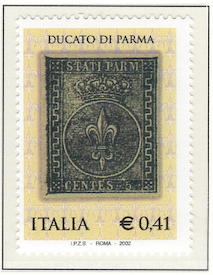
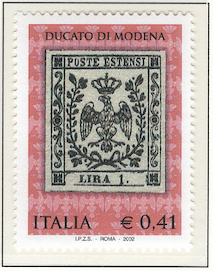
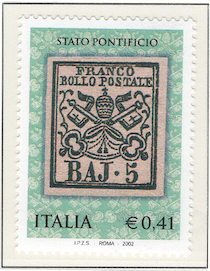
I like the stamps on the first row here showing stamps from the previous states of the Italian peninsula. It’s good to remind people of the origins of stamps in the country. They’re similar to the souvenier sheet issued by the U.S. post office in 1947 showing the first two stamps it sold. They depicted Benjamin Franklin and George Washington (see Afforable Firsts).
Contains 11 spots: own 11 – 11 unused, 0 used.
Page is finished.
Album or Web Page Last changed Oct 13, 2024
Stamp Details
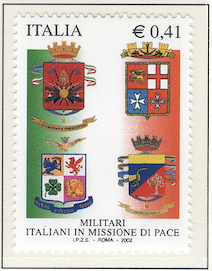
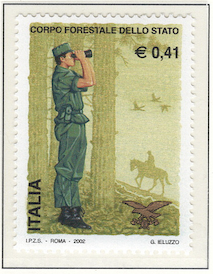
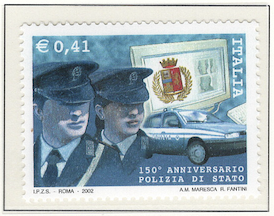
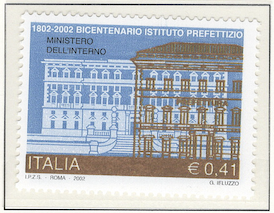
The table below lists information about the stamps shown on this page of Lighthouse’s stamp album. For more details about a particular stamp, click on its description. That will take you to the related web page of Colnect.
spot |
own |
catalog |
subject |
description |
comment |
|---|---|---|---|---|---|
✓ |
2604 |
41c (jan 2002) |
|||
✓ |
2628 |
41c (jun 2002) |
|||
✓ |
2650 |
41c (oct 2002) |
|||
✓ |
2602 |
41c (jan 2002) |
|||
✓ |
2603 |
41c (jan 2002) |
|||
✓ |
2621 |
41c (may 2002) |
|||
✓ |
2611 |
41c+21c (mar 2002) |
|||
✓ |
2629 |
41c (jun 2002) |
|||
✓ |
2657 |
41c (oct 2002) |
|||
✓ |
2618 |
41c (apr 2002) |
|||
✓ |
2634 |
41c (jun 2002) |
Footnotes
Spot refers to the postion of the stamp on the album page (e.g., 3.2 indicates row 3, position 2).
Amt. is an abbreviation for the face amount of the stamp.
Own indicates the stamp status: ✓ for unused; ✗ for used or canceled; ⭑ signifies I ordered one; ; ✨ indicates it was bought recently; ✠ means an auction bid is pending; and ◎ is used, and it costs too much for unused.
To search by catalog number, go to the search box and enter it in the catalog number box. However, it’s a bit broken; I need to fix it.










