Captain Cook
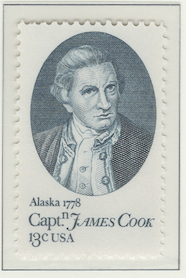
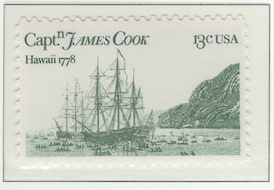
There are two stamps on this album page commemorating James Cook. They’re on the second row. One is of Cook and the other is of his ships: HMS Endeavour and HMS Resolution – or possibly HMS Adventure or HMS Discovery – for which the Space Shuttles Endeavour and Discovery were named. Cook was famous for three scientific voyages to the Pacific Ocean, with one or two of these ships on each voyage. But it’s an artist’s rendition, so the specifics of each ship probably weren’t used for the drawing.
Cook joined the Royal Navy when he was a teenager, in 1755. Four years later, he was stationed in the St. Lawrence Seaway as part of his assignment during the Seven Year War, in which England took Quebec from the French. Afterwards, he surveyed and mapped the coast of Newfoundland. He did so well that he was given more cartography assignments over the yeqrs.
In 1768, a mature Cook was given command of HMS Endeavour and sent to the Pacific Ocean to explore, record islands found and navigation information, and create maps for the Royal Navy. While on this scientific voyage, he was told to claim any new lands discovered for the King of England. He was also to observe and record the transit of Venus for the Royal Society of London. He sailed to the southern end of South America and then into the Pacific Ocean to Tahiti to make recordings.
He was then to search for the Southern Land (i.e., Antarctic) which they believed existed but had not yet discovered or confirmed. He discovered New Zealand and its islands, and created maps of its coasts. He found Australia and made maps of its east coast. They spent a lot of time in what they named as Botany Bay, capturing and recording many species of insects, animals, and plant life. His crew included the famous botanist, Joseph Banks. He didn’t find Antarctica, so he returned to England by way of the Indian Ocean and then around the southern tip of Africa.
On his second voyage, Cook returned to the Pacific with HMS Resolution and HMS Adventure. He charted all of eastern Australia. At some point, while looking further south for Antarctica, HMS Adventure was separated from HMS Resolution, lost its way and returned to England without Cook. He found and claimed many islands in the South Pacific. He didn’t find Antarctica, although he came close, but didn’t know it.
On Cook’s third and last voyage to the Pacific, he pushed North and discovered the Hawaiian Islands, claiming them for England and named them the Sandwich Islands after John Montagu, the Earl of Sandwich, who was First Lord of the Admiralty. Cook made it to North America, to the southern end of what is now the state of California – south of the Spanish – and then went around the Spanish colony to Vancouver and all the way to Alaska before returning to Hawaii. He spent a month there and intended to leave, but one of his masts broke. So he had crew cut down a tree, which unknownst to them was on sacred ground. Because the Hawaiians were preparing to attack the ship in retaliation, Cook took one of their leaders hostage to give his crew time to prepare the mast on the shore. In return, the Hawaiians attacked and killed Cook and a few of his crew.
Note
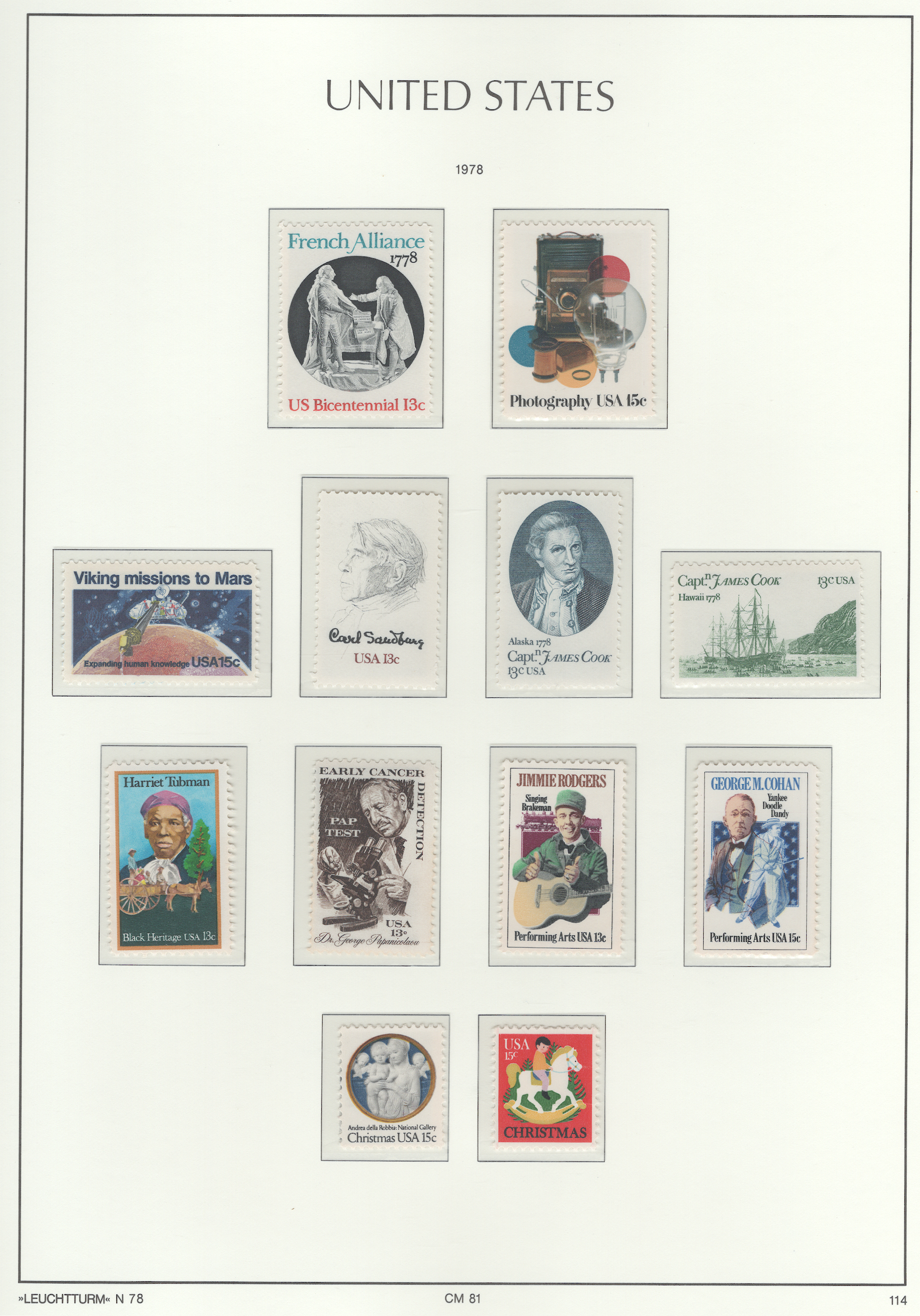
This page is part of the Bicentenial album, so I should write about the stamp for the French Alliance that Benjamin Franklin formed in 1778. However, I’m tired of researching and writing about the American Revolution. I guess the Post Office suspected the public had enough and that’s why they reduced the number of Bicentenial stamps. Besides, Captain Cook and his voyages are too interesting to ignore.
Contains 12 spots: own 12 – 12 unused, 0 used.
Page is finished.
Album or Web Page Last changed May 9, 2025
Stamp Details
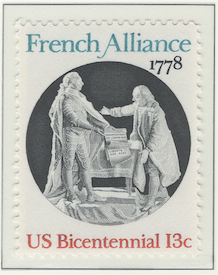
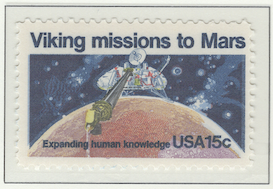
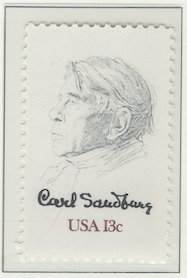
The table below lists information about the stamps shown on this page of Lighthouse’s stamp album. For more details about a particular stamp, click on its description. That will take you to the related web page of Colnect.
spot |
own |
catalog |
subject |
description |
comment |
|---|---|---|---|---|---|
✓ |
1753 |
13c (may 1978) |
|||
✓ |
1758 |
15c (jun 1978) |

Space Exploration
✓ |
1759 |
15c (jul 1978) |
Novelists, Playwrights & Poets
✓ |
1731 |
13c (jan 1978) |
Famous Explorers
✓ |
1732 |
Captain Cook |
13c (jan 1978) |
||
✓ |
1733 |
Resolution & Discovery |
13c (jan 1978) |
Famous Americans
✓ |
1744 |
13c (feb 1978) |
|||
✓ |
1754 |
13c (may 1978) |
|||
✓ |
1755 |
13c (may 1978) |
|||
✓ |
1756 |
15c (jul 1978) |
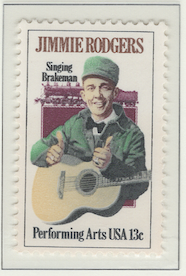
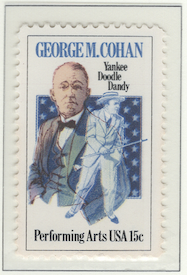
Christmas & Holidays
✓ |
1768 |
Madonna & Child |
15c (oct 1978) |
||
✓ |
1769 |
15c (oct 1978) |
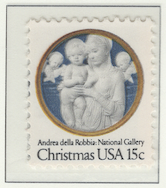
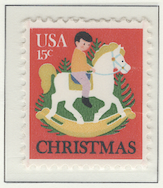
Footnotes
Spot refers to the postion of the stamp on the album page (e.g., 3.2 indicates row 3, position 2).
Amt. is an abbreviation for the face amount of the stamp.
Own indicates the stamp status: ✓ for unused; ✗ for used or canceled; ⭑ signifies I ordered one; ; ✨ indicates it was bought recently; ✠ means an auction bid is pending; and ◎ is used, and it costs too much for unused.
To search by catalog number, go to the search box and enter it in the catalog number box. However, it’s a bit broken; I need to fix it.











