South America
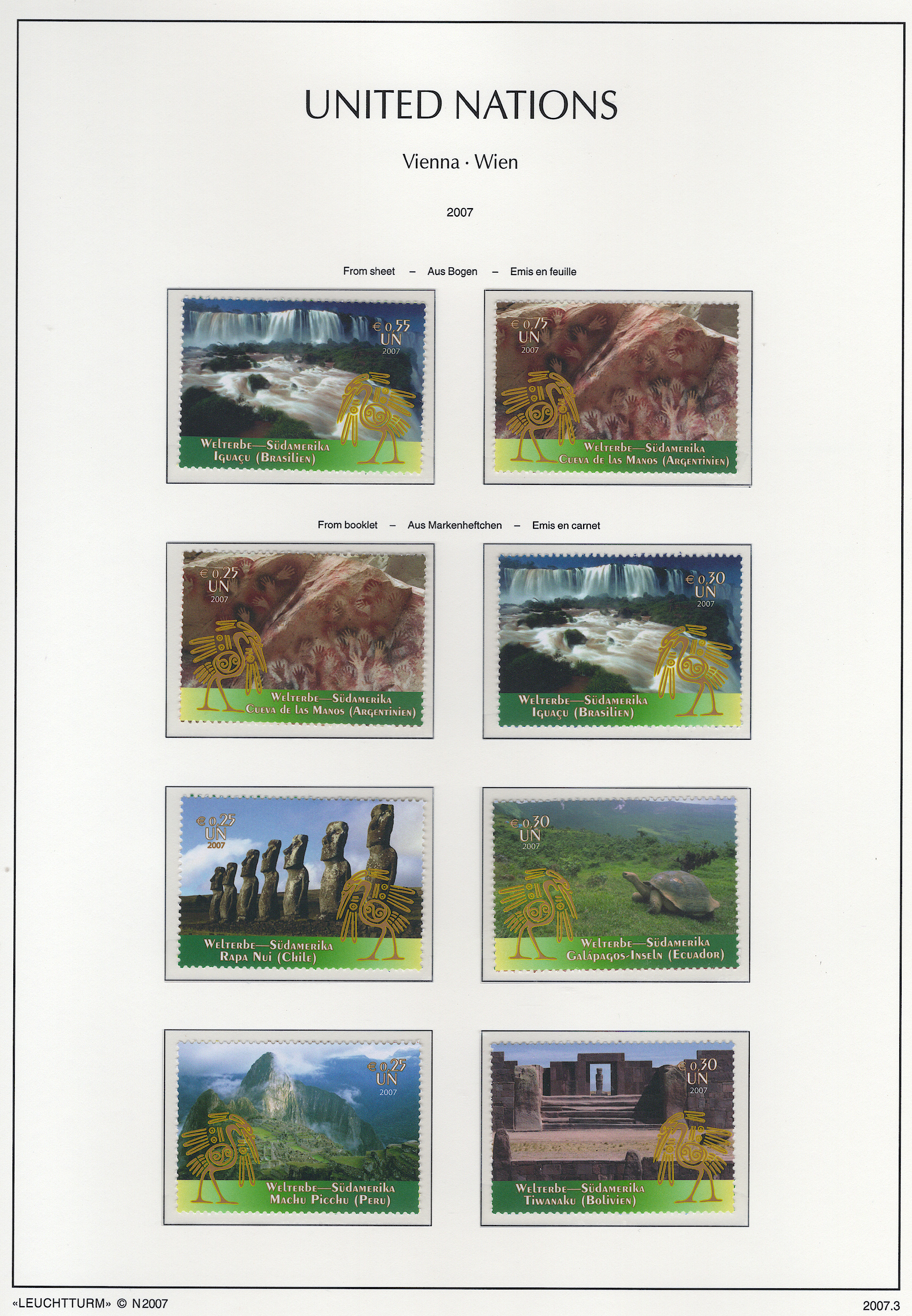
South America has seventy-three World Heritage sites. These stamps commemorate just six of them. The first two stamps were sold in sheets of individual stamps. Whereas the other six were sold in a booklet with images and text describing the sites.
Galápagos Islands
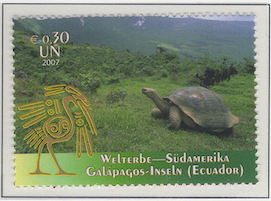
The Galápagos Islands is a set of islands in the Pacific Ocean, over five hundred miles east of South America. They’re famous for the most unique species of animals that exist no where else. They were explored by Charles Darwin in the 1830s and in part the basis for his famous book on evolution.
Easter Island
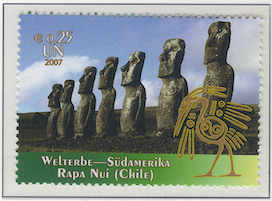
Easter Island, also called Rapa Nui, is an island in the Pacific Ocean, over two-thousand miles west of Chile. It’s particularly known for large statues of people carved from black volcanic stones by hand over a thousand years ago. Most of them are twenty to thirty feet tall and weight several tons, some close to ninty tons. Many were left where they were carved; some were moved elsewhere. You can see some of them in the stamp for this site.
Machu Picchu
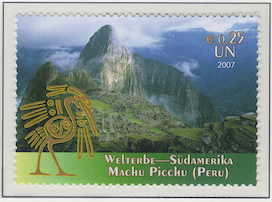
Machu Picchu is a citadel of the Inca people, a civilization that existed long before the arrival of Europeans in the Americas. Located in southern Peru, the ruins of a royal estate in the mountains belonging to the Inca emperor in the 1400s can be found there. You can see its peak in the stamp for the site.
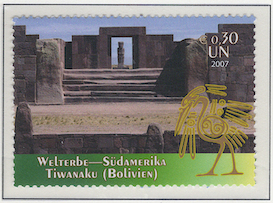
Tiwanaku
Tiwanaku is an archaeological site in Bolivia in which many structures and art works in tact have been found dated from about 300 b.c.e. until 700 c.e. On the stamp for this site you can see a monolith statue at the center of an arch, at the top of some stairs of a temple.
Cueva de las Manos
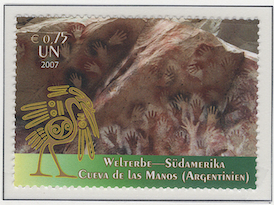
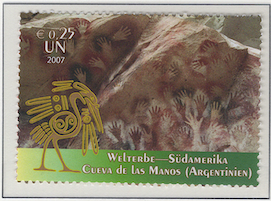
Cueva de las Manos (i.e., Cave of the Hands) is located in Argentina. It contains many stencil paintings of hands that were made starting in 7300 b.c.e, with the last set of hands in 700 c.e. The images were believed to be made by inhabitants of the caves, by placing their hands on the rocks and blowing a paint mixture around their hands. There are also paintings of people and animals found in the caves.
Iguaçu
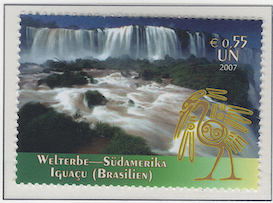
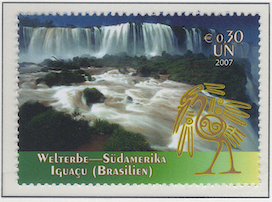
Iguaçu National Park is about a half-million acres of land located in Brazil. The park contains some unique wildlife, as well as huge waterfalls. You can see one of them in the stamp for the site here, the Iguazu Falls.
Note
I complain about the images for the stamps of each of the World Heritage Site issues. These aren’t too bad. You can see moderately well the sites in these photos. Still, there’s too much clutter with the band with text at the bottom of each. The ones for Germany, though, with drawings instead of photographs are better (see Germany).
Contains 8 spots: own 8 – 8 unused, 0 used.
Page is finished.
Album or Web Page Last changed Nov 21, 2025
Stamp Details
The table below lists information about the stamps shown on this page of Lighthouse’s stamp album. For more details about a particular stamp, click on its description. That will take you to the related web page of Colnect.
spot |
own |
catalog |
subject |
description |
comment |
World Heritage Site
✓ |
400 |
0.55 (aug 2007) |
|||
✓ |
401 |
0.75 (aug 2007) |
|||
✓ |
402b |
0.25 (aug 2007) |
|||
✓ |
402e |
0.30 (aug 2007) |
|||
✓ |
402a |
0.25 (aug 2007) |
|||
✓ |
402f |
0.30 (aug 2007) |
|||
✓ |
402c |
0.25 (aug 2007) |
|||
✓ |
402d |
0.30 (aug 2007) |
Footnotes
Spot refers to the postion of the stamp on the album page (e.g., 3.2 indicates row 3, position 2).
Amt. is an abbreviation for the face amount of the stamp.
Own indicates the stamp status: ✓ for unused; ✗ for used or canceled; ⭑ signifies I ordered one; ; ✨ indicates it was bought recently; ✠ means an auction bid is pending; and ◎ is used, and it costs too much for unused.
To search by catalog number, go to the search box and enter it in the catalog number box. However, it’s a bit broken; I need to fix it.








No Covers Found.