Volta & Fascists
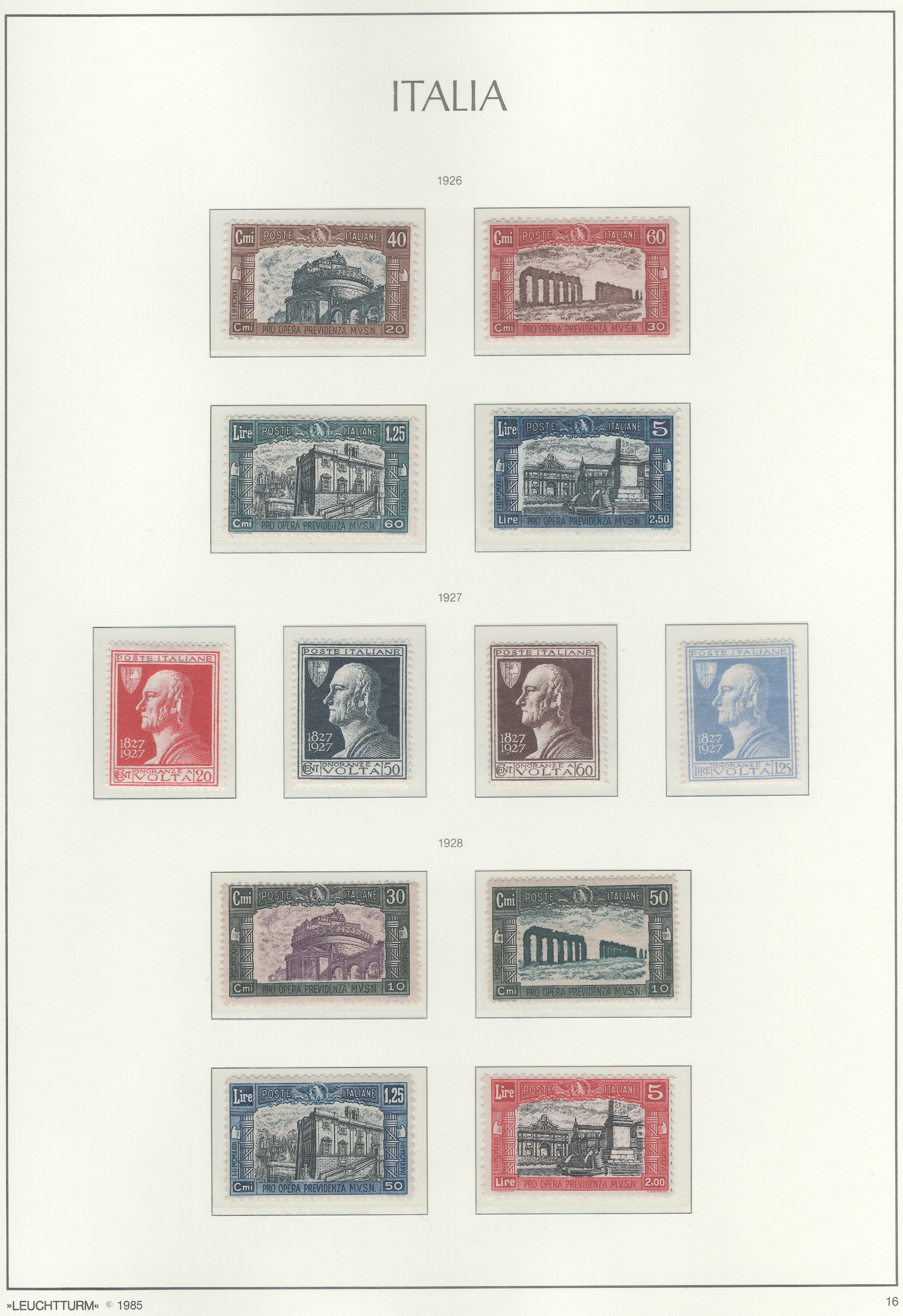
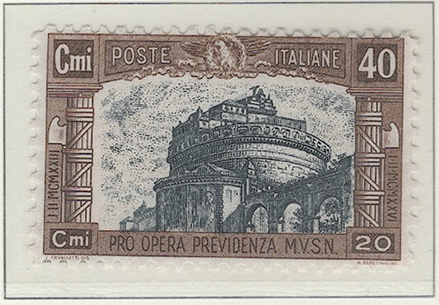
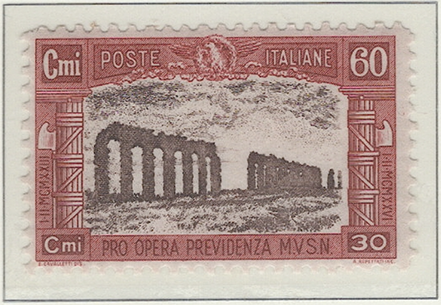
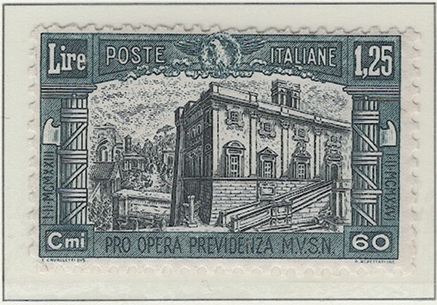
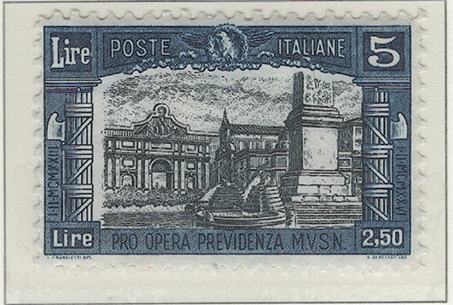
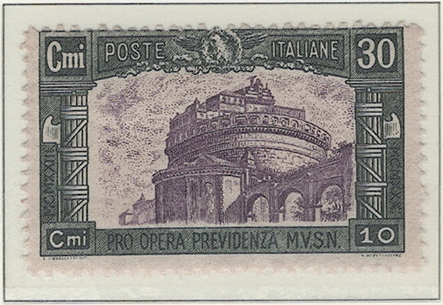
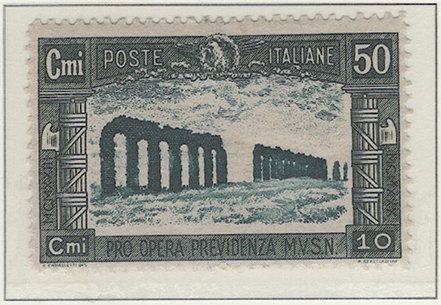
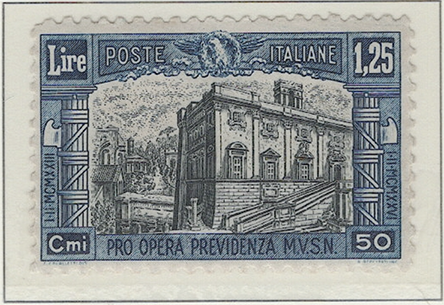
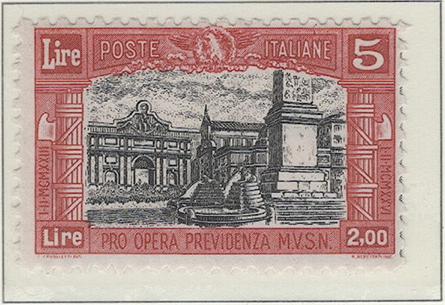
At this point in Italy’s history, the Fascists and Mussolini in control of the government and the country. There’s the king, but he didn’t have much power to stop them from doing what they wanted. The set of four stamps on the top and the other set of four on the bottom of this page of the album depict historic sites in Italy: like St Angelo Castle in Rome, near the Vatican. Incidentally, that castle was featured in my latest novel, The Pages of St. John. These stamps include the initials, M.V.S.N. This stands for the Milizia Volontaria per la Sicurezza Nazionale (i.e., the Voluntary Militia for the National Security), better known as the Black Shirts or just the fascist paramilitary.
You’ll notice on these stamps that there are two amounts on each. For example, the first one has 40 cents printed on the top right and 20 cents on the bottom right corner. To buy this stamp from the post office at the time, you would have to pay the total, 60 cents. The 40 cents is for postage and the 20 cents was for some fund set up and managed by the Fascist party, supposedly for some special purpose like feeding the elderly or restoring these castles and other buildings. I suspect they kept it for the continued growth of their paramilitary.
Alessandro Volta
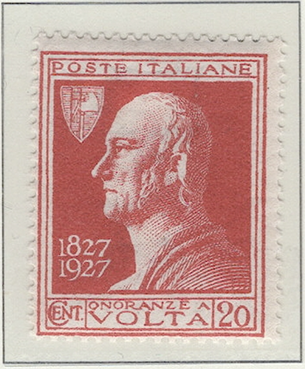
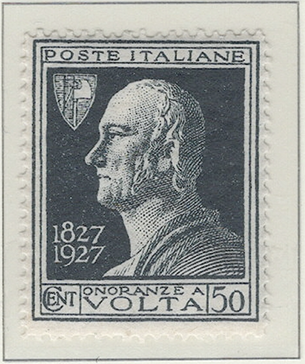
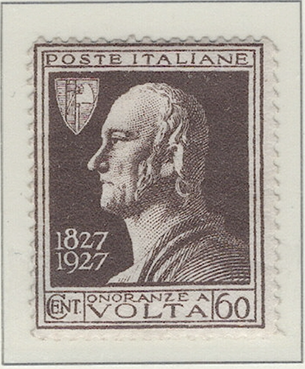
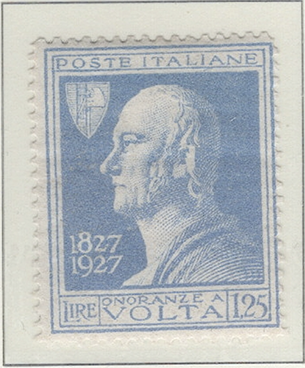
At the end of the 18th century, Alessandro Volta of Como invented the first battery. We get the word volts as an electrical measurement from his name. If you speak a little Italian, you may have learned that Italians call batteries, pile. This may be because Volta’s first battery was called a voltaic pile: its construction involved a stack or pile of metal discs with a rod through the center of them.
The four stamps in the center of this page of my album show an image of Volta. The dates in the bottom left corner read, 1827 – the year Volta died – to 1927. So it’s the 100th anniversary of his death. The same year this stamp was issued, they built a museum in honor of him in Como, by the lake. I’ve been to the Volta museum a few times – well, I’ve passed by it, but never went inside since it was always closed when I was there.
Note
Recently, I received the first and second set of stamps. There were two missing from the second set, the last two on the page. But I found them for sale individually and the cost wasn’t high. So now this page is complete. It may seem silly to struggle with buying two stamps to complete a page, but it’s that there are so many pages that are just a couple of stamps away from completion. I have to pick and choose which to get, which pages to complete, or else go broke in the process. It’s nice to have another one completed.
Contains 12 spots: own 12 – 12 unused, 0 used.
Page is finished.
Album or Web Page Last changed Oct 28, 2022
Stamp Details
The table below lists information about the stamps shown on this page of Lighthouse’s stamp album. For more details about a particular stamp, click on its description. That will take you to the related web page of Colnect.
spot |
own |
catalog |
subject |
description |
comment |
Fascist Paramilitary
✓ |
206 |
40+20c (oct 1926) |
|||
✓ |
207 |
60+30c (oct 1926) |
|||
✓ |
208 |
1.25+0.60₤ (oct 1926) |
|||
✓ |
209 |
5+2.50₤ (oct 1926) |
Alessandro Volta
✓ |
210 |
20c (apr 1927) |
|||
✓ |
211 |
50c (sep 1927) |
|||
✓ |
212 |
60c (mar 1927) |
|||
✓ |
213 |
1.25₤ (apr 1927) |
Fascist Paramilitary
✓ |
220 |
30+10c (mar 1928) |
|||
✓ |
221 |
50+20c (mar 1928) |
|||
✓ |
222 |
1.25+0.50₤ (mar 1928) |
|||
✓ |
223 |
5+2₤ (mar 1928) |
Footnotes
Spot refers to the postion of the stamp on the album page (e.g., 3.2 indicates row 3, position 2).
Amt. is an abbreviation for the face amount of the stamp.
Own indicates the stamp status: ✓ for unused; ✗ for used or canceled; ⭑ signifies I ordered one; ; ✨ indicates it was bought recently; ✠ means an auction bid is pending; and ◎ is used, and it costs too much for unused.
To search by catalog number, go to the search box and enter it in the catalog number box. However, it’s a bit broken; I need to fix it.











