Baseball
The history of the game of baseball is a bit convoluted. Prior to what we now call baseball, there were several bat and ball games (i.e., one player hits the ball with a stick and others try to catch it), as well as rounder games (i.e., a sport in which players run around bases). These were created and developed by the French and English going back almost seven-hundred years. In modern times, we can see several forms of sports similar to baseball: cricket, which is a bat and ball game; punchball, which has no bat or pitcher, but is a rounder game involving a diamond shaped field with bases.
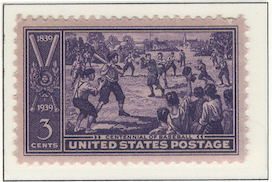
The last stamp on this page depicts children playing baseball in an open field. There are no spectators other than the players. There are no uniforms or set teams, or a league. There are no adults, no coaches, and no money involved. It’s just kids playing and enjoying baseball. That’s how I used to play baseball when I was a boy. I wasn’t a member of a Little League team or any other team. We just played for fun and often at the spur of the moment.
One kid would say, “Hey! Let’s play baseball.” Then we’d all run home and get our gloves and one would get a bat and a ball. We’d reconvene on an empty lot of land in the neighborhood, or at the park at the end of the street. We’d use pieces of trash for the bases, placing them roughly where we thought they belong. We’d choose sides and positions – we rarely had nine players for each team – and started playing. We never played nine innings. We’d just play until our mother’s called some of us for dinner, or until a grumpy neighbor would chase us off, or we’d get in an argument about something silly and then we’d disburse. That’s baseball at its finest to me. No pressure, no abuse, just fun.
Note
Here’s another page of violet and purple stamps. They must have gotten a special price on the ink. Anyway, I have all of them unused. This page is complete.
Contains 11 spots: own 11 – 11 unused, 0 used.
Page is finished.
Album or Web Page Last changed Mar 21, 2025
Stamp Details
The table below lists information about the stamps shown on this page of Lighthouse’s stamp album. For more details about a particular stamp, click on its description. That will take you to the related web page of Colnect.
spot |
own |
catalog |
subject |
description |
comment |
Constitution & Decl. of Independence
✓ |
835 |
Constitution Ratification |
3c (jun 1938) |
United Nations & Other Nations
✓ |
836 |
First Swedes & Finns |
3c (jun 1938) |
U.S. Territories
✓ |
838 |
Iowa Territory - Centenial |
3c (aug 1938) |
||
✓ |
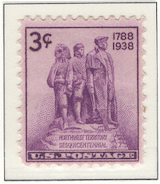
837 |
Northwest Territoy - 150 Years |
3c (jul 1938) |
Other
✓ |
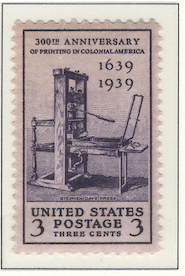
857 |
Printing in Colonies - 300 Years |
3c (sep 1939) |
||
✓ |
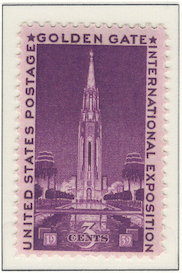
852 |
Golden Gate Intl. Expo. |
3c (feb 1939) |
||
✓ |
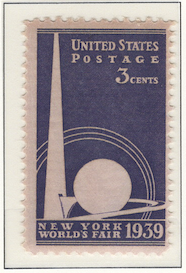
853 |
New York World’s Fair |
3c (apr 1939) |
||
✓ |
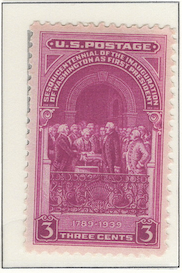
854 |
Washington Inauguration |
3c (apr 1939) |
||
✓ |
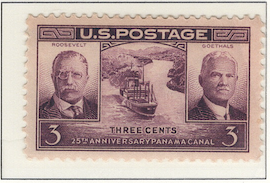
856 |
Panama Canal - 25 Years |
3c (aug 1939) |
||
✓ |
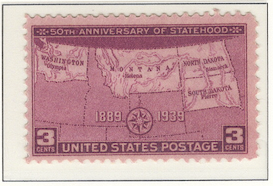
858 |
Dakotas, Montana & Washington |
3c (nov 1939) |
||
✓ |
855 |
3c (jun 1939) |
Footnotes
Spot refers to the postion of the stamp on the album page (e.g., 3.2 indicates row 3, position 2).
Amt. is an abbreviation for the face amount of the stamp.
Own indicates the stamp status: ✓ for unused; ✗ for used or canceled; ⭑ signifies I ordered one; ; ✨ indicates it was bought recently; ✠ means an auction bid is pending; and ◎ is used, and it costs too much for unused.
To search by catalog number, go to the search box and enter it in the catalog number box. However, it’s a bit broken; I need to fix it.










