Albania
Albania is a country in southeastern Europe, on the Adriatic and Ionian Seas, with an area of about 30,000 square kilometers and Tirana as its capital. The name goes back to the Albani, an Illyrian tribe, and to the settlement of Albanopolis that Ptolemy mentioned in the 2nd century AD. Albanians themselves call the country Shqipëria, usually translated “Land of the Eagles,” a name that only replaced the older Arbëria in the late 17th and early 18th centuries. The Illyrians were conquered by Rome in 167 BC, and the region later stayed in the Byzantine Empire.
In the Middle Ages, Albanian principalities appeared, e.g., Arbanon in 1190 and the Kingdom of Albania, which Charles I of Anjou established in 1272. When the Ottomans invaded, Skanderbeg organized the League of Lezhë on March 2, 1444, and his campaigns halted Ottoman advances for about 25 years. Thousands of Albanians fled to Calabria, Naples and Sicily, and their descendants are the Arbëreshë of southern Italy. Albania declared independence from the Ottoman Empire on November 28, 1912, and the Treaty of London of July 29, 1913 drew its borders, leaving many Albanians outside them. Prince Wilhelm of Wied arrived in Durrës on March 7, 1914, but his regime collapsed and he left on September 3.
Italian influence grew after World War I, and in 1928 Zog turned the republic into a monarchy with the backing of fascist Italy. Mussolini invaded in 1939, Zog went into exile and Albania became an Italian protectorate, until Germany took control in 1943. The partisans under Enver Hoxha liberated the country in 1944, and his communist regime lasted until 1991, with Albania becoming the first constitutionally atheist state in 1976. In 1997 the collapse of pyramid schemes led to civil unrest, and an Italian-led force, Operation Alba, entered the country in April to help with evacuations. Albania joined NATO in 2009, became an EU candidate on June 24, 2014 and has been negotiating accession since 2022.
Note
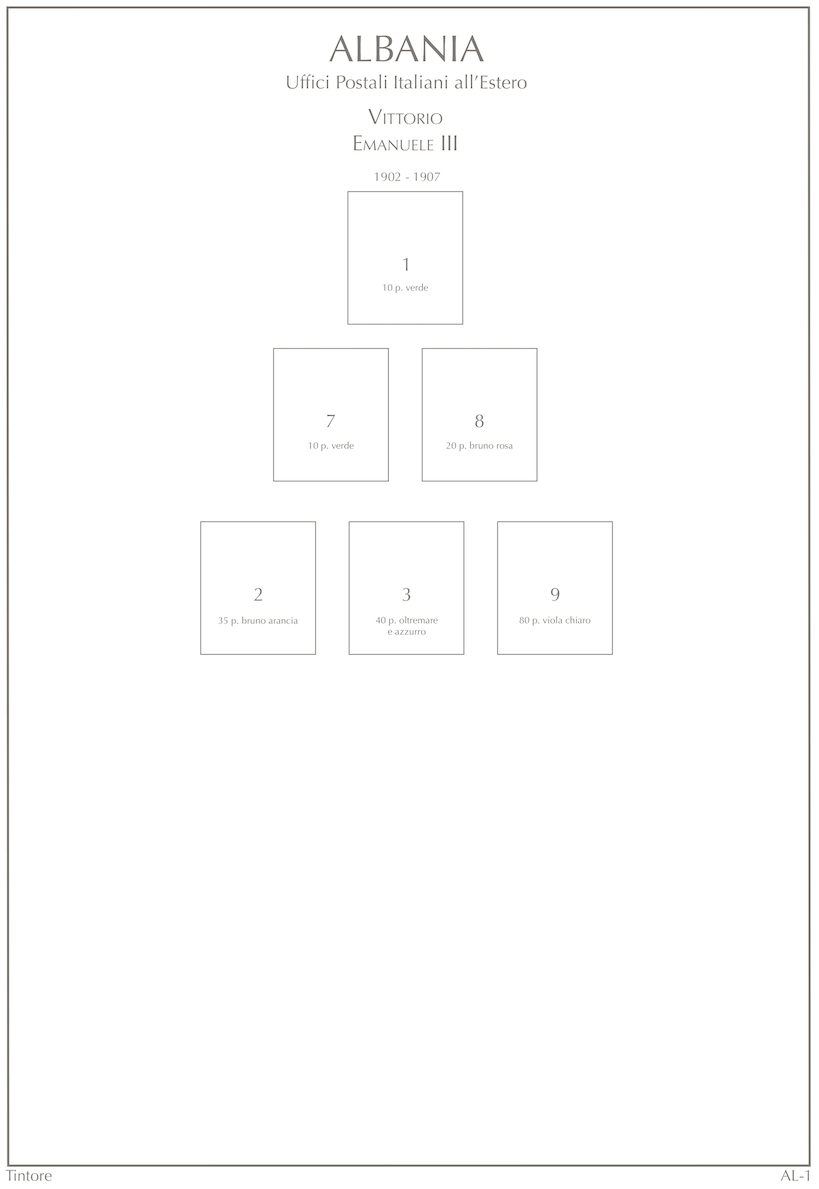
These stamps are from when Italy had foreign post offices in Albania starting in the early 1900s until 1939 when all of Albania was occupied of Italy – which lasted until 1946 when Italy gave up all of its colonies and occupied foreign territories. The stamps from the colonial period are in the Italian Occupations section, in its Albania album.
Contains 6 spots: own 0 – 0 unused, 0 used.
Stamp Details
The table below lists information about the stamps shown on this page of Lighthouse’s stamp album. For more details about a particular stamp, click on its description. That will take you to the related web page of Colnect.
spot |
own |
catalog |
subject |
description |
comment |
|---|---|---|---|---|---|
1 |
Savoy Crest |
10p (sep 1902) |
|||
7 |
Vittorio Emanuele III - Leoni |
10p (may 1907) |
|||
8 |
Vittorio Emanuele III - Leoni |
20p (nov 1907) |
|||
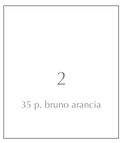
2 |
Vittorio Emanuele III - Cellini |
35p (sep 1902) |
|||
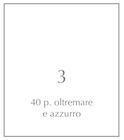
3 |
Vittorio Emanuele III - Cellini |
40p (sep 1902) |
|||
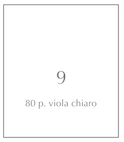
9 |
Vittorio Emanuele III - Cellini |
80p (nov 1907) |
Footnotes
Spot refers to the postion of the stamp on the album page (e.g., 3.2 indicates row 3, position 2).
Amt. is an abbreviation for the face amount of the stamp.
Own indicates the stamp status: ✓ for unused; ✗ for used or canceled; ⭑ signifies I ordered one; ; ✨ indicates it was bought recently; ✠ means an auction bid is pending; and ◎ is used, and it costs too much for unused.
To search by catalog number, go to the search box and enter it in the catalog number box. However, it’s a bit broken; I need to fix it.





