Peacekeepers
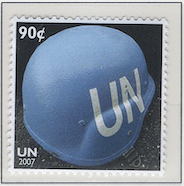
Chapter VII of the U.N. Charter allows for the U.N. Security Council to deploy troops to keep peace in member states.
In addition to Peacekeeping, the U.N. recognizes peacebuilding, peacemaking, and peace enforcement as moderately different modes, even if they might overlap in reality. The distinctions are made for when voting on actions to take and to set the mission scope.
Before a peacekeeping mission begins, a peace settlement or treaty must be decided and agreed upon. Then the parties involved must request the U.N. to handle peacekeeping, usually because one or more of the parties involved locally cannot trust the others not to violate the peace until the situation is stabilized and waring factions have disbanded. After peacekeeping troops have been requested, a department of the U.N. will then plan the details of deploying, controling, and administering troops. This includes requesting and receiving troops from U.N. neutral, unrelated member states – the U.N. doesn’t have its own military. The financing of peacekeeping must be determined. These funds come from volutarity contributions from member states for this specific use.
The first peacekeeping operations was in Israel in 1948 with the creation of the state of Israel. Peacekeepers were called in for the Suez Crisis in 1956. They were used again in 1960, in the Congo (see the Congo Operation album page). They were used successfully in Cambodia, El Salvador, Mozambique, and elsewhere. Canada has assisted in almost every peacekeeping mission, having provided about ten percent of all troops used in U.N. peacekeeping missions, for a total of over one-hundred twenty-five thousand Canadian soldiers and support personnel.
Note
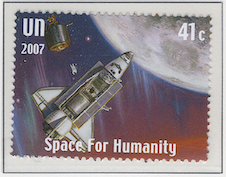
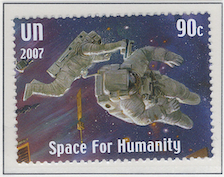
In case you’re curious about the stamps depicting space stations and exploration, they’re to commemorate the fiftieth anniversary of the U.N. Office for Outer Space Affairs. See the Space page of the Geneva album for more information.
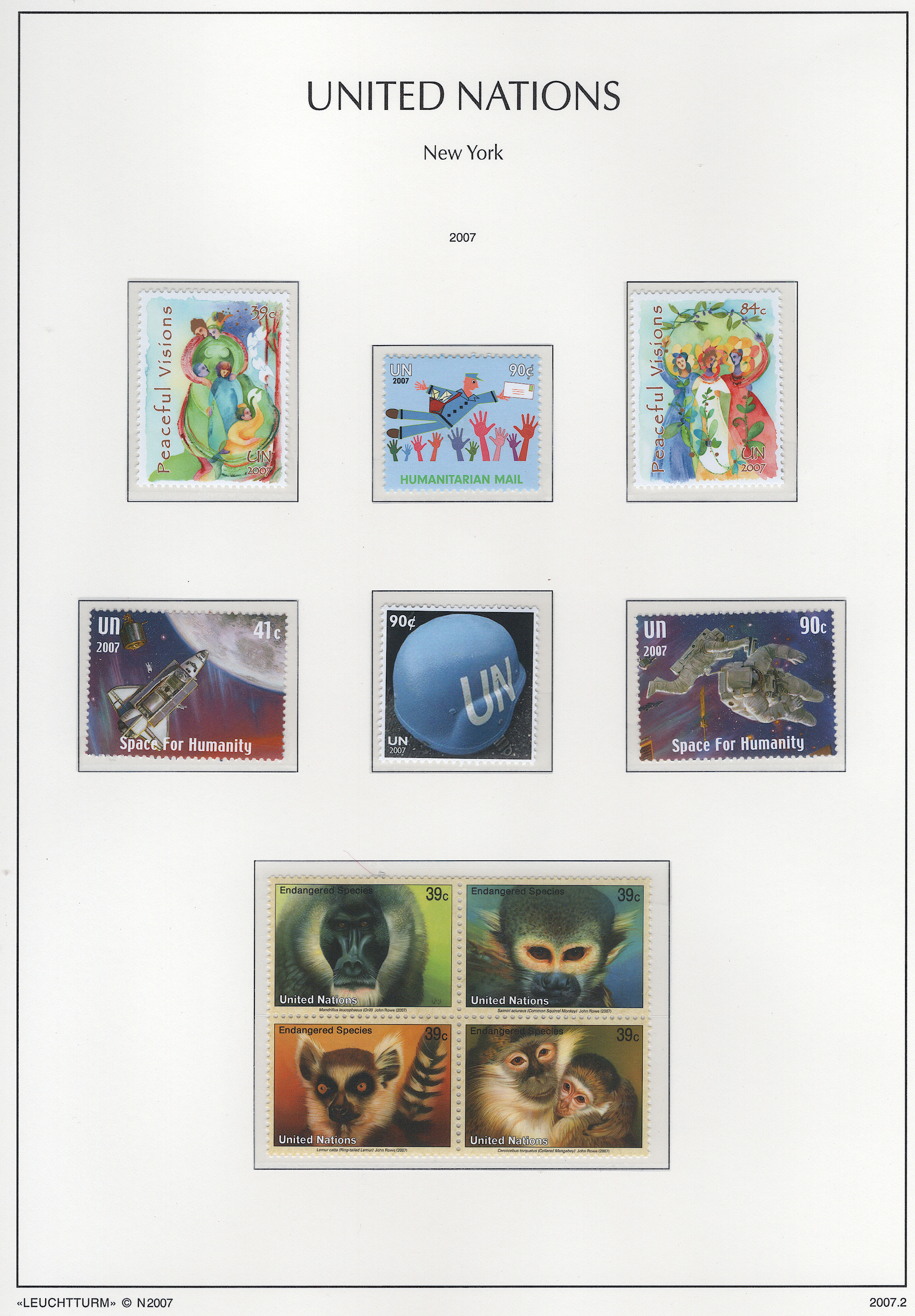
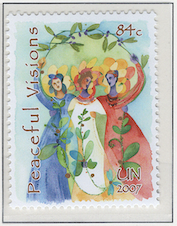
For infomration on the stamps at both ends of the top row, the Peaceful Vision stamps, see the Peace Sowers page.
Contains 10 spots: own 10 – 10 unused, 0 used.
Page is finished.
Album or Web Page Last changed Nov 20, 2025
Stamp Details
The table below lists information about the stamps shown on this page of Lighthouse’s stamp album. For more details about a particular stamp, click on its description. That will take you to the related web page of Colnect.
spot |
own |
catalog |
subject |
description |
comment |
|---|---|---|---|---|---|
✓ |
932 |
39 (jun 2007) |
|||
✓ |
944 |
90 (sep 2007) |
|||
✓ |
933 |
84 (jun 2007) |
|||
✓ |
945 |
41 (oct 2007) |
|||
✓ |
940 |
90 (aug 2007) |
|||
✓ |
946 |
90 (oct 2007) |
Endangered Species
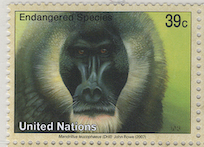
✓ |
925 |
39 (mar 2007) |
|||
✓ |
926 |
39 (mar 2007) |
|||
✓ |
927 |
39 (mar 2007) |
|||
✓ |
928 |
39 (mar 2007) |
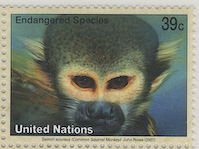
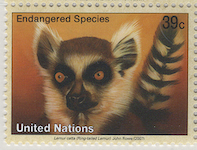
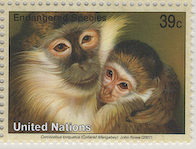
Footnotes
Spot refers to the postion of the stamp on the album page (e.g., 3.2 indicates row 3, position 2).
Amt. is an abbreviation for the face amount of the stamp.
Own indicates the stamp status: ✓ for unused; ✗ for used or canceled; ⭑ signifies I ordered one; ; ✨ indicates it was bought recently; ✠ means an auction bid is pending; and ◎ is used, and it costs too much for unused.
To search by catalog number, go to the search box and enter it in the catalog number box. However, it’s a bit broken; I need to fix it.










No Covers Found.